

How Exactly Are Cheese Puffs Made?

When snacktime strikes, foodies are likely focused more on their munchies than on how, exactly, those snacks got made. But, if you've ever gazed down at orange-stained fingertips and wondered how cheese puffs come to be, this one's for you. The snack is a combination of cornmeal, cheese powder, seasonings, and sometimes vegetable oil for frying. While different types of cheese and ingredient proportions vary from brand to brand, at large, the coarse production of those cheese puffs follows a fairly universal series of steps.
Those cheese-dusted curls and their craveable umami flavor are the product of a high-tech manufacturing process. It's all about precision to create a consistent product. Large bags of dried cornmeal get emptied into silos, where the cornmeal gets weighed to portion. In one episode of Food Network's "Unwrapped 2.0," which follows Snak King brand cheese puffs, those cornmeal bags clock in at a whopping 2,000 pounds, so large that they must be lifted by mechanical cranes.
Here's where the most crucial aspect of the cheese puff process happens. The texture and density of each airy cheese puff all come down to one component: moisture. In order to make cheese puffs, cornmeal's natural 10% moisture level needs to be increased to between 15-20% (according to Snak King's process), which is achieved by adding a controlled amount of water to the corn. Another video posted by Trader Joe's reveals that its Reduced Fat Cheese Puffs are produced using a nearly identical process.
Cornmeal gets hydrated, shaped, baked, and cheese-dusted
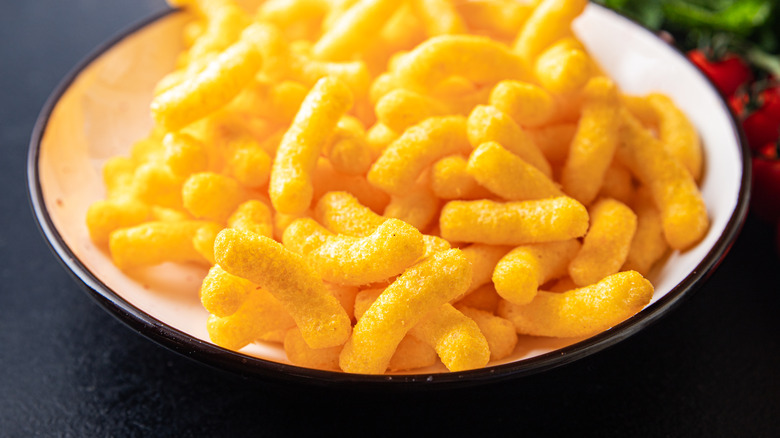
From there, the hydrated, liquified cornmeal is forced through a heated extruder with intense pressure (300 pounds per square inch). Those extruders are equipped with specialized nozzles that form the tubular shape of each individual, 1 ½-inch, par-cooked cheese puff. To crisp 'em up, the moisture that was added earlier must be removed, which happens via baking in a large commercial oven. Under heat, the moisture inside the dough turns to steam, puffing up the "puff." But, expose 'em to heat for too long or they'll become overly crunchy instead of light and cloudy. Temperature control is crucial. To finish, those puffs get sprayed with cheese powder inside a large tumbling drum. The puffs are weighed once more to portion and package.
It's impressively high-tech production for a snack that had a secret first life as cow feed. Per the lore, in 1935, the Wisconsin-based Flakall Corporation accidentally invented cheese puffs after running moist cornmeal flakes into the grinder; the cow feed flakes miraculously puffed up like popcorn after exposure to the grinder's heat. Nowadays, commercial cheese puff manufacturers recreate this process using an extruder — the specialized machine for achieving cheese puff perfection. The snack was quick to catch on, and Cheetos hit the market soon thereafter in 1948 (Flamin' Hot remains our all-time favorite Cheetos flavor, for the record).