

Pottery Collectors Can Spot Fake McCoy Cookie Jars Just By Looking At Which Character It Is
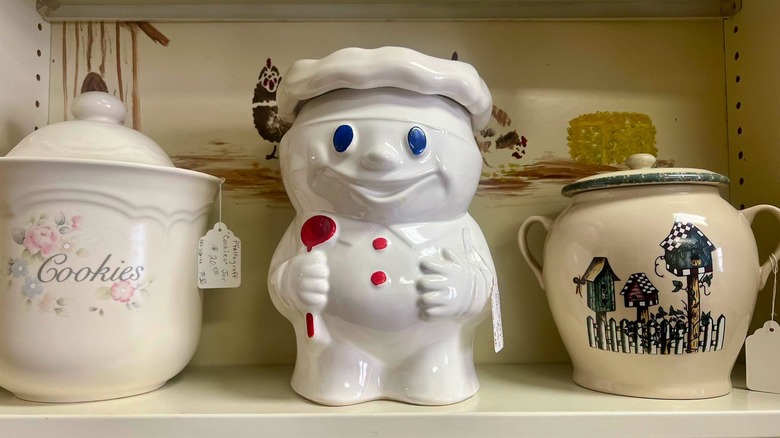
Vintage McCoy cookie jars — particularly those shaped as cartoonish, whimsical characters — are a delight for collectors. Authentic McCoy cookie jars are some of the most sought-after pieces, and whether you're holding on to an heirloom mid-century jar or you're interested in collecting, it's worth taking some time to identify the markers of a true McCoy. Sometimes this is as easy as knowing which characters are distinctly associated with McCoy, and which are imposters.
Cookie jars made their way to the countertops of American kitchens in the late 1920s, around the time of the Great Depression. The Nelson McCoy Co., originally known as the Nelson McCoy Sanitary Stoneware Co., produced its first character-based cookie jars in the 1930s. These and other vintage cookie jars are rare, charming, and worth the thrift store hunt, but only McCoy rolled out certain characters. If you come across a Bobby the Baker (a Pillsbury Dough Boy doppelganger), Clown in a Barrel, Betsy Baker, Coalby Black Cat, or Freddy the Gleep cookie jar, chances are you've got the real McCoy. But because there were so many reproductions (and fakes) produced throughout the 20th century, determining authenticity is important.
The bottom of the cookie jar should display the McCoy logo, be stamped USA, or both. McCoy jars have a glossy glaze finish and precise molding, whereas fakes may appear cloudy or have inconsistencies in shape. Authentic McCoy jars are heavy and solid — lightweight jars are most likely dupes. Most importantly, get to know the characters. The existence of a Little Red Riding Hood cookie jar with a McCoy logo had unsuspecting collectors excited, until they learned that McCoy didn't actually manufacture a Little Red Riding Hood.
Look for fakes, but get to know your McCoy cookie jar — it could be worth more than you think
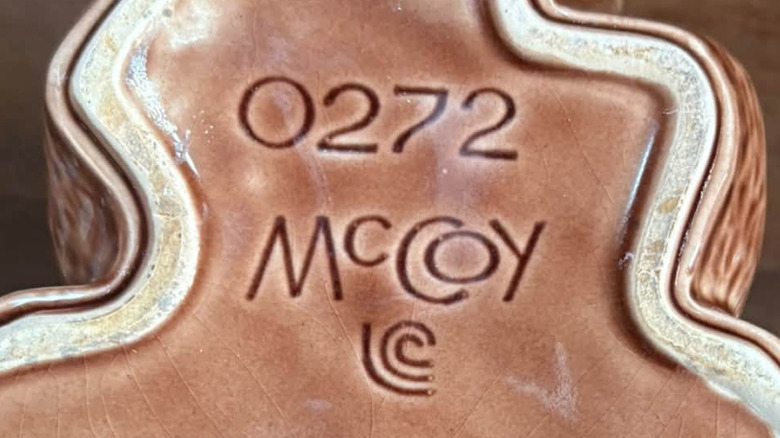
A little research can go a long way when it comes to recognizing which playful figurine cookie jars are truly NMPC (Nelson McCoy Pottery Co.) characters. Books like "McCoy Pottery Collector's Reference & Value Guide (Vol. 1)" can be extremely helpful and should name all of the McCoy productions, as well as include pictures. In addition to looking for markers on your McCoy cookie jar, get to know some of the common jars that simply weren't ever produced by NMPC.
According to the McCoy Pottery Collector's Society, there are many cookie jars that are fraudulently labeled McCoy, but if you can identify the characters, you may have won the battle. Do you have Snow White, Cinderella, Daisy Cow, or Donald Duck Turnabout? While they are probably cute, they were never produced by McCoy.
Even if you aren't interested in McCoy jars as collectibles, if you're in possession of Grandma's collected cookie jars, take a closer look — some could be worth hundreds, if not thousands. The McCoy Santa cookie jar, produced in the 1980s, can fetch up to $3,000, and a vintage 1961 pesky brown squirrel jar sold for slightly more than that on eBay. Just remember that there is now a long history of fraud around these cookie jars. If it has a McCoy logo, but you suspect it's a cleverly disguised phony, take some measurements. Fake McCoys are often created from a mold and will have shrunk during firing.