

Are Lily Chocolate Bars Really Healthier Than Hershey's?
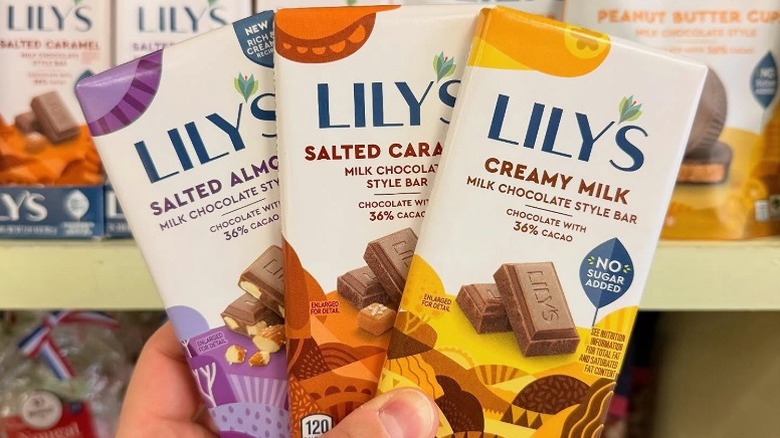
It's hard to beat the nostalgia of a classic Hershey's Milk Chocolate bar. It's one of reviewers' favorite Hershey's products, after all. But with so many other offerings in the candy aisle, you might be tempted to branch out. One brand you've likely seen, with an eye-catching and colorful label, is Lily's. Lily's is one of many brands owned by Hershey, offering a full range of no-sugar-added chocolate bars. So what makes these bars different from a candy store classic, and is a no-sugar-added chocolate bar better for you? Let's find out.
The biggest difference between a Hershey's Milk Chocolate bar and a Lily's Creamy Milk Chocolate bar is the sweetener. Hershey's bars use refined sugar, which has 15 calories per one-teaspoon serving and a glycemic index of around 60. The glycemic index measures how quickly a food raises blood sugar. Lily's uses erythritol (a sugar alternative with almost zero calories and a zero glycemic index), isomalt (derived from sugar beets, with a glycemic index of nine), and stevia extract (from the Stevia Rebaudiana plant, an incredibly sweet-tasting product with zero calories and a glycemic index of zero). If you're looking to reduce your sugar intake, Lily's bars offer a chocolate treat made with alternative sweeteners and no added sugar.
The use of plant-based or artificial sweeteners does not mean that Lily's chocolate is good for you, though. Excessive consumption of erythritol, in particular, can increase the risk of blood clots and has been linked to a higher risk of cardiovascular events like heart attack and stroke. Just as with refined sugar, sugar alternatives should be consumed in moderation and should only be a small part of a nutritious and balanced diet.
How else do Hershey's and Lily's Milk Chocolate products compare?
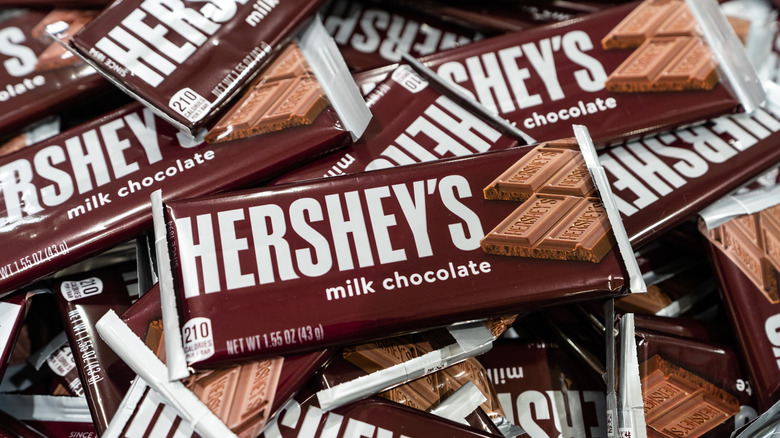
When comparing other nutritional information for Hershey's and Lily's milk chocolate bars, many of the values are quite similar. Overall, Hershey's Milk Chocolate has 150 calories per 31-gram serving, while Lily's Creamy Milk Chocolate has 130 calories per 31-gram serving. Hershey's and Lily's both have 5mg of cholesterol and 25mg of sodium per 31 gram serving, and 9 grams and 10 grams of total fat, respectively.
Other notable differences, beyond the types of sugar used, are in the stabilizers and emulsifiers used to make the chocolate bars. Lily's uses inulin, also known as chicory root, a soluble plant fiber that is quite sweet and contributes to the mouthfeel and snap of chocolate products. The addition of this fiber is important because it provides the structure that chocolate loses when sugar is removed. Lily's uses non-GMO sunflower lecithin as an emulsifier, a plant-based product that helps keep water (or in this case, milk) and oil (milk fat and fats in chocolate) properly combined. Hershey's uses soy lecithin, as well as PGPR (polyglycerol polyricinoleate), a synthetic emulsifier. This emulsifier is often used in place of cocoa butter and reduces fat blooming, but is also why less expensive chocolate products have a waxy texture and less robust taste. If you want to avoid bloomed chocolate, don't store those bars — pricey or otherwise — in the fridge.