

Scrambled Eggs Vs Boiled Eggs: Which Is Actually Healthier?

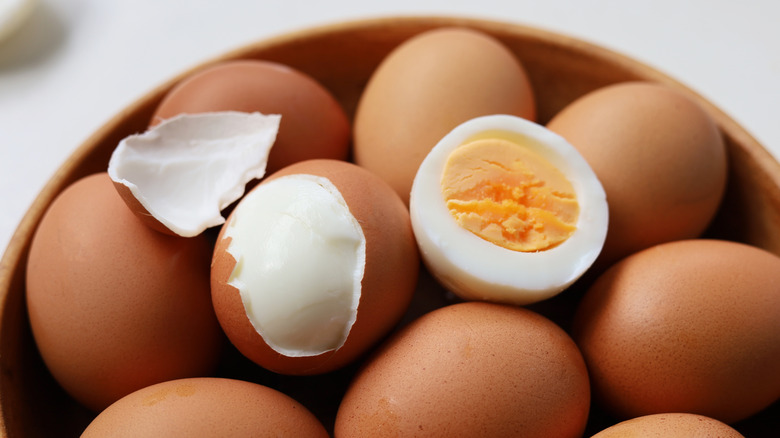
Lots of foods are subject to swings in how healthy we consider them, but eggs have been hit particularly hard. The varying opinions on eggs mostly came from concerns over cholesterol, and the belief that eating food high in dietary cholesterol, like egg yolk, would raise the cholesterol in people's bodies. We now know that mostly isn't the case, as most cholesterol is produced in the body and is more tied to unhealthy fats. Eggs are in fact quite nutritious, and how healthy they are comes more down to preparation. And that can be seen in how boiled eggs are more healthy than scrambled.
Making classic hard-boiled eggs is a great baseline, because there are no added ingredients. If you don't add salt when you eat them, it's just pure egg. Scrambled eggs can also be healthy, as they still retain the same great nutrition as any cooked eggs, but what you cook them in, or add to them, can make them a little less healthy than ones that are simply boiled. That is because common ingredients, especially butter, can be higher in nutritional elements that can impact your health.
The main one is saturated fat. It is not inherently that bad for you, like trans fat, but it should be consumed in moderation because diets high in saturated fat can mean higher cholesterol and heart disease risks. One boiled egg by itself has a little, 1.5 grams per egg. But add butter for scrambled eggs and that shoots up. If you use just one tablespoon of butter it adds 7 grams of saturated fat. That means two scrambled eggs would have 13 grams, which is 65% of the daily recommended total for a 2,000 calorie diet.
Boiled eggs tend to be healthier as they don't have added fat
Beyond saturated fat, there isn't too much difference for scrambled eggs compared to boiled. If you like to add a little milk to your scrambled eggs for creaminess, it doesn't make much difference, as a cup of milk, even full-fat whole milk, only has 5 grams of saturated fat, so a few tablespoons barely adds any. The other things the U.S. Food and Drug Administration (FDA) says to limit in your diet are sodium, trans fat, and sugar. And as long as you use unsalted butter, there will be little sodium and no trans fat or added sugar in scrambled eggs.
Because the health difference between the two mostly comes down to saturated fat, you can make scrambled eggs closer to boiled eggs by swapping in oil for butter. While olive oil might not perfectly replicate your favorite creamy scrambled eggs, a tablespoon only has about 2 grams of saturated fat compared to butter's 7 grams.
The one other small advantage of boiling is that less high-heat cooking methods tend to retain some vitamins and nutrients in eggs at higher levels. So boiled eggs might have a bit more vitamin A, or zeaxanthin, which is good for your eyes. That also applies to poached eggs, which are nutritionally identical to boiled. But the reality is that as long as you don't go too heavy on the cooking fat, both scrambled eggs and boiled are pretty healthy, delivering 6 grams of protein per egg, along with high levels of nutrients like vitamin B, calcium, and iron. So let those old cholesterol concerns go, and enjoy your breakfast eggs however you prefer.