

How Much A Pint Of Häagen-Dazs Cost When The Company Began In 1960
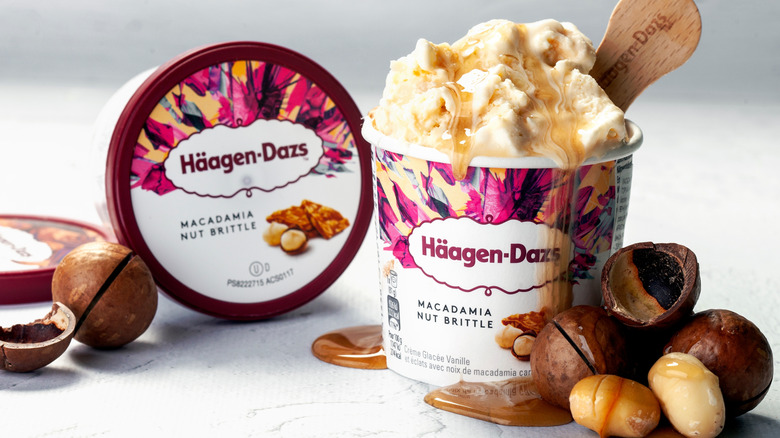
When Häagen-Dazs hit grocery shelves in 1960, you could pick up a pint of their original three flavors of chocolate, vanilla, or coffee for 75 cents. Sound cheap? It might surprise you to learn that, adjusted for inflation, that's an equivalent of around $8 today. Put into context, if you're shopping this week at Walmart, you can grab a strawberry flavored pint (or butter pecan or coffee or pistachio) for a little over four bucks. Inflation is a funny thing, but so is the ice cream business and Häagen-Dazs inventors, Reuben and Rose Mattus, knew their opportunity to stand out in the commercial ice cream crowd would call for creative thinking.
Mass-marketed ice cream in the 1960s was selling strong, but consumers were wearying of its synthetic flavor profile. Home freezers that were a new innovation in the 1940s had well taken hold by the 1960s and consumer buying habits had shifted accordingly. Grocery stores in the 60s had expanded into supermarkets that sold tv dinners and Jell-o, which had been around longer than you might think, but such cheap products from faux ingredients were gaining a whole new level of 1960s notoriety. The Mattuses decided to pull a full pivot away from that trend and roll out a luxury product made with simple ingredients that were real. The only fake thing about Häagen-Dazs, was the Häagen-Dazs name.
Häagen-Dazs launched pints priced at three times more than 1960s competitors
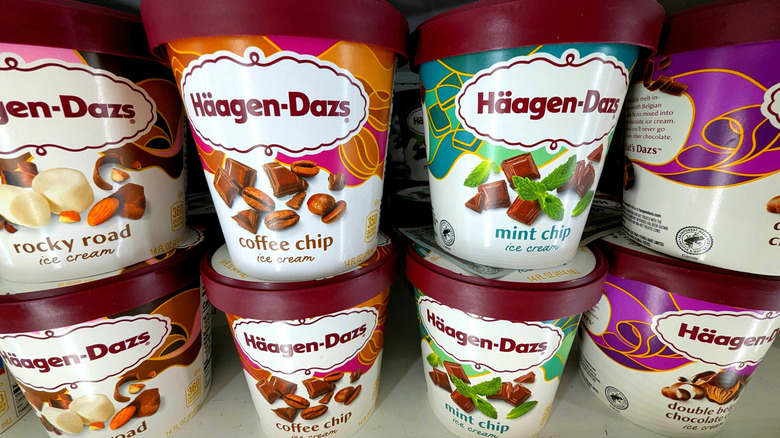
As big box ice cream manufacturers drove down the price of ice cream with their low-quality ingredients, the Mattuses leaned in to marketing their product as a premier, gourmet-level quality ice cream. The commercial grade ice cream had begun blasting its already sub-par mixture of artificial flavors and dry milk or milk product with air, known in the industry as "over-run", to create a lighter, scoopable product (that was cheaper, given the container volume was pumped-up, literally, with air).
The Mattuses launched their ice cream using simply egg yolks and real cream. Their ice cream was sold as an indulgence, a luxurious 12% butterfat to the average 10%, and an overrun percentage that was less than half of most competitors. To cover the cost, the Mattuses upped the price of their ice cream to nearly three times that of comparable supermarket pints.
They also bluffed their way into a bougie Danish name by simply making it up. Häagen-Dazs means...really, nothing, aside from a brilliant marketing tactic.. It's not even Danish. There is no umlaut used in the Danish language, plus the letter combo "zs" is Hungarian, not Danish. Nevertheless, the more expensive ice cream was such a hit, that by the early 1980s, the Mattuses were able to sell Häagen-Dazs for $70 million to the Pillsbury Company.