

How Butchers Actually Choose The Best Cuts In The Case
We may receive a commission on purchases made from links.
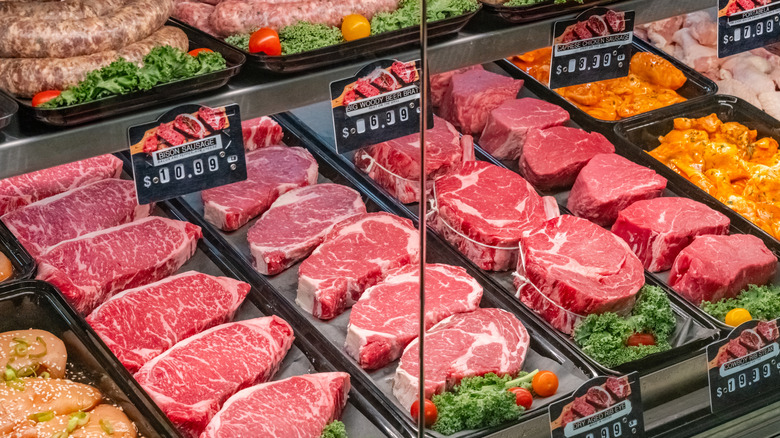
Cooking a supreme cut of meat can often be a complex, if fun, task, but knowing where to start in picking the perfect cut is another skill entirely. Bone structure, fat content, and muscle type can all vary by cut and even by the source. When all of these variables are on display in the meat case, decisions are daunting. So, to aid in training your eye to catch the best chops in the case, we consulted two seasoned butchers to share their wisdom.
Eddy Shin, owner of A Cut Above Butcher Shop in Santa Monica, California, cites fat content for beef – in particular steak marbling – as the most telling trait to look out for. Of all factors, he says, "marbling is by far the most important."
Another factor, introduced by Brad Baych, a professional butcher and author of "Primal Cuts: A Butcher's Guide to Selecting, Preparing, and Perfecting Beef", is the occasion. "When choosing a cut of meat," he says, "it's real important to know what you are going to do with this meat." To him, everything from the day of the week to the reason for the get-together can make one cut more favorable than another.
Spotting the best individual cut comes down to color and marbling
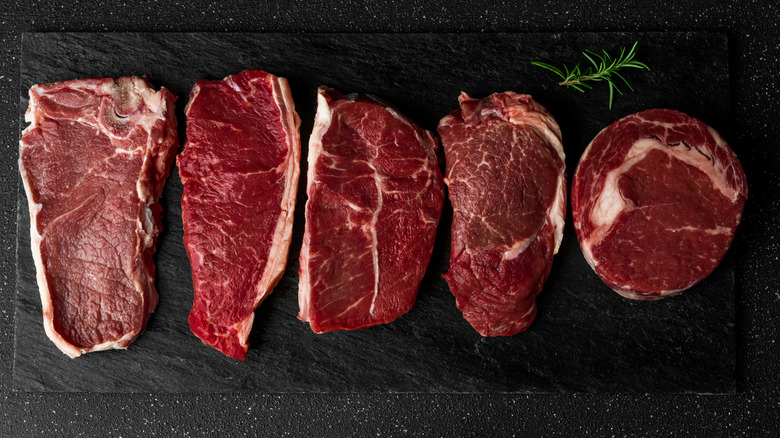
Professional butchers are trained in color and pattern recognition so that they can curate the highest quality meats for their customers. For any variety of meat, there are standards of shape and color that you can look out for, too. Shin says, "For beef, we look for a bright cherry-red (for grass-fed, a deeper burgundy hue with yellowish hue on the fat, due to the higher beta-carotene from the pasture diet). For pork, we look for a nice pinkish-grey hue. And poultry, slightly pink." He also notes that clean, sharp cuts are a better sign than jagged edges, no matter the kind of meat.
Prime marbling, or intramuscular fat, can be slightly harder to identify, but it's safe to live by the rule that the denser the web of white fat, the more unctuous your meat will be. According to Shin, the main pattern to look out for is one of "fine specks of fat distributed throughout the steak. When this fat renders during cooking, it adds flavor, moisture, and tenderness."
The dish, too, is good to consider before simply swiping the best-looking chop. Sometimes — say, for raw preparations like steak tartare – an especially lean cut will do you best. On the other hand, a cut that seems overly fatty could be among the best cuts for braising. There are numerous factors at play here, but with an eye for color and an awareness of circumstances, you're sure to walk away with the best cut.