

How To Pick The Best Vermouth For Your Favorite Martini, According To An Expert Bartender

Vermouth is often treated as the supporting actress in a martini, but a good bartender knows better than that. Even a small amount can dramatically change a drink's aroma, sweetness, and overall balance. But if you're wondering which vermouth style to stock in your home bar, listen to Justin Lavenue's advice, a master mixologist and co-owner of The Roosevelt Room in Austin, Texas, as well as owner/operator of The Eleanor and RoadHaus Mobile Cocktails. "I'm reaching for dry vermouth," he says. "My go-to is Dolin Dry. It's French, classic, and balanced in exactly the way I want a martini vermouth to be."
We placed Dolin second in our ranking of the best vermouth brands, thanks in part to its storied French history and centuries of Alpine fortified wine-making tradition. Lavenue explains: "It has enough body and subtle sweetness to keep the drink from tasting thin, but it still has that dry, herbaceous, lightly floral character that lets the base spirit shine." Dry vermouth works particularly well at mellowing gin's juniper and botanical characteristics.
Lavenue adds, "It's not trying to be the loudest person in the room, which is exactly what good vermouth should do in a martini." It makes sense, then, that James Bond himself also preferred his martinis made with dry vermouth. But that wasn't always the case. Lavenue explains that while the original martini actually used sweet vermouth, the modern martini typically calls for dry vermouth, with the specific vermouth depending on the gin or vodka being used.
Match your vermouth to the cocktail's personality
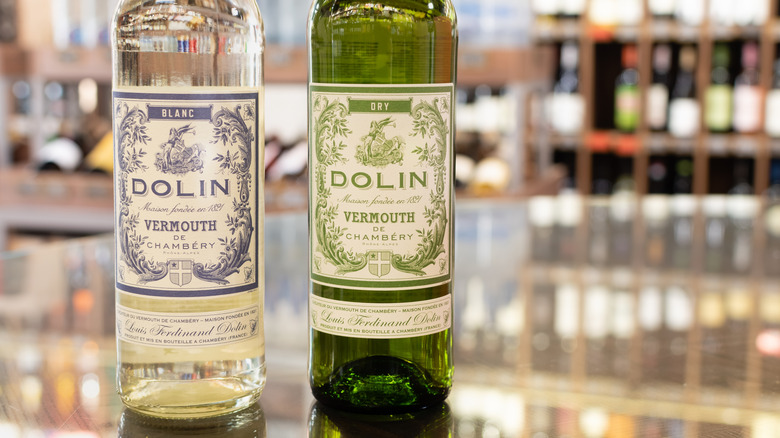
While Justin Lavenue still uses Dolin Dry with a London Dry gin, he likes to add "a small portion of Dolin Blanc or Carpano Bianco... to soften the edges and make the drink more rounded." With other styles of gin, like New Western or Old Tom, or sweeter fruit-based vodka, he opts for something even drier, like Noilly Prat Extra Dry.
Martinis are always up for customization, so you can opt for extremely spirit-forward 3:1 ratio, or go lighter with a 1:1 combination. A "wetter" martini simply gives the vermouth a bigger role to play. Lavenue likes to mix it up, literally, depending on what he's working with. "My basic build is either a 2:1...or a 3:1 with 2 ¼ oz gin or vodka and ¾ oz dry vermouth," he says. But unlike Bond, Lavenue doesn't shake. He recommends it "stirred on large ice in a frozen mixing glass, then strained into a frozen martini or Nick and Nora [glass], and garnish with a lemon twist."
While a modern martini recipe might be the safest starting point, playing with different measurements and vermouths is how you figure out your favorite combination, much like Julia Child did with her Upside-Down Martini. "The real advice is to know your vermouths," Lavenue says. "They're often sold in 375 ml bottles, they're inexpensive, and they're just wine with herbs and a little extra alcohol, so buy a few, taste them, keep them refrigerated in between uses, and match them to the base spirit to make your martini become greater than the sum of its parts.