

The Popular Chicken Sandwich Chain Almost No One Remembers Popeyes Once Owned
The fast food business is competitive across the board, but nowhere does the cutthroat nature seem to show up more than in the world of fried chicken. The "Chicken Sandwich Wars" stand among the most iconic fast food feuds, but it is far from the only evidence of intense competition among fried chicken chains. In the late 1980s, the fast-food rivalry peaked when Louisiana-based Popeyes launched an attempted hostile takeover against its neighboring competitor, Church's Chicken.
In 1989, Texas-born Church's was the second-largest fried chicken chain in the U.S. Despite that title, the company was in financial trouble thanks to issues with management and marketing in the preceding years. Louisiana-based Popeyes, the third-largest chicken chain at the time, first offered $290 million to take over Church's, but the company's board rejected the bid, saying the price was too low, alleging that Popeyes had used confidential information from a former Church's employee. Popeyes then pursued a hostile takeover by seeking to buy enough shares of publicly traded Church's to gain control of the company. After months of legal battles and other efforts to fend off the takeover, however, Church's agreed to merge with Popeyes in a deal worth up to $330 million, bringing two of the best fried chicken restaurant chains in the U.S. under the same roof.
Unfortunately for Church's, the plan for the merger involved making deep cuts to the brand's presence. Popeyes intended to clear space for itself by converting some Church's restaurants to its own brand while closing or selling off many others, reducing Church's footprint to just a fraction of what it had been at the time of the sale. For Popeyes, however, the loan required to finance the purchase turned out to be more than the company could handle.
The tumultuous journey of Church's Chicken
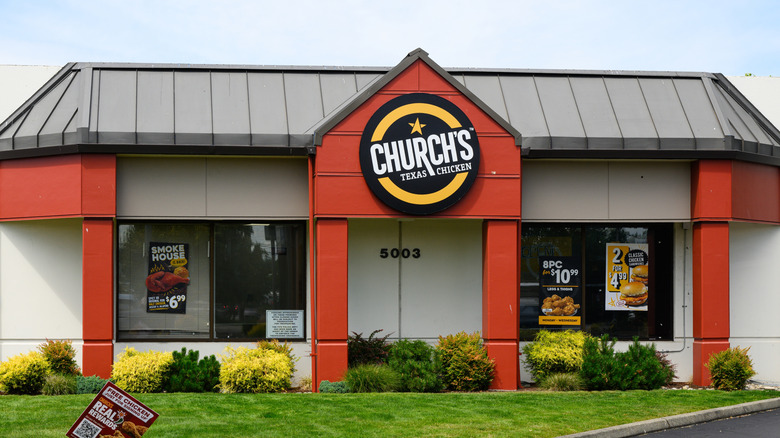
Just a few years later, after the original plan had failed, the similarities of Popeyes and Church's Chicken were perhaps the least of the company's problems. The high-interest-rate loans used to finance the merger put significant financial strain on the combined company, which filed for bankruptcy in 1991. Just a year later, the creditors that had financed the purchase of Church's acquired both brands, forming a new umbrella company called America's Favorite Chicken Company, or AFC Enterprises Inc.
Under AFC, Church's saw a significant resurgence. With a new logo and remodeled restaurants, the fried chicken chain began climbing toward its former glory. Despite this new growth, however, Church's continued changing hands. In 2004, the brand was sold to private equity firm Crescent Capital Investments, allowing AFC to focus its continuing operations on Popeyes. Then, in 2009, the chain was sold to San Francisco-based firm Friedman, Fleischer & Lowe. Finally, in 2021, High Bluff Capital Partners purchased the company for an undisclosed amount.
The history of Church's Chicken has certainly been tumultuous, but the brand has managed to hold on. In the hands of the current owners, the chain has leaned back toward its roots, once again changing its logo and this time its name to Church's Texas Chicken. Today, the chain isn't exactly challenging for its old second-place position among chicken restaurants, but it's still hanging in there. According to QSR Magazine, Church's just made the list of the top 50 fast-food chains by sales in 2025, coming in at No. 49. Its longtime rival and former owner, Popeyes, however, ranked much higher at No. 13, second in the chicken category only to Chick-fil-A.