

The Rick Steves 'High-Rent' Rule To Know Before Dining In Italy

Italian cuisine is extremely simple, hinging on fresh produce, local products, and minimal ingredients. In Italy, you won't find Italian seasoning or Italian dressing. Instead, you'll find fresh herbs, oil, vinegar, salt, and pepper. But dining in Italy as a tourist isn't always as simple. In fact, as tourism rises in major cities like Rome and Florence, it's getting harder and harder to find authentic restaurants where simplicity shines. Luckily, travel writer Rick Steves has a handful of tips for avoiding tourist traps — but if you only remember one for your next trip to the Bel Paese, let it be this one: Avoid dining on high-rent streets.
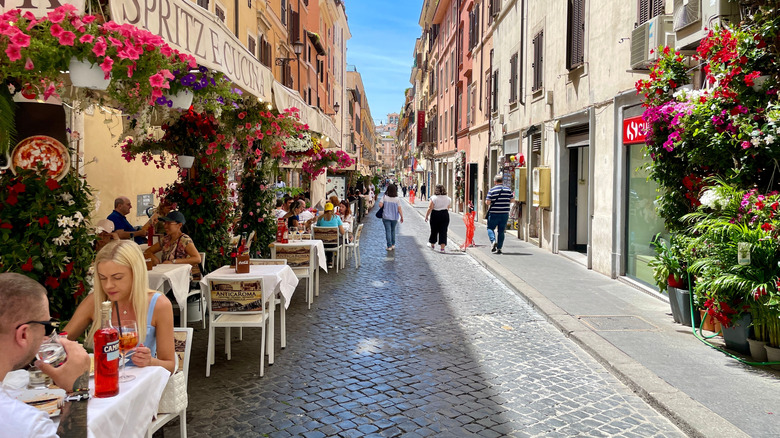
A high-rent street is exactly what it sounds like: A street near a major tourist attraction where it's more expensive for businesses to operate. According to Steves, more often than not, these restaurants will be both disappointing and expensive. The more expensive their rent, the more likely they are to skimp on quality. Additionally, many of these restaurants cater to tourists, not the local population. If the restaurant is advertising in English, it's safe to say that you won't find many locals dining there. The food you'll find inside might be fine, but if you're looking for an authentic dining experience while in Italy, Steves recommends walking further away from the heart of the city center.
Signs of authentic Italian food, according to Rick Steves
If you're seeking authentic Italian food, there are a handful of green flags to look out for on your next trip. Even if you're not fluent in Italian, Steves says that it's a good idea to seek out menus that are only offered in the country's mother tongue. If it's handwritten, that's even better, as it shows that the menu changes based on the season and what ingredients are available.
Keep in mind that the menu shouldn't be a novel, either. Page-long menus with a range of dishes from various Italian regions — think cacio e pepe from Lazio and ribollita from Tuscany — are an instant red flag. Not only will you fail to get the most authentic version of the dish, but you might also get a dish with out-of-season vegetables and non-local ingredients. When in doubt, choose the restaurant with the small, limited menu.
Beyond lunch and dinner, gelato is another important area of Italian cuisine where tourists tend to go wrong. One of the most important things to look for when buying gelato in Italy is the color; Steves recommends avoiding brightly-colored gelato. For instance, banana-flavored gelato shouldn't be the color of a banana peel; it should be a very light, muted yellowish gray, similar to the part of the banana that you eat. You should also avoid gelato that's towering in its container and decked out with toppings. Real-deal gelato isn't stuffed to the brim, and it's often covered with a lid. It's simple, just like it should be.