

Here's What Those Wavy Lines On Your Crock-Pot Really Mean
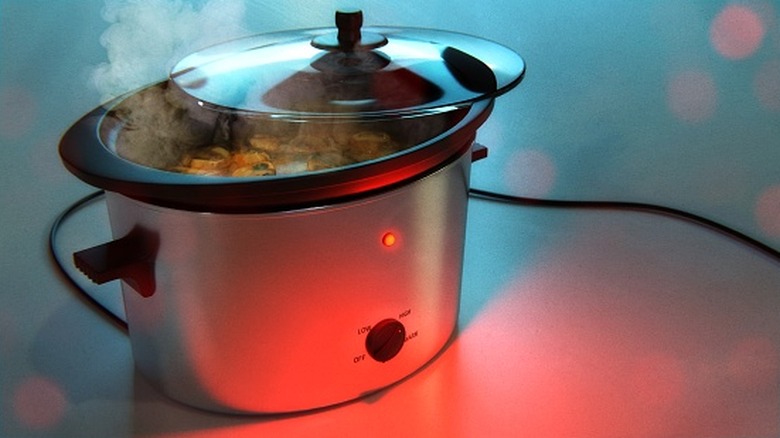
Symbols predate written language, an ancient method of conveying meaning across time, culture and literacy. But sometimes, a supposedly universal symbol ends up getting lost in the sauce and becomes an inscrutable little mark everyone learns to just ignore. If you've scanned the face of your crockpot and wondered if there's more to those little wavy lines than "double wavy," we're here to clear the air: They're meant to represent rising heat, Hot Springs-emoji style, and they control the heat level, specifically the Warm setting.
This is worth understanding because it performs a different job from Low and High. Warm is intended to hold food that's already at serving temperature but not continue cooking it. That can be useful if your chili is finished before the party starts, or you want to keep Ro-Tel queso dip or classic Swedish meatballs heated up during a potluck. On a manual Crock-Pot, turn the dial to Warm once it's done cooking, but there are some programmable models that automatically switch over when their programmed cooking time ends.
Keeping your Crock-Pot warm and fuzzy
The rest of your crockpot's dial uses an even older symbolic system, deploying Roman numerals to convey that O means Off, I means Low, and II means High. It may have made a lot of sense at the drawing board stage, but it's apparently less self-explanatory than the designers hoped. For years, Crock-Pot has fielded questions from owners trying to decode its controls, with one frustrated Crock-Pot owner reporting that their confusion drove them to write an "L" and an "H" on the appliance after repeatedly having to look them up. Sometimes the most effective interface is one with personalized modifications. Plenty of machines do display the words Off/Low/High/Warm, but symbols notably allow the device to be sold and be usable in any country.
The High and Low settings on a slow cooker are also a little less straightforward than their symbols may suggest. On many Crock-Pot models, both settings eventually bring food to approximately the same simmering temperature, 209 degrees Fahrenheit. The difference is how long it takes to get there — High heats the food faster, while Low makes the climb over several more hours. This is exactly why many slow cooker recipes will give you one cooking time for High and another for Low.
Warm sits apart from both because its purpose begins after the cooking is done. The three symbols are really just a tiny cartoon depiction of heat rising from your cooked food. Like the floppy disk symbol that means "Save," or the, sadly, increasingly theoretical telephone receiver icon we tap to make a phone call on a smartphone, kitchen appliances have their own little visual language, even if it sometimes gets a bit cryptic. Once you see it, it seems obvious. If you ever forget, there's always a Sharpie.