

How Chili Became A Staple Meal For Cowboys On The Trail In The Old West
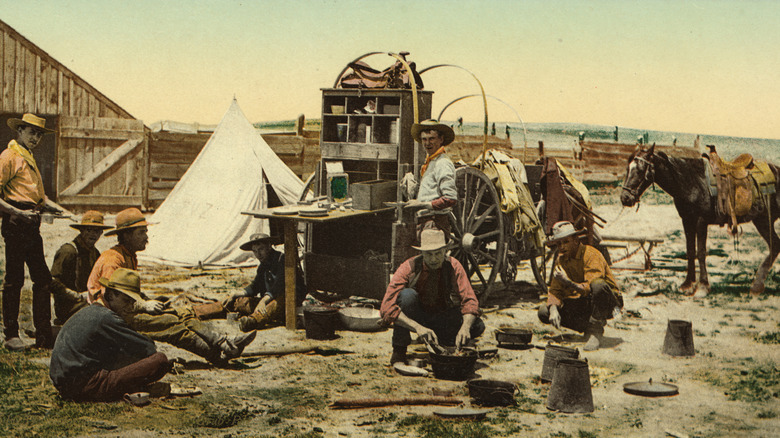
The austere, hardscrabble culinary culture of the Old West was markedly different from the vibrant Tex-Mex cuisine that would evolve from and supplant it, but one connective thread runs through both. When we think of cattle drivers gathering around campfire meals on the plains, one dish arguably comes to mind before all others — so how did chili become a staple meal for cowboys on the trail in the Old West?
To answer that, we have to dig into the notoriously tangled and nebulous history of chili itself. Theories regarding its precise origin abound, with some suggesting that stews of meat and chili peppers could be found in the region that would become Texas as early as the 17th century. While the roots of chili may stretch back much further, it was only definitively identified as such fairly late in the period we think of as the old West (approximately from 1865 to the late 1880s-1890s). Per Texas Monthly, the first mention in print of "chili con carne" came in 1882, in a travel guide to San Antonio — a city that would be pivotal in making chili a cowboy standard.
The official website of Visit San Antonio proudly proclaims that the city "is the birthplace of the American cowboy." It was also where, from roughly the 1880s onwards, the legendary "Chili Queens" of San Antonio would operate chili parlors in open-air plazas, feeding the vast numbers of cowboys who would pass through this frontier town and gain their first exposure this dish of Mexican origin. This would, in turn, inspire the version of chili they would eat on the trail.
How cowboy chuck wagons made chili
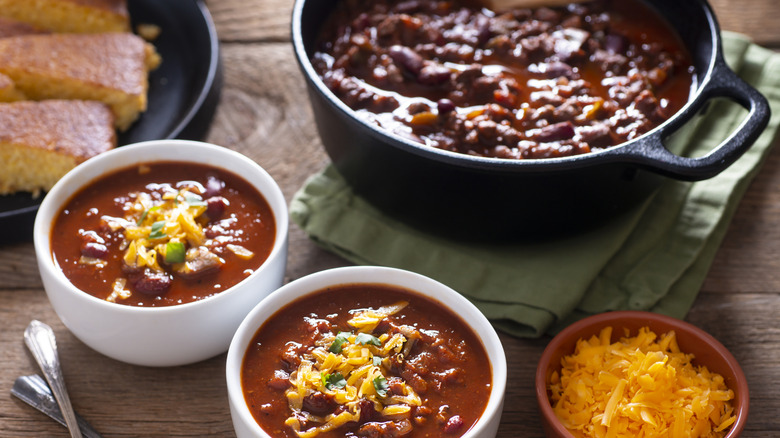
Fans of chili today, whether they favor a no-beans-allowed West Texas chili or the famously divisive Cincinnati variety, would likely not recognize the stuff served up by cowboys on the trail. For sustenance, those driving cattle across the West would be reliant on their chuck wagon — essentially, a mobile kitchen/pantry — which could carry enough supplies to feed a large group for weeks. Chuck wagon cooks often relied on cheaper cuts of beef, and it has been suggested that stewing the meat of the Texas longhorn cow — as you would in chili — was necessary to disguise its toughness and taste. To achieve the latter, it's believed chuck wagon cooks planted pepper seeds, onions, and oregano along the trail to ensure there was an ever-present supply.
To keep their food both portable and long-lasting, cowboys would sometimes resort to "chili bricks", in which dried beef, crushed chili peppers, fat, and salt were pressed together into dense cuboids that could be rehydrated with water over a fire. It should go without saying that garnishes, including most of what we consider to be the 20 best toppings for chili, were unavailable on the trail – you wouldn't find sour cream or guacamole on an unrefrigerated chuck wagon (and given how hot it can get in Texas, you wouldn't want to).
Chili would gain popularity beyond the Tex-Mex environs that produced it when a chili stand appeared at the Chicago World's Fair in 1893, just as the Old West era was drawing to a close. It continues to evolve, with modern recipes featuring everything from peaches to sweet potatoes (the key for a thick and hearty vegetarian chili).