

Where Does Costco Get Its Strawberries From?
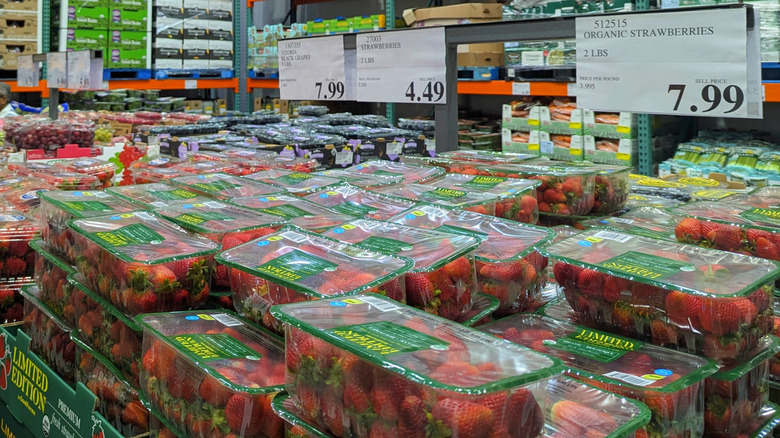
Few fruits pull off the trick strawberries manage: Showing up fresh in a fridge in the dead of January and again at the height of summer, with barely a dip in quality either way. Strawberries have become a year-round staple in kitchens across the country, and Costco's bulk clamshells are a big reason why, for millions of members. But that brings us to wondering how did Costco manage to get strawberries year round in the first place? Perhaps more importantly, where do all these strawberries come from?
Costco has always been very tight-lipped about its suppliers, but they're required to disclose where fresh produce is sourced from by law — the Country of Origin Labeling rules, administered by USDA's Agricultural Marketing Service, made certain of this. For generic, sold-by-the-pound strawberries, Costco Same-Day's website lists these as being sourced from the U.S., Mexico, or Canada. Kirkland Signature Organic Strawberries, meanwhile, are labeled plainly with "Product of Mexico" in the back. Considering Mexico was the fourth-largest strawberry grower in the world, behind only China, the U.S., and Turkey, in 2023, this isn't too surprising a result (via World Population Review).
Despite ranking nowhere near the top strawberry-producing nations, Canada made it onto Costco's shortlist of key partners. While we don't know the reason, it could be anything from proximity to the U.S. to existing grower partnerships, or even climate change opening up new growing regions. Major berry producers like Driscoll's and Naturipe Farms have reportedly been testing crops in Ontario and Quebec. Warming weather is extending growing seasons in the North, and companies want in early. So give it a few years, and Canada's strawberry output might catch up to its spot on Costco's list.
Why even bother checking where your strawberries come from, anyway?
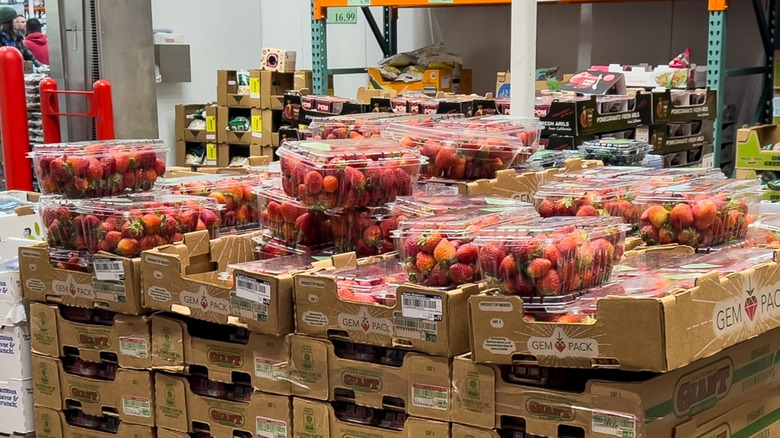
Knowing the grower information or, better yet, the exact fields they were harvested from carries far more value than just sating simple curiosity. The USDA reports that roughly 85% of Mexico's U.S.-bound strawberry shipments arrive during winter and spring, so a package labeled as a product of Mexico in January is more likely reflecting active harvest than fruit pulled from cold storage, and is therefore a reasonable signal that it was picked close to peak ripeness. On the other hand, a Mexico-labeled package showing up on shelves in July falls well outside of that window, which could suggest the fruit traveled further or spent longer in transit before reaching the store.
The same logic applies in reverse for a California-grown package in June, squarely inside the state's peak season of April-through-August, versus one from December, when only patches in Santa Maria and Oxnard are still harvesting and overall in-state volume is thinner. The growing region is also useful information in terms of food safety, too. There have been many recalls tied to specific farms and packing facilities, such as a May 2022 outbreak of Hepatitis A on batches of strawberries sourced from Mexico.
Recall notices from the FDA and other health authorities typically include lot numbers, grower names, and similar identifying details. Knowing precisely where your strawberries originate from makes it easier to check a package against that notice and act quickly. For shoppers who care about supporting domestic agriculture, or organic and sustainability practices tied to a particular grower, the packaging is the only place that distinction actually shows up, so be sure to check.