

What Do Grocery Stores Do With Food During (And After) A Power Outage?
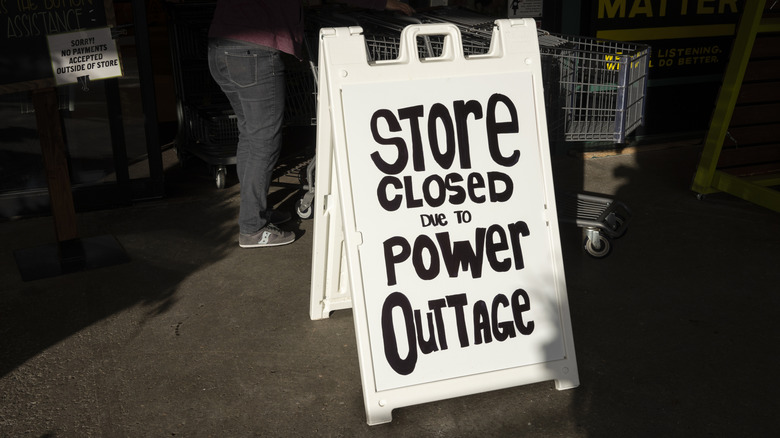
Anyone who has ever experienced a blackout is likely familiar with the anxiety over how the food in your suddenly de-powered freezer will fare (along with the urge to eat all the ice cream before it melts). Now imagine this scenario from the perspective of a supermarket stocked with aisles upon aisles of frozen and refrigerated goods. What exactly do grocery stores do with food during (and after) a power outage? That's what we're here to uncover.
While you may imagine that stores would be left with no other option than to throw out all the perishable goods since they can no longer keep them chilled, this is precisely the outcome many have plans in place to avoid. Large grocery stores will often have an emergency power system — usually a backup generator — prepared for power outages, so that their fridge and freezer units remain functional. However, given that power outages can last for days in extreme cases, the generator will need sufficient fuel to keep running until electricity is restored.
After a power outage, grocery stores may be legally required to get rid of any food adversely affected by the loss of refrigeration. According to the New York Department of Health, for example, in the aftermath of a power outage, food operators must discard any food they are not entirely certain is safe. For insurance purposes, these chains keep a record of every abandoned item. If you have shopped at a store that has recently suffered a power outage and are still uncertain, remember the 12 signs you should throw out your food before eating it.
A major power outage can result in millions of pounds of spoiled food
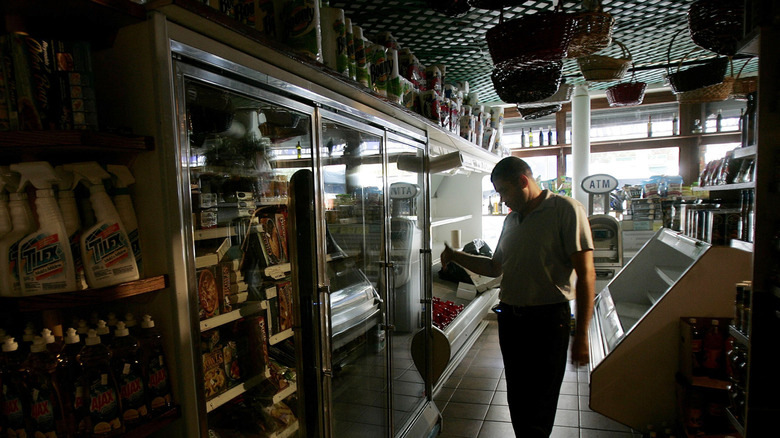
If generators are not feasible, some stores may be forced to implement alternative protocols. One commenter on Reddit with reported grocery experience outlined some common procedures, stating that store employees will typically rope off frozen food aisles to keep the doors closed. This is because freezers can maintain their internal temperatures for several hours if shut.
Open air freezer units are covered with heavy plastic, with dry ice used to keep them cool, while highly perishable items like fresh meat, seafood, and bagged salads are immediately placed in sealed freezers and coolers, or put into a refrigerated trailer (similar to what reportedly happens if the coolers break at Costco). The Redditor noted that while their company did have backup generators, the power demands were more than they could handle. "Knowing what to do in this situation can make the difference between a store losing $0 in product and a store losing tens of thousands in product," the user explained.
Proof of this came during the Northeast blackout of 2003, the largest power outage in North American history, which forced many grocery stores across the Midwest and Northeast United States to discard enormous amounts of food despite the use of refrigerated trucks and emergency generators. Per Progressive Grocer, the hunger relief organization America's Second Harvest estimated that up to 15 million pounds of food in New York, New Jersey, Ohio, and Michigan was spoiled. As blackouts can afflict your own home just as much as grocery stores, remember to bear in mind our tips for protecting perishable foods from summer power outages.