

'Enhanced' Grocery Store Steaks Never Get A Proper Crust For One Sneaky Reason
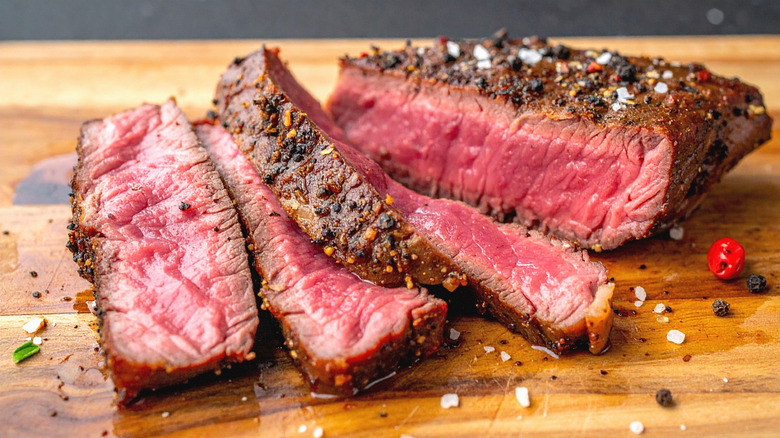
You may not realize it, but your grocery store steak may be hiding a secret ingredient that is going to prevent you from getting the crust you desire. Some grocery stores "enhance" meat prior to packaging by injecting a brine to flavor the beef. This has been done for years, and stores say it's to improve the taste, but it also has several downsides. For one, it means you are paying for that extra water weight. And as K.C. Gulbro, the owner of FoxFire Steakhouse in Geneva, Illinois tells us, that extra water is also going to make it harder to get a good crust on steak.
"For crust development," he explains, "the key is removing as much surface moisture as possible." That is because the crust comes from browning due to the Maillard reaction, which only meaningfully happens once the meat hits 300 degrees Fahrenheit on the outside. But water on the surface will absorb heat from the pan instead of letting the energy go towards browning. So excess moisture coming out of your steak from injections will essentially hold the exterior temperature at the boiling point, well below 300 at 212 degrees Fahrenheit, until the water evaporates.
"The easiest way to tell if the steak has any solution in it is to look at the ingredients on the label," Gulbro says. "[The] FDA does not allow stores to inject products without the shoppers knowing. You will see ingredients listed such as water, salt, sodium phosphate, flavorings, sugar, or marinade ingredients." Other labels to look out for include: "contains up to 10% solution," "enhanced with solution," "marinated," "seasoned," and "tenderized."
Grocery store steaks are sometimes injected with brine that will add moisture and inhibit browning
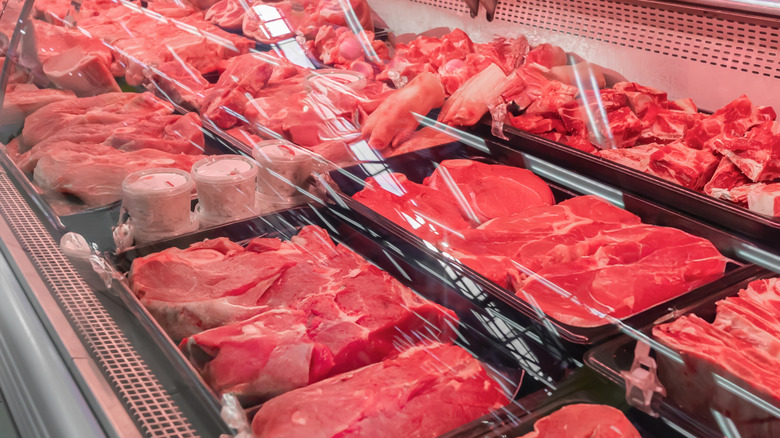
The best move is to avoid brine-injected steaks completely, but maybe you bought one without realizing it. Thankfully, there are still tricks to limit the moisture. "If the steak is enhanced or has been sitting in a wet package," Gulbro says, "I like to dry it even more aggressively by placing it uncovered on a rack in the refrigerator for a few hours." This should be paired with patting the outside of the steak dry with paper towels. The inside of the fridge will dry out your steak, and if you plan ahead you can even air dry your meat in the fridge for 24 hours to get more moisture out.
You can also change up how you cook your steak. "Use a hot pan, grill, or sizzle plate," Gulbro suggests. "A light coating of oil can help with even contact and browning." He also recommends reverse searing your steak, saying "cook the steak gently first, then finish it with high heat." That gentle heat will dry out the exterior of the steak before you sear it.
The one area where you should be cautious is by using salt to draw out the excess moisture, with Gulbro explaining that "many are already salted in the solution/marinade." You may get a better crust, but if it's already brined you could end up with a steak that's far too salty, and compared to that, a mediocre crust isn't so bad.