

How My Favorite NYC Butcher Shop Helped Me Find A Place To Call Home
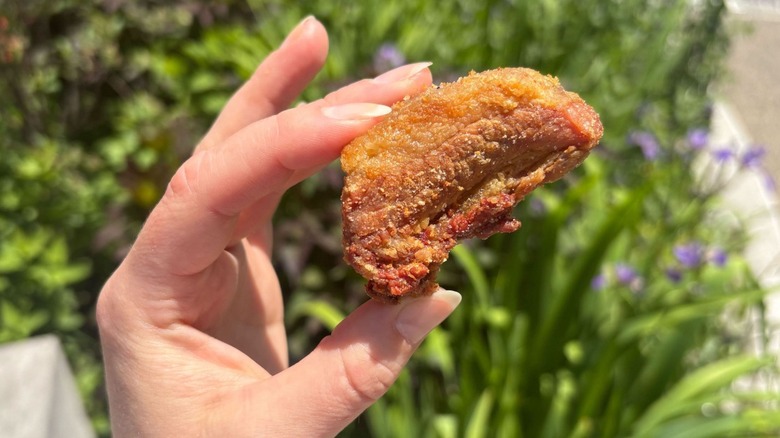
My legs always feel like jelly when I walk home from my Pilates class in Ridgewood, Queens. Post-workout, some people might reach for Muscle Milk, but I know what my body needs: a generous helping of hot, salty, deep-fried pork skin from Muncan, my favorite butcher shop in the neighborhood. Served by the scoop, each blessed chunk is layered with equal parts meat and fat, fried and tossed with seasonings. The huge tray is refreshed with sizzling batches throughout the day, staying hot beneath a heat lamp. The display is labeled in Romanian, Spanish, and English: "Jumări/Chicharrón/Pork Rinds."
Inside Muncan, I stand in line with Ecuadorian grandmothers, tattooed 20-somethings, and old Balkan men. We all order from the same pile of hot pork. Eyes twinkling, the butchers joke about how one scoop is never enough. They know us by name, and switch fluidly between English, Spanish, and a blend of Danubian languages my ear is just beginning to train toward. On the walk home, translucent grease stains blossom through the white paper bag as I eat my jumări, piece by crispy, golden piece.
During some New York City pandemic-era wandering, I landed in a temporary sublet a few blocks from Muncan while finishing graduate school. Work and school often pulled me into Manhattan. But on my days off, walking Ridgewood's mellow, linden tree-lined streets to accomplish the pedestrian circuit of mundane life-maintenance errands, I noticed an equilibrium of spatial familiarity had begun to develop within me. Like a well-cured kobasica develops character and settles into itself through slow exposure to ambient smoke, Ridgewood's culture and atmosphere cured me of my wandering, and I didn't want to be anywhere else. I signed a lease with my brother, and Ridgewood became my home. The front door was through Muncan.
Muncan provides a taste of home, no matter where you are
Ridgewood was once a paradise of Old World pork stores, but in the five years I've lived here, I've watched some close up shop. While cutting paper-thin slices of Muncan Special Salami, my butcher tells me they used to be busier, pre-COVID, but "everyone moved to Indiana." For now, Muncan, a third-generation family-run business, is holding on. Originally from Vojvodina — a multiethnic province in today's Serbia (also called former Yugoslavia, depending on who you ask) — brothers Tima and Jonel Muncan opened the shop in 1978.
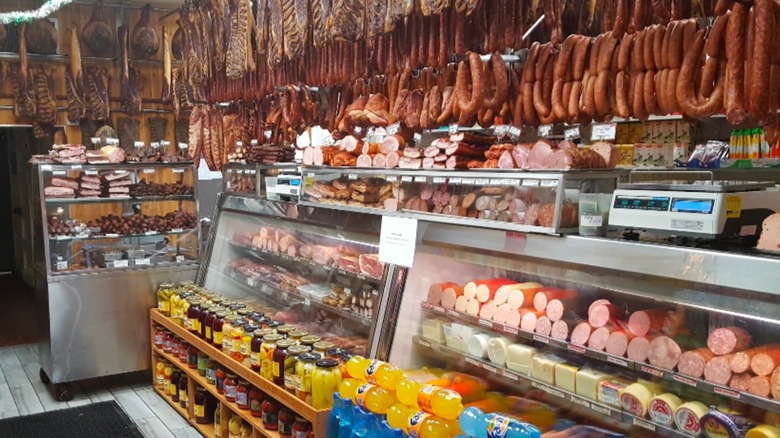
The family packs the shop as tight as a sausage. In the refrigerated cases, familiar cuts are nestled next to deliciously obscure, artisan victuals most mainstream supermarkets abandoned long ago: liver salami, smoked pork feet, coils on coils of different types of house-made sausage, and the dense, white slabs of one of my new favorites — slana, a smoke-imbued and calorie-dense cured pork fat that sustained Magyar fieldworkers through long days of hard labor. Stacked on top of the cold case live the pricier charcuterie: duck and lamb prosciutto, spicy meat sticks, and multitudinous varieties of smoked bacon. From the ceiling hang room-temperature sausages, dangling like a wisteria arbor, but to me, even more beautiful.
While the storefront with the jumări is a bit deeper into Queens, bordering Glendale, Muncan's smokehouse sits closer to the Bushwick-Ridgewood border, on the corner of Seneca Avenue, right along my daily walk to/from the M train. Here the air is perfumed with the heavy fragrance of curing meats, a smoky mélange that settles over the block so thick you could cut through the aroma with a knife.
Home is where the heart-shaped salami is
As much as Muncan has made me feel at home, it comes home with me, and has changed the way I cook and eat. My love language has always been food, and now I speak it with an offering of a recycled pickle jar stuffed full of Muncan meat sticks, tied up pretty with a pink ribbon. Their intensely smoky aroma is dangerously pervasive; if I forget one in my bag, everything I own will smell strongly of charcuterie for the next week. Every New Year's Day, my brother makes a huge pot of black-eyed peas and collard greens for good luck — now, crucially flavored with a smoked Muncan ham hock. For years, I rejected beans as joyless, utilitarian slop, but it turns out I actually love them, as long as they're cooked with a healthy portion of animal fat.
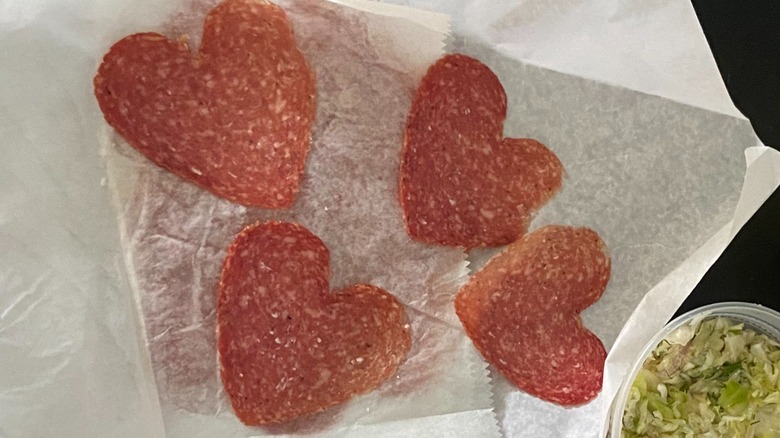
At the end of every summer, my brother and I throw a party on our rooftop, called Sequinox. We stop at Muncan with a bigger-than-usual budget for the party spread, aiming for a sort of Eastern European-Dionysian feast vibe. We order stacks of heart-shaped salami, slices of lamb proscuitto, and Podlaski cheese — whatever catches our eye. By the time the sun sets over Manhattan, the haul is spread across the roof, and we're surrounded by friends, their faces lit up under jury-rigged Christmas lights.
In a city obsessed with novelty, perpetually demolishing and rebranding, Muncan specializes in preservation. Every time I walk through the door, I get the feeling that something worth keeping has managed to endure. For almost 50 years, Muncan has fed the people of Ridgewood — and I'm so, so grateful to be one of them.