

What Target Does With Unsold Food Products
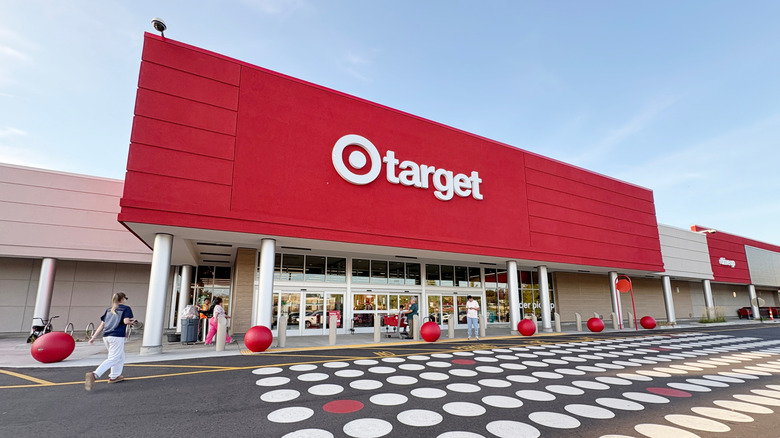
The food system in the United States supports hundreds of millions of people, but it remains appallingly inefficient. According to the U.S. Department of Agriculture (USDA), one in seven American households experiences food insecurity, while nearly 30% of the entire food supply remains unsold or uneaten (per ReFED). While some states have introduced legislation to prevent food waste, it's often left up to businesses to decide how they handle unsold food products. Target is one of the country's largest supermarket chains and grocery retailers, so it's fair to question how it aims to reduce its food waste and what it does with unsold items.
At the national level, Target works with food donation organizations like Feeding America to divert unsold food from the landfill into the hands of those experiencing food insecurity. Some stores also partner with organizations at the local level and donate items to community food banks (which are seeing a huge spike in demand as a result of SNAP cuts). In 2024, the company says it donated the equivalent of 134 million meals.
Target's food donation efforts are part of a larger goal to completely eliminate waste within the business. This doesn't necessarily mean every morsel of unsold food will be eaten, but the aim is to recycle food waste that can't be donated to prevent it from ending up in landfills. However, while the company certainly appears to be moving in the right direction, employee accounts suggest the results can vary from store to store, raising questions about how consistently those goals are put into practice.
Why some unsold food still goes to waste
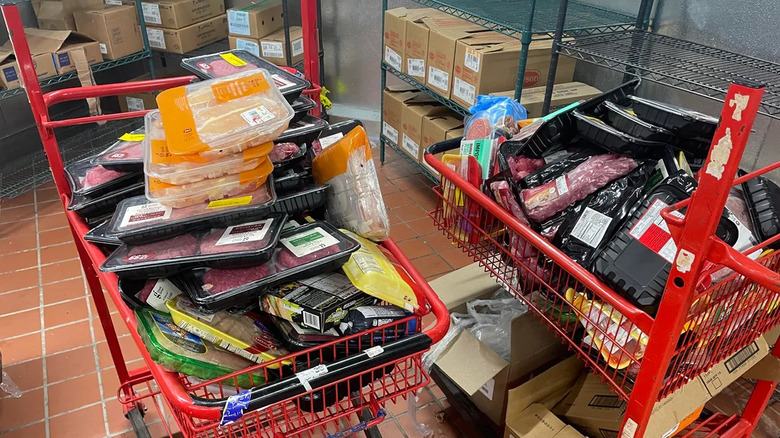
While Target's donation programs have managed to redistribute millions of pounds of food, some locations seem to be more successful than others. On sites like Reddit, some employees laud their stores' efforts to reduce food waste, while others claim to have seen huge amounts of food end up in the trash.
It seems that there are a few different factors that impact how an individual Target store deals with unsold food items. For example, one Redditor notes that some stores have a "cold donate" area for storing temperature-sensitive products until a local charity can collect them, but others don't. If the food can't be kept safe, it has to be thrown out. Similarly, another user recalled a time when their store's coolers malfunctioned, but the local food bank refused to take the unsellable food — this may have been due to food safety concerns, or simply that the food bank didn't have a way to collect or transport the items. Additionally, some states have better-established food bank networks than others, with regulations that more effectively support donations.
Food safety rules can also limit what retailers are able to donate. Products with damaged packaging, uncertain storage histories, or insufficient shelf life might be deemed unsuitable for redistribution even if they appear perfectly edible. In these cases, stores may have little choice but to dispose of the items. Finally, there's the human factor to consider — some Target managers might simply find it easier to toss food out than to go through the effort of sorting and donating it.