

There's Magnum, Then There's The Party-Sized Wine Bottle Named After A Biblical King
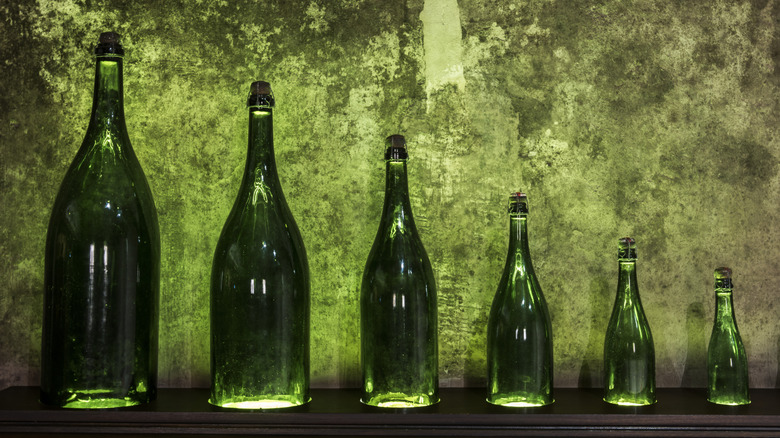
Most wine enthusiasts are familiar with the standard 750-milliliter bottle, and many know of the magnum, a jumbo-sized bottle that holds twice the usual amount, as well. A standard bottle contains around five glasses of wine (perhaps fewer if the pourer is feeling generous), meaning a magnum is good for about 10 servings. But when you really want to ensure there's enough vino to go around, you may want to bust out the jeroboam.
In the wine world, a jeroboam is considered the next step up from a magnum, but the exact size can vary. When used for Champagne, a jeroboam holds three liters (four times the amount of a standard bottle) and is sometimes referred to as a "double magnum." However, in the French winemaking region of Bordeaux, a jeroboam holds a whopping four and a half liters — a smart choice for a sizeable dinner party. That said, while a jeroboam will certainly make an impression on guests, the convenience and "wow" factor aren't the only reasons why big wine bottles are popular.
Some wine collectors prefer larger bottles because they supposedly age more gracefully than smaller ones. With less oxygen trapped inside the bottle compared to the volume of liquid, the wine matures more gradually, helping to preserve its character over a longer period of time. The name "Jeroboam" is particularly interesting, considering most of our wine terminology comes from Latin, French, or Italian. In this case, it actually comes from the eponymous figure described in the biblical Old Testament — one who seemingly had very little connection to wine.
Why is a giant wine bottle called a Jeroboam?
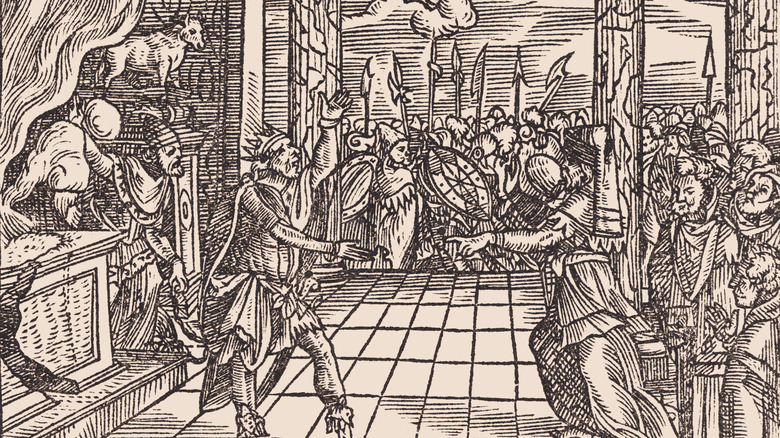
There are actually two Jeroboams in the Bible. The first ruled over the northern Kingdom of Israel for 22 years following the death of King Solomon. Despite being one of the more prominent Old Testament kings, he is viewed unfavorably for his spiritual apostasy. A few generations later, Jeroboam II ruled during a period of relative prosperity. Interestingly, some scholars believe there was only one Jeroboam who became two distinct figures over time. Two Jeroboams or not, the real question is — what do either of them have to do with wine?
As far as we know: absolutely nothing. Historians have found very little evidence tying either King Jeroboam to the wine world. Some theories tie Jeroboam's religious impropriety to the sinful act of imbibing, while others believe the name evolved from an Old English term, "jorum," for a communal drinking vessel. However, the most likely answer reveals itself when we look at the naming convention for large wine bottles. Wine bottles come in many sizes, and a jeroboam is pretty small compared to the rest. The largest is known as a "melchizedek," another reference to a biblical character, and holds an incredible 30 liters of wine (or 40 standard bottles).
There are plenty of sizes in between, and most of them have one thing in common — they're named after legendary rulers or biblical figures from ancient times. It's still unclear who chose this method of naming wine bottles or why. Wine and history buffs have attempted to find connections between the bottle sizes and the rulers they're named after, but without much success. The likeliest answer is that winemakers wanted their grandiose bottles to have regal titles and turned to the history books for inspiration.