

Why Trader Joe's Was Once Sued Over Juice
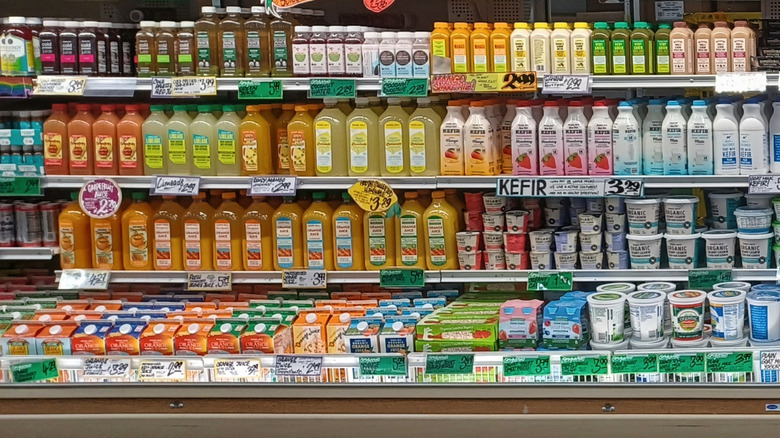
Nobody likes to overpay, but these days, it's hard not to feel that's happening too often. Whoever finalizes the prices at Trader Joe's knows this. Among grocery chains, TJ's has a general reputation of affordability, though, of course, shoppers will still often bump against economics in the cheese aisle, and who among us could've kept Two Buck Chuck at $2 in this economy? Back in 2022, a class action lawsuit alleged that TJ's wasn't just expensive — but intentionally overcharging customers for its cold-pressed green juice, by way of misleading packaging.
The lawsuit, filed to cover plaintiffs in 12 states, alleged that TJ's juices were more processed than advertised. The lawsuit argued that cold-pressing is taken to mean a single pressing of fruits and vegetables to juice, and nothing more. It was also argued that cold-pressing is inferred to mean minimal processing, and minimal processing was what justified its higher price. At the time, the cold-pressed green juice retailed at $3.39 for 15.2 ounces of juice. Trader Joe's, according to the plaintiffs, "sold more of the Product and at higher prices than it would have ... resulting in additional profits at the expense of consumers."
The case reached a federal judge in Illinois, who dismissed it. TJ's uses what is called hydrostatic pressure processing (HPP) to prep its cold-pressed juices. HPP is a water-based, high-pressure method for packaging perishables. Plaintiffs claimed this process was the problem. Yet, in the judge's opinion, Trader Joe's had been factually accurate. Its products undergo cold-pressing before HPP, and had (and still does) expressly declared on the juice packaging that it was processed.
What is hydrostatic pressure processing?
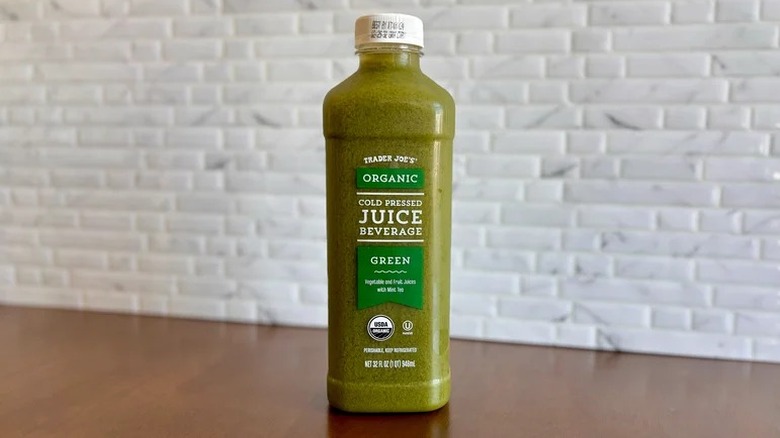
HPP is a pretty inventive industrial method. It's nonthermal and it doesn't involve preservatives. Instead, the packaged goods are put into a chamber where water is used to create intense amounts of hydrostatic pressure. Think of it like transporting a juice bottle to the bottom of the ocean. The pressure doesn't collapse the packaging, but the bacteria and pathogens inside and outside are zapped. After the pressure eliminates the ickies, the products are food safe and can be moved on to shipping. Some HPP methods use ambient temperature, but others use cold temperatures from 39 to 50 degrees Fahrenheit. It's unclear if Trader Joe's used the latter during the HPP of its cold-pressed green juice, but the packaging does say the juice is first made with a hydraulic — aka — cold press.
These days, the cold-pressed green juice from Trader Joe's sells for about $6 per 32 ounces. It's a top 10 juice according to our reviewers, mostly because it breaks the mold for what the chain offers (TJ's is heavy on the fruitier juice options, and this one has chard, cucumber, and parsley, to name a few). Although it finishes with a breath of mint tea, folks on Reddit have called it a "refreshing lawn" flavor. Sounds fresh.