

Ever Notice Fruit Tastes Sweeter When You Add Salt? Here's The Reason
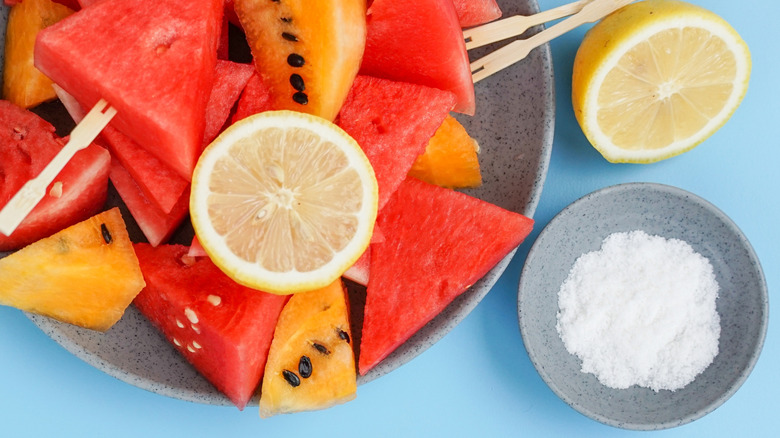
Have you ever watched someone sprinkle a piece of fruit with salt before eating it? It's one of those counter-intuitive tricks that folks love to share. You take something that is already sweet, add a bit of salt, and suddenly it (somehow) tastes even sweeter. While it may seem like it, this is not, in fact, magic. There's a bit of interesting science involved.
Even if you have never added salt directly to fruit, maybe you have tried a bite of prosciutto-wrapped cantaloupe or a grilled watermelon salad sprinkled with salty cotija. To get away from fruit, the experience of bacon served alongside syrupy pancakes or dark chocolate topped with coarse sea salt delivers the same effect. The easiest explanation has always been that these contrasting flavors play off one another, and this idea gets bandied about quite a bit. In truth, it is much more complex than that, with the salt enhancing your experience of sweetness through several different channels.
We will start with the simplest: Salt is a universal flavor enhancer. The more salt you use, the more it reduces our ability to taste sweetness while enhancing umami. At lower concentrations, however, it reduces our experience of bitterness while increasing sweet, sour, and umami flavors. When the bitterness receptors on your tongue are inhibited, many things are likely to taste a bit sweeter. But there is still more to it. Researchers have shown a clear physiological link between salt and sweet with one particular neurological pathway.
Salt unlocks its own sweetness pathway on the tongue

Sweetness is a universally adored flavor, and for good reason. Sweetness has always been an indicator of good, carbohydrate-rich foods. On our tongues, we have several types of receptors, each of them operating a little bit differently, and responsive to different sorts of flavors. The group that is responsible for detecting sweetness from both sugars and artificial sweeteners is known as T1R. When these receptors are exposed to sweet stimuli, they fire, sending the signals to our brains that give apple pie and ice cream that satisfying sugary flavor.
But what would happen if these receptors were in some way turned off? In theory, that would mean the affected party would no longer experience sweetness at all. As it turns out, however, there's another channel for experiencing sweetness that just requires a little bit of salt to unlock. Researchers working with mice genetically modified to remove the T1R receptors discovered that despite this impairment, the animals could still detect some types of sweeteners — but only if they were mixed with salt. A protein called sodium-glucose cotransporter 1 — SGLT1 for short — has been theorized to be at least one cause behind this phenomenon.
SGLT1 is an important protein in the intestines and kidneys, where it uses sodium to transport glucose into cells, providing them with energy. Studies have suggested that this same protein is working on some sweetness receptors on the tongue, causing the neurons to fire in instances when both glucose and salt are present.
The science of salt and glucose in plain language
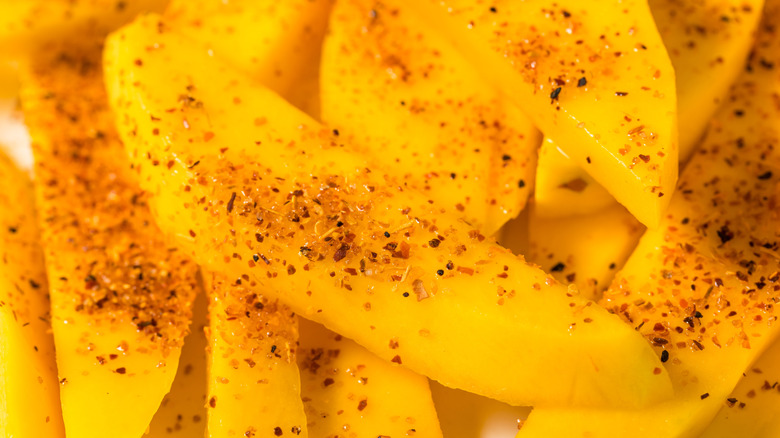
Alright, we know; that was a lot of science. In layman's terms, we can sum it up like this: Among the different pathways to experiencing sweetness that exist on all of our tongues, it appears that there is at least one — but perhaps more — that are specifically activated by the combination of sugar and salt. Interestingly, the studied pathways did not respond in the same way to artificial sweeteners, only natural sugar. Obviously, this research was done on mice, not humans, but it is believed that this may well be one of the reasons that a sprinkle of salt can sauce a piece of fruit to taste sweeter.
It may be hard to keep all that jargon and all those acronyms neatly organized in your brain until your next opportunity to offer someone a watermelon slice sprinkled with Tajín, but you don't need to remember it exactly — that's what the internet is for. But if you don't feel like bookmarking this article so that you can come back for a later explanation, the larger concept shouldn't be too hard to lock away. When you get a raised eyebrow from your partner as they watch you add a pinch of salt to your smoothie, you can just explain that science says that fruit needs a little salt to taste all its sweetness.