

Giada De Laurentiis' Concern About Pasta Made In The US Is Eye-Opening

There are so many types of pasta to be enjoyed all over the world, far beyond just fresh or dried. With over 350 known types of pasta, dried pasta is one of the easiest ways to try a plethora of shapes, as it has a much longer shelf life than fresh pasta and is simple to bring home and prepare. But not all dried pastas are created equally. Out of all the pasta tips we've learned from Giada De Laurentiis, her insights into pasta making might be the most informative. In a video on her Instagram, Italian-American chef Giada De Laurentiis speaks to the major differences between pasta extrusion in American versus Italy, and what risks the American versions may carry.
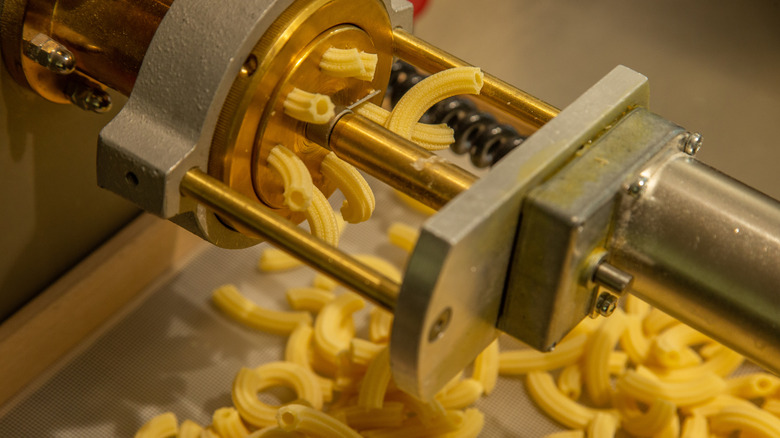
Dies are molds that pasta dough is extruded, or pushed, through to make specialty shapes of pasta via a machine. In Italy, pasta is traditionally extruded using dies made from bronze, while in the United States we mostly rely on plastic dies that are sometimes coated in Teflon. Plastic and Teflon aid the fresh pasta to slide out of the dies more quickly, allowing manufacturers to make a larger quantity of pasta in a shorter amount of time. This isn't great for the final product nor for our health, De Laurentiis alludes to, saying "the faster you push out dough, the hotter the dough has to be," and heat and plastic don't mix well.
Bronze is the superior metal for pasta extrusion
Teflon, which is simply the brand name for a the nonstick chemical coating known as PTFE (polytetrafluoroethylene), is part of the group of forever chemicals known as PFAS. Unfortunately for us humans, these forever chemicals cannot degrade in our environment, and simply linger, especially in our water supply, soil, and foods. According to the Environmental Protection Agency, exposure to PFAS is likely bad for our health, and can lead to increased cancer risk, hormone disruption, decreased fertility and other reproductive issues, and developmental delays in children.
Aside from the possible health risks of plastic dies, bronze dies are not only more traditional, but they are also one of the things that helps sauce cling to the pasta. Unlike plastic or dies coated in a nonstick material like Teflon, bronze dies produce a pasta that is a bit more porous and have a slightly more coarse, surface, which enables a sauce to better adhere to the pasta. Additionally, the lightly marred surface of the pasta allows more starch to be released into the pasta cooking water, which can add to the silkiness of your pasta sauce when added back into the sauce as it finishes.
In contrast, plastic or Teflon-coated extrusion dies produce more pasta in a shorter amount of time, however the pasta that's extruded from non-stick dies has a much smoother surface, meaning the pasta sauce won't cling as well to cooked pasta. Teflon die-extruded pasta can also have the potential to cook unevenly and become gummy, leading to an inferior dish.