

Why You Should Always Grill Tomahawk Steaks, According To Chef Aaron May

Given the often prohibitive price you pay for a tomahawk steak, you'll likely want to ensure that your cooking lives up to all the potential contained within the distinct-looking slab of beef. When it comes to the eternal battle between the grill and the pan, there is only one option for Food Network alumnus and chef Aaron May, who is resolute in his belief that a tomahawk steak is served best by the grill.
Fresh from the Guy Fieri Stagecoach Smokehouse at the 2026 Stagecoach Music Festival in California, May took the time to talk exclusively with Tasting Table about why the open flame is his choice when cooking tomahawk steak. "Grilling is about character," he explains. "Live fire gives that unmistakable depth of flavor that you simply cannot replicate in a pan." While the chef is diplomatic about the most popular methods for cooking steak, noting that a cast iron pan "gives you consistent, even cooking and is great for indoors," he maintains that grilling is the better option. "When it comes to something like a tomahawk, I'm going to grill every time," May adds.
A tomahawk steak is thick, heavy, richly flavored bone-in ribeye that's been trimmed (using a technique called "frenching") to resemble its namesake, and includes the ribeye cap, the eye of the ribeye, and the complexus. These elements inform May's preferred method of cooking. "The bone, the fat cap, the thickness — it all benefits from open flame and the char you can't get any other way," he says. "If I want the best of both worlds, I'll sometimes start on the grill for flavor and finish in cast iron with butter."
A good tomahawk steak needs patience and the right temperature
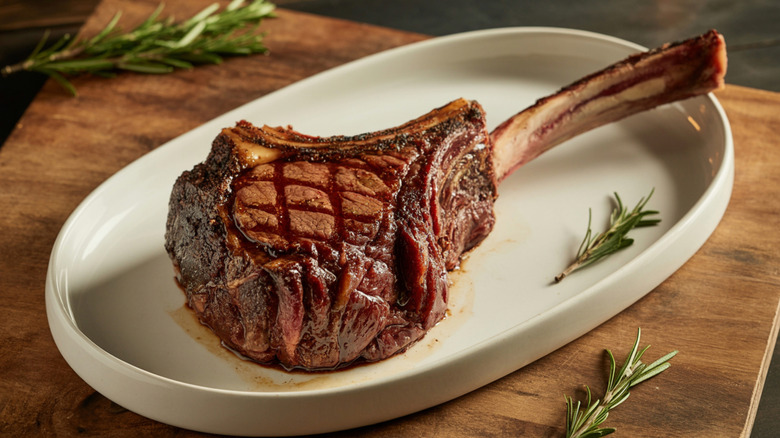
Other than a preference for the grill, May's other tips for cooking steak are simple but important. "I like to make sure the steak is perfectly dry and at room temp to take the chill off it," May explains. For those worried about food safety, rest assured that this isn't dangerous — according to the U.S. Department of Agriculture, food should not be left unrefrigerated for any longer than two hours to avoid bacteria. That goes down to a single hour if the temperature is above 90 degrees Fahrenheit. However, your steak should reach room temperature long before that.
When it comes to seasoning, May prefers a simpler approach. "You have to leave it alone [on the grill] long enough for the crust to form," he adds. "That patience is where most people mess up." Patience is also key once your now beautifully crusted tomahawk comes off the grill. "Not enough people rest their steaks — both before and after cooking," May notes. "After cooking you want to rest it, depending on size, to let the juices relax and thoroughly redistribute."
May's contention has scientific backing — the longer you allow a piece of cooked meat to rest after cooking, the more of its flavorful moisture will be locked inside. This keeps it juicy down to the last bite. Bear in mind, however, that size matters when it comes to resting. A 1.5-inch-thick steak will need roughly 10 minutes, but something like a prime rib could take over four times as long.