

Here's What Happened To A Filet-O-Fish After 3 Years In The Fridge, According To A McDonald's Customer 'Experiment'
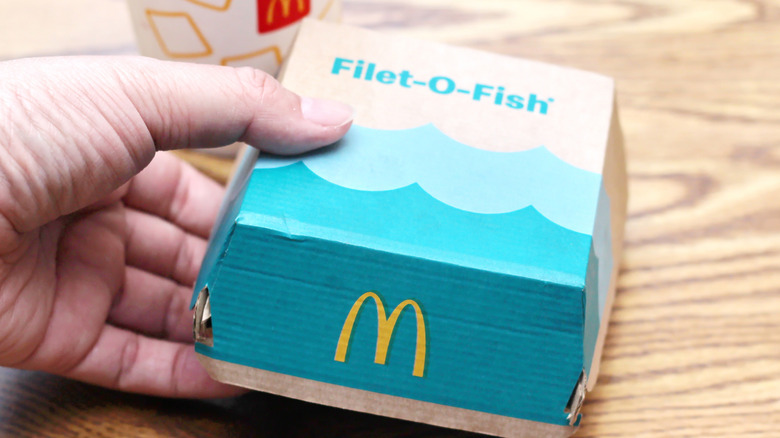
Most of us have heard at least one urban myth about fast food saying that it supposedly never goes bad, but one McDonald's customer decided to put that claim to the test by keeping a Filet-O-Fish in the fridge for three years. At first glance, in the photo (see below), this venerable sandwich does look to be in surprisingly good condition, although on closer inspection, "good" may be overselling it somewhat. While it certainly doesn't look its age, the sandwich appears noticeably dry with a crack running down the middle of its desiccated bun. Under a glob of congealed sauce, the patty itself also dried out, shrinking inside its once-crispy coating — certainly not the kind of Filet-O-Fish shrinkflation people usually complain about.
This aged Filet-O-Fish, possibly the oldest one in the world, was shown off in a Reddit thread, where its owner states, "It has effectively no mold and does not smell bad at all." They posted this and speculated on why it might be so, wondering, "How many chemicals are in the food to enable it to last this long without going bad."
Most of the commentary around this was, understandably, from grossed-out people saying to just throw it out, and one commenter laughing at the "immortal" Filet-O-Fish. There was also an angry McDonald's assistant manager who instructed the poster to, "Go put a piece of bread in your fridge and it won't mold either." More serious commenters argued that food additives were nothing to do with this, with one pointing out, "The low temp plus lack of virtually all moisture means mold/bacteria will have a hard/impossible time growing." Meanwhile, because this is the internet, others were poking fun at using "chemicals" as a scare word, leaving comments like, "I googled it and my whole body is actually chemicals! This has gone too far."
Why does fast food survive so well?
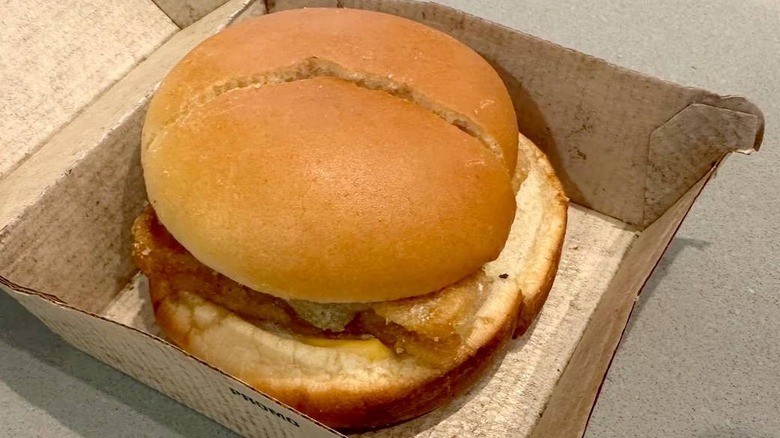
It is true that while it may not look too appetizing, this 3-year-old Filet-O-Fish is in undeniably in good condition. Like some kind of twisted collectible, it was kept in its original packaging, which looks arguably in worse shape than the burger itself. Perhaps most surprisingly, though, this sandwich is relatively young compared to some others.
One man in Iceland kept a McDonald's cheeseburger for over a decade, while a group of friends in Australia held onto a Quarter Pounder for over 30 years. Older still is a Twinkie, which has been kept at a high school in Maine for over half a century. By some metrics, that makes it an actual antique. While these geriatric foods are certainly no longer edible, they also survive the ravages of time remarkably well.
"It's about moisture," as one Reddit commenter said, calling it "a piece of Filet-O-Fish jerky." McDonald's claims not to use preservatives in its beef patties, though it reportedly does put them in the buns, to stop things going bad in storage. But what matters is the water — mold and bacteria just can't grow without it. McDonald's itself has even posted online to bust the chemicals myth, saying that its burgers will simply dehydrate rather than decompose if left in a dry environment. Any burger, even a homemade one, will dry out this way without molding. We really can't recommend trying it for yourself, though.