

Real Philadelphians Eat Cheesesteaks Covered In One Iconic Cheese (Not Cheez Whiz Or Provolone)
We may receive a commission on purchases made from links.
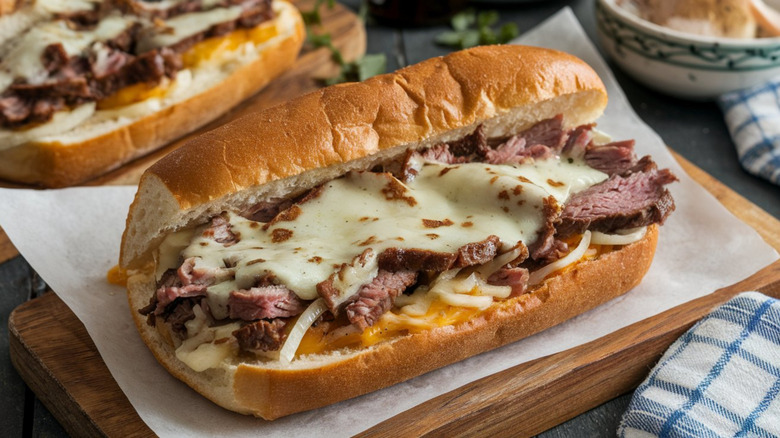
If there's one thing Philadelphians love almost as much as Philly cheesesteaks, it's arguing about cheesesteaks – what constitutes a great one, what renders one inauthentic, and what ingredients are vital or verboten. Like Bologna with its profoundly strict interpretation of ragu alla Bolognese or New Jersey's defiant attachment to a sloppy Joe entirely unlike what the rest of America recognizes as a sloppy Joe, certain foods inspire combative opinions in the places that birthed them — and Philadelphia's favorite sandwich is no exception. One abiding controversy is what precisely puts the cheese in cheesesteak, and for some, there is only one answer – Cooper Sharp.
First, the basics: The cheesesteak is an elegant amalgamation of beef, cheese, bread, and onions (but not, as many Philadelphians will be happy to explain to you, bell peppers). The cheesesteak has its origins in 1930, when Italian-American hot dog vendor Pat Olivieri decided to try something new. Per National Geographic, after Olivieri grilled some beef scraps and onions and stuffed it into a hot dog bun, a nearby cabdriver ordered one as well. After consuming it, the customer suggested that Olivieri "forget 'bout those hot dogs, you should sell these." This may have been the first and the last time two Philadelphians agreed about the sandwich that would become the cheesesteak.
The cheese would be added some years later, after Olivieri opened his own restaurant, and its manager 'Cocky Joe' Lorenzo decided to add provolone to the sandwich. Since then, the argument over what cheese to employ has been one of the many simmering controversies surrounding the cheesesteak. While many favor Cheez Whiz, a strong contingent argues it must be Cooper Sharp, a pasteurized, processed cheese that, like most American cheese, melts beautifully without splitting while maintaining its titular sharp taste.
How Cooper Sharp came to be associated with Philly cheesesteaks
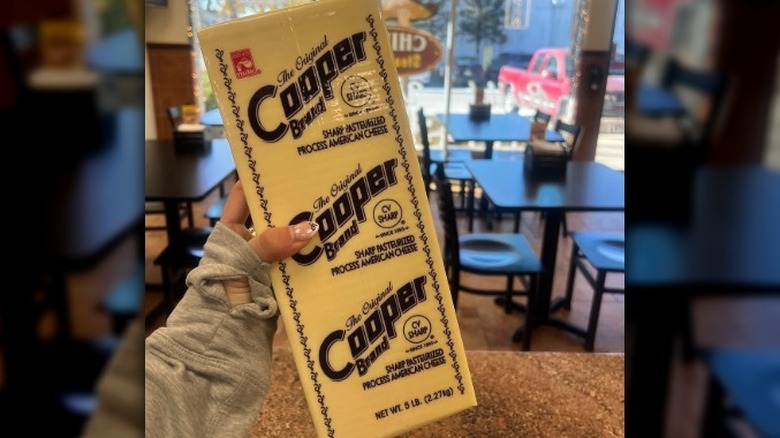
Founded in 1893 by former New York banker I.C. Cooper, Cooper Cheese's association with Philadelphia began after the company moved to Pennsylvania in 1918. Despite this long-standing history, Cooper's connection with Philly cheesesteaks is a relatively recent development. The broad consensus is that the use of Cooper Sharp in cheesesteaks was popularized in the 2010s by South Philly institution Angelo's Pizzeria – known for its enormous cheesesteaks and the equally huge lines that stretch around the block to purchase them — though it is far from the only eatery to offer the cheese. Cooper devotees argue that, while it melts like standard American cheese, it brings a better, more complex flavor profile. As one Reddit user put it, "It's still American cheese, but it's American cheese turned up quite a bit."
If you find yourself hankering for a Cooper smothered cheesesteak and cannot make it to the City of Brotherly Love, but can lay your hands on some of this prized regional cheese (you'll find Cooper Sharp on Amazon in various weights), the company suggests its own method for making a Philly cheesesteak. The recipe calls for boneless top round or flank steak, reduced-sodium soy sauce, yellow onion, and a generous amount of Cooper Sharp White. After coating the thinly-sliced beef in the soy sauce, set aside, fry your onions in vegetable oil. After removing the onions, fry the beef on a high heat until the liquid is almost gone, then add the onions back to the pan. Take the the pan off the heat, scatter torn slices of the cheese over the beef and onions, and stir. Finally, scoop it all into a hoagie roll and enjoy. Of course, what kind of roll should be used for a cheesesteak is another debate entirely, but we'll leave that one for now.