

T-Bone Vs Porterhouse: Which Steak Cut Is More Affordable?
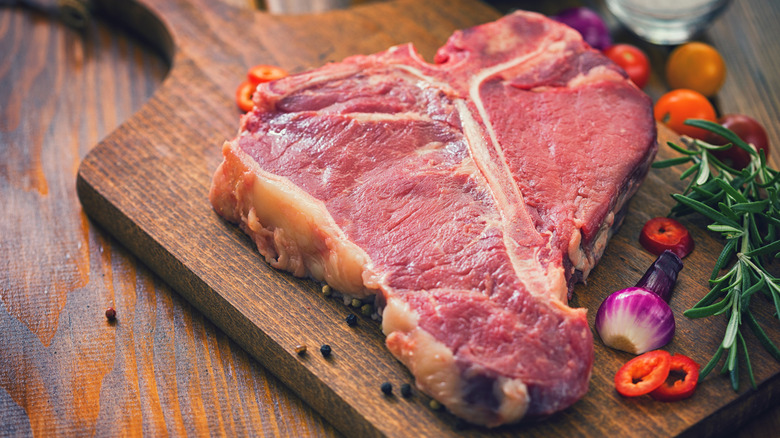
Sure, they cost a pretty penny, but when you can get yourself a plate of either T-bone or porterhouse, you know dinner's going to be the bomb. These two cuts represent the upper echelon of beef — aside from their huge size and the dramatic T-shaped bone running down the middle, few other steak cuts can match the buttery flavor and melt-in-your-mouth texture that they offer. If you're planning a steak dinner at home on a budget, though, you'll want to crunch the numbers and see what's going to give you better value per pound.
Despite the numbers being surprisingly close, there's an actual winner: T-bone. According to the USDA's quarterly National Grass Fed Beef Report, porterhouse steaks (nationwide) run $21 to $42 a pound as of March 2026, while T-bones go for $18.46 to $40. That's roughly a $2-a-pound savings if you go with T-bone.
If you're only serving a special someone or one or two friends, the difference might not be much. But if you're buying enough beef to feed a family? T-bone will edge out on its larger cousin on pure economics and will let you get quality steaks sans the overspending.
Where you shop for steak matters (and so does the grade)
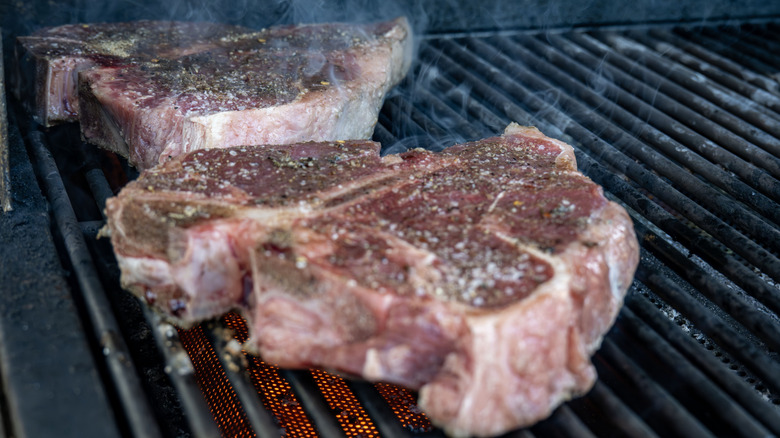
You might have noticed that the USDA puts the price on a scale instead of fixing it to a precise number. The reason is simple: the price will differ depending on where you buy it, as well as the beef grade. If you're in NYC and buy from Lobel's of New York, for instance, an 18-ounce cut of USDA Prime porterhouse steak is $94.95 (USDA Prime T-bone goes for $84.95 per 18-ounce cut). But down south in the cattle capital of the U.S., Texas, a USDA Prime porterhouse of roughly the same weight only goes for $36.99 from Longhorn Market in Austin, while a USDA Prime T-bone goes for a cool $27.99. Lots of things affect the regional pricing of beef — supply and demand, transportation, processing and labor cost, and dozens of other factors. So, before you buy, it'll be smart to do some fast market research and see how much beef goes for in your state.
Beyond geography, the USDA grade itself can make dramatic price swings. Take that same Longhorn Market porterhouse: drop from Prime to Choice, and you'll save $13 ($36.99 to $23.99). T-bone sees similar savings — $27.99 for Prime, $19.99 for Choice. You'll see these price hikes across grades at every butcher shop, no matter where you're located.
Here's the wrinkle: a Prime T-bone in this case costs more than a Choice porterhouse. If you're hunting for "the most value for the price" rather than just the lowest sticker, T-bones might not be the answer here.
The best value steak cut comes down to your personal taste
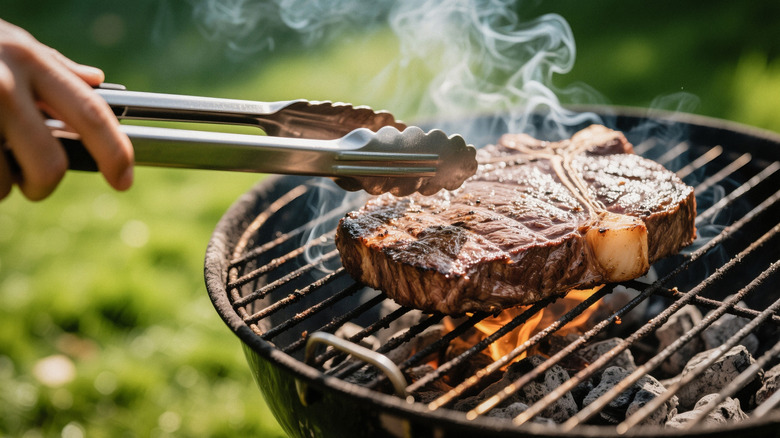
Both porterhouse and T-bones are sourced from the short loin — a premium section of the cow that doesn't work as hard as the rest of its body, so the meat here is naturally very tender. Both feature a T-shaped bone running through them, separating the New York strip on one side from the filet mignon on the other. Visually, they look almost identical — but there's one crucial distinction that separates their tasting experience (and their prices).
The porterhouse is cut from further back along the short loin, where the tenderloin has grown significantly thicker. Per USDA standards, a porterhouse's tenderloin must measure at least 1.25 inches across — a T-bone needs just 0.5 inches. This seemingly small difference makes all the, well — difference. More filet means more of the most prized (and expensive) muscle on the animal, so you'll get a more tender bite with a porterhouse than a T-bone.
But tenderness isn't the only thing that matters, as any steak enthusiast will tell you. The marbling is where the true flavor of a steak sits — and that's where USDA grades come into play. A Prime T-bone, while not as tender, will be far more juicy and flavorful than a Choice-grade porterhouse. So if maximum flavor is your priority, go Prime T-bone. If you want tenderness and size, a Choice-grade porterhouse will do the job — assuming you cook it well.