

Why You Should Always Give Your Cucumbers A Good Scrubbing
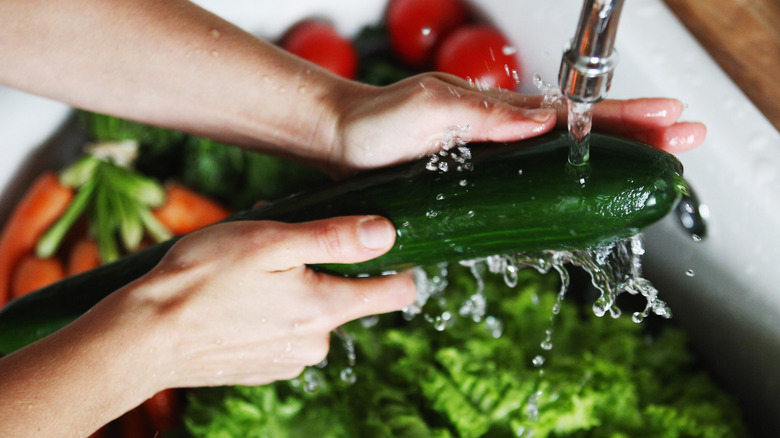
Americans have an appetite for cucumbers. Much of our taste for them is satisfied through pickles, but in 2023, our average consumption of fresh cucumbers still weighed close to 8.5 pounds per person per year (via Statista). However, as the domestic industry shrinks, more cucumbers than ever are being imported (primarily from Mexico). Many of today's fresh cucumbers are international travelers, but they pack light, wearing only a waxy coating where they go. The wax layer applied to cucumbers is designed to replace a natural protection that often gets washed off during processing; it assures that a perishable product can make it from garden to grocery without spoiling, shriveling, or otherwise losing its formidability. It doesn't lend an appealing texture or taste though, but fortunately, removing wax from cucumbers is an easy process.
If you've bought unwrapped, unbagged, conventional cucumbers, you can bet on having to de-wax them. The simplest way is to peel the skin off of your cucumbers. For those who prefer to keep this nutritious part on, scrubbing is necessary. For this, a mix of acid and abrasion are needed to de-wax. One of the best methods is to use a pinch of vinegar, a bit of baking soda, and a vegetable brush. Let your cucumber soak in a mixture of vinegar, water, and baking soda for around 10 minutes, and then scrub lightly. Alternatively, applying vinegar to a kitchen towel and rubbing the surface of your cucumber also works, but it can be messy and more labor intensive.
Food wax is for quality control, not necessarily food safety
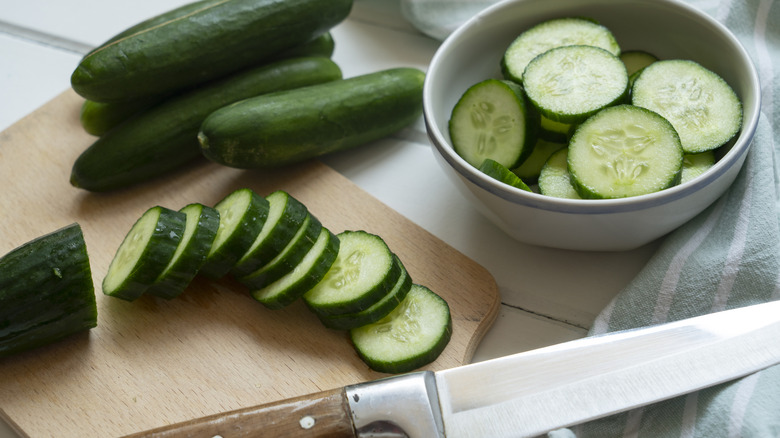
It's important to note that not all types of cucumbers are coated in synthetic wax. Large slicing cucumbers are the most common recipients, while cucumbers grown in greenhouses are more often plastic-wrapped or sold in polyurethane bags. Similarly, the type of wax used may vary. Conventional varieties may be covered in shellac, mineral oil, or petroleum-based wax; organic cucumbers are often coated in plant-based, non-synthetic wax made from things like carnauba, which is derived from tree leaves in Brazil.
In and of itself, food grade wax is Generally Recognized as Safe by the FDA, a categorization used to determine and signal to shoppers that small amounts are edible and not harmful to consume. However, this wax is applied to prevent cucumbers from losing moisture after harvest, processing, transportation, and storage, meaning it's a quality control measure, not a food safety one. A 2021 study in the Journal of Food Safety suggests that wax-covered cucumbers may actually be greater vectors for bacteria and salmonella, or may at least be more susceptible to transferring salmonella during processing. Thus, regardless of how safe the FDA believes this wax is to eat, removing it is a sensible decision before consuming.