

The Pricing Problem Behind Beyond Meat Disappearing From Shelves
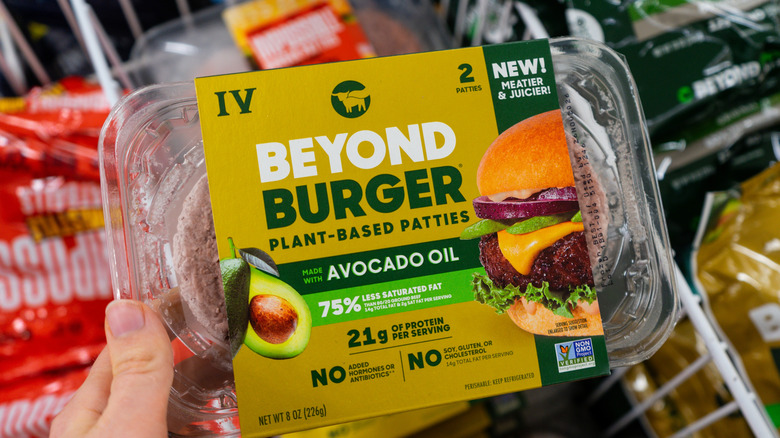
For a while before the pandemic, the world looked like it was on the precipice of a meat revolution. Beyond — formerly Beyond Meat — became publicly traded in May of 2019, to the tune of a $240 million IPO. The company's products were everywhere, from McDonald's to Del Taco, and of course, stocked on grocery shelves as far as the eye could see. Fast forward, and Beyond is now facing an uphill battle to maintain its presence in stores. Though there are deeper reasons why the value proposition lost its shine, the story of what happened to this Wall Street darling can be simplified to a pricing problem.
Meat alternatives had a few expectations on them when first released, one being that they would match the level of disruption that milk alternatives were able to create within the dairy industry. However, meat and its alternatives are not analogous. Take, for example, this snapshot from the middle of Beyond's current decline: In 2023, The Food Institute reported that milk alternatives had just a $0.31 price gap between conventional dairy options; meat alternatives, however, were almost $4.20 per pound more expensive than conventional stuff. For most of Beyond's existence, it has been sold as a premium product that costs even more than the premium-most versions of what it was intended to replace.
Inflation pushes consumer habits towards affordability. In a country like the U.S., this favors the heavily subsidized conventional meat industry. Theoretically, 2025 should have been a successful for Beyond — it was a year that the cost of real beef soared, while at the same time, the company dropped prices. Yet, in the third quarter of last year, Beyond still experienced over 10% decline in sales.
Why demand is sluggish
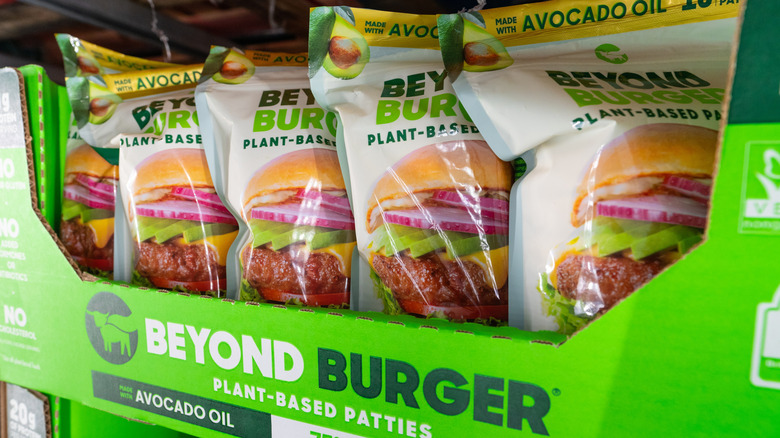
For a long time, consumers and producers had mismatched messaging about how to think of Beyond. That's had a significant impact on demand for its products. In Beyond's earliest stages, consumers were on the hunt for a plant-based alternative that allowed them to eat healthier than the alleged downsides of consuming animal meat. For Beyond, however, the first mission was less about nutrition and more about the environmental upsides to plant-based proteins. The company learned that Americans are rarely altruistic spenders; while the environmental impact resonated with vegans and vegetarians, neither segment of eaters are rapidly growing in that they can sustain hundreds of millions in sales.
Instead, the message which took off was that of Beyond being an ultra-processed product. Boasting a higher price tag for foods with less perceived nutritional upside has put Beyond in a difficult position. So, in 2024, Beyond struck "Meat" from its name and steered towards a clean label pivot. Fewer ingredients have yet to yield the expected turnaround, but in terms of price, things are changing.
A recent search of Walmart commodities tells an interesting story. At the time of publication, a pound of lean ground beef is 46.7¢ per ounce. Plant-based ground from Beyond, on the other hand, goes for 45.3¢ per ounce. The inverse in this case is promising, but there's room to go. In the chicken department, a bag of Tyson nuggets are nearly half as cheap per ounce as Beyond's alternative. All in all, plant-based meats have a ways to go before both quality and cost can undercut the conventional meat industry.