

Ube Vs Taro: What's The Difference?
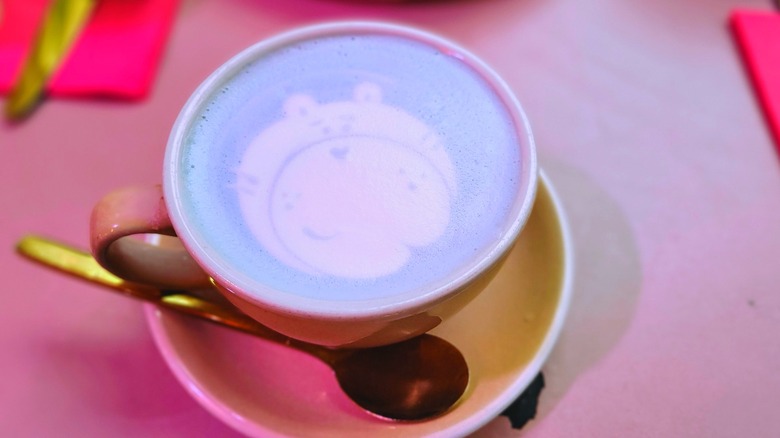
Sharing commonalities has its pros and cons. Actors who are often mistaken for one another, such as Margot Robbie and Jaime Pressly or Jessica Chastain and Bryce Dallas Howard probably have something to say on the subject. And if the two root vegetables ube (OO-beh) and taro (TAH-roh) could talk, they'd probably have something to say about it, too. With both experiencing their own Hollywood-level surge in popularity — due in no small part to their vibrantly purple, Instagram-worthy appearances — it's the perfect time to understand the similarities and differences between them (even though you're probably just here for the yum factor).
Though both are root vegetables, ube (Dioscorea alata) is a tuber in the Dioscoreaceae family, while taro (Colocasia esculenta) is considered a corm and belongs to the Araceae family. While both are indigenous to Southeast Asia and are important staples in the Philippines, ube has a stronger tie to Filipino culture exclusively, while taro is cultivated in many other regions including India, the Pacific Islands (especially Hawaii), the Caribbean Islands, West Africa, Egypt, and Greece .
While taro's been basking in the limelight for some time, primarily as a flavor of the popular and ubiquitous Taiwanese boba tea (aka bubble tea), ube is all the rage right now. As one Filipino TikToker, recently put it, "the world is obsessed with ube." Her motivation for making the video — to teach people that ube is, ". . . not just a flavor, it's tradition and ancestry."
Uses and availability
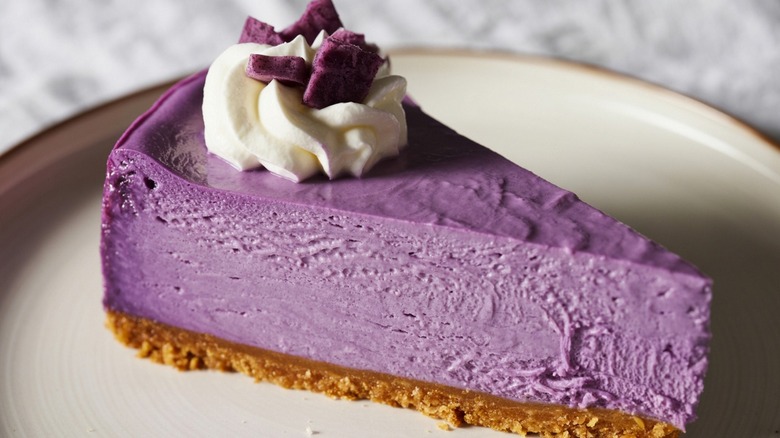
Sometimes referred to as purple yam, and not to be confused with purple sweet potatoes, ube is used in a litany of sweet treats including lattes, cheesecake, cookies, ice cream, pancakes, donuts; you name it. With even the likes of Taco Bell jumping on the ube dessert bandwagon, it's easy to think ube is just a fluffy fun food, but as the aforementioned TikToker points out, for some indigenous Filipinos it's an intrinsic part of their survival.
With its dark brown, knobby, bark-like exterior, the deep purple inside of the ube is soft once cooked. Its flavor is often described as sweet with hints of vanilla and nuttiness. One of the most common traditional dishes made from it is halaya. Once peeled and chopped, the vegetable is boiled, mashed, and simmered with condensed milk, butter, or coconut milk . Taro's rounder exterior is also dark brown, but with rings. The inside is white with purple flecks. It can also be used to make halaya and other sweet dishes, though its milder, earthier, less-sweet profile makes taro root more versatile than you might expect and suitable for savory dishes as well. Warning: Whichever one you're working with, treat them like a potato — they both contain toxins and neither is safe to consume raw.
Whole fresh ube can be difficult to find. In the U.S., Filipino and Asian grocery stores are your best option. If you can't find a whole one, experiment with a variety of ube derivatives such as ube extract, dehydrated powder, jam, or paste, which are sold by various online retailers.