

This Chicken Cut Is Better Than Breasts 'In Every Conceivable Way,' According To Alton Brown

Alton Brown has never been shy about declaring favorites, and when it comes to chicken, he makes his position very clear: "I cannot tell a lie, all I need is thigh. If I had but one critter to cook, it would be a chicken. And the reason I would cook that chicken is to get me a thigh." Maybe a little hyperbolic, but he has a point. Chicken breast became the darling of low-fat diet culture of the late 20th century, but a well-cooked thigh delivers rich, nuanced flavor, and only gets better with low-and-slow cooking.
As Brown puts it in a YouTube video, "unlike those bland lobes, thighs work for the money," and he means it literally; the distinction between the way the parts cook and taste, and the nutritional difference between white meat and dark, is explained anatomically. "Their musculature is aerobic in nature," he says, "so it's darker in color, and those muscles are sturdily connected to bone and joint. Much of that tissue can break down in cooking, becoming lip smacking juiciness that the breast can't even dream about."
That darker color comes from myoglobin, a protein that helps muscles store oxygen. Muscles that work harder and are built for endurance, like a chicken's legs, contain more of it. That means darker meat with more flavor, and a higher concentration of connective tissue that melts into silky, tasty gelatin during cooking. Breasts, meanwhile, are built for short bursts of motion, and industrial selective breeding for larger, faster growing parts has led to problems like woody breast, which is exactly what it sounds like. Overall, breast is lean, pale and doesn't contribute a lot flavor-wise, which is great if your culinary goal is counting calories, but for most other purposes, thighs win. As Brown argues, "chicken thighs taste like chicken, real chicken."
Thighs soar above breasts in popularity, price and performance
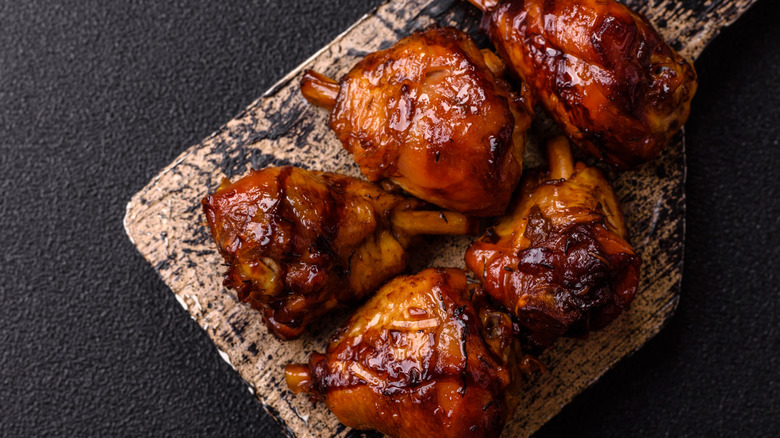
With Marry Me Chicken and its twists and variations going viral every other week, and thigh-price officially outpacing breast-cost for the first time in 2025, it seems like chicken thighs have definitively become desirable. But for decades in the United States, white meat carried the prestige. Parting chickens, and buying whole packages comprised of multiple of the same cut, became popular and widely available in the 1980s. Breast was the priciest, and the most purchased. It was milder, which can be important in certain recipes, like chicken cordon-bleu, where there other strongly flavored ingredients play a part. But most crucially, it had less fat, and was therefore easy to sell to a new cultural value system of the era that prioritized low-fat eating. Chicken breasts became the centerpiece of diet culture, crowning gym meal plans and endless salad-y lunches with sauce on the side. Thighs were tossed away, seen as an unhealthy, cheap cut.
But, over the last five to 10 years, cooks have remembered something fundamental: Fat and connective tissue are what give meat character, and the cheap, hard-working cuts, once denigrated as low-class, often taste the best. We've seen same thing happen with brisket, oxtail, and chicken wings; humble meats that became recipe and restaurant darlings once people rediscovered how wonderful they are. Where breast's proteins would seize up and dry out, thighs get tender, or as Brown says, "overcooked thighs are kind of hard to produce."
Brown shares his preferred technique for getting the most out of thighs, saying "of all the [chicken thigh] recipes I collected ... my favorites are all pounded flat. Not only does this process allow for the mechanical tenderization of the aforementioned tissues, it increases surface-to-mass ratio, so we've got more bird-part to brown."