

This Classic Italian Street Food Packs Tons Of Flavor Into Bite-Sized Balls
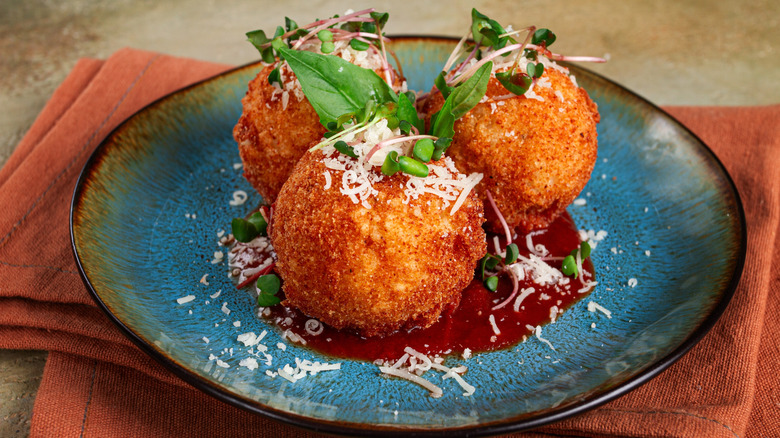
Take a thousand years of Sicilian history, the intermingling of culinary traditions, and a ferocious, still-ongoing linguistic dispute, roll them all into one bite-sized morsel, and the result is arancini. Though best known as an Italian street food, the endlessly versatile arancini works just as well as a canapé, bar snack, or as part of a full restaurant meal — a small dish that nevertheless contains multitudes.
Arancini at its simplest is a ball of cooked rice wrapped around a seemingly endless variety of fillings, then breaded and deep-fried to crispy, golden perfection. As with so many beloved foods, the origins of arancini are somewhat disputed, but a common belief is that its roots lie between the 9th and 11th centuries, when Sicily was under Islamic rule. During this period, Sicily was exposed to the influence of Arabic cuisine — in particular, rice as a staple and saffron as a seasoning. The Sicilian king and later Holy Roman Emperor Frederick II is said to have adored a casserole of rice and saffron, and one legend holds that the earliest arancini were an effort by his cooks to render the dish portable so it could be taken on hunting trips.
Over subsequent centuries, arancini would steadily absorb wider Italian influence — if there is a meat, vegetable, cheese, or seafood available in Italy, chances are it has been used as an arancini filling. When preparing it as home, arancini also offers a delicious opportunity to be thrifty — for example, by utilizing leftover risotto for the rice layer, or last night's Ragu Alla Bolognese for the filling.
Be careful what you call this beloved Sicilian snack
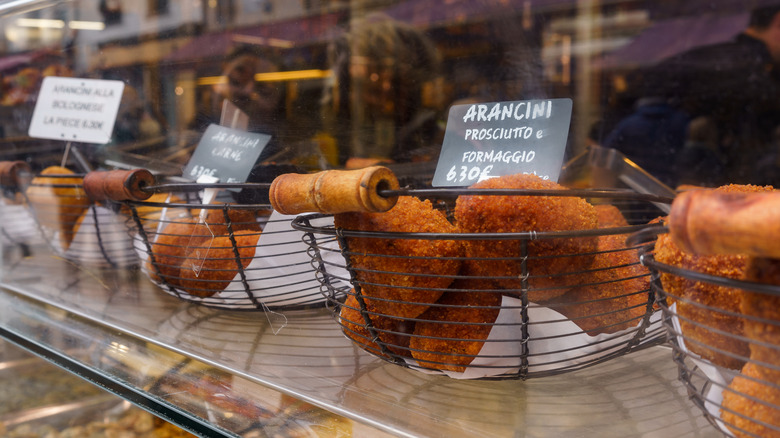
Though its popularity extends far beyond Sicily, any visitor to the island eager to sample arancini should be wary of the perennial debate over its name, the etymology of which lies in the laranja, a type of sweet orange brought to Sicily by the Portuguese in the late 15th century, which arancini can resemble in color and shape. Those who live in eastern Sicily refer to the delicacy as "arancini" (or "arancino" in singular), while those on the west favor "arancina" (or "arancine"). This hotly contested argument has long been a proxy for the rivalry between the Sicilian cities of Catania and Palermo (so if you find yourself in either, play it safe, and call it whatever the locals do). Thankfully, arancini unites more than it divides, as shown in 2019, when activists gathered at the docks of Catania to greet asylum-seekers who the Italian government had denied permission to disembark after being rescued from the Mediterranean, bringing plentiful arancini to welcome the new arrivals.
If you are unable to visit Sicily but would still like to try arancini yourself, there are no shortage of recipes. Andrew Rea, author and host of YouTube's "Binging With Babish", offers three variations, filled with either pork ragu, bechamel, or the egg-plant based "alla Norma." A ragu filling is also favored by actor and "Searching For Italy" host Stanley Tucci — in his case, a blend of beef and pork, robustly flavored with red wine. The Roman chef and TV host Nadia Caterina Munno, better known to her followers as the "Pasta Queen", makes the very traditional addition of saffron to the rice, which Rea excludes, and Tucci diplomatically renders optional — an understandable allowance, given that it is the most expensive spice in the world.