

The Unusual Way Coffee Has Been Aged In Japan For Centuries

Generally, when we talk about coffee, emphasis is put on just how fresh everything is. Whether we are talking about coffee beans roasted that same day, or the science behind why freshly ground coffee tastes better, quality is typically equated with immediacy for that most popular caffeinated brew. As it turns out, however, aging coffee can have some really beneficial effects on the final product. And while the practice of snow-aging coffee may have come about in Japan for purely practical reasons, it does have some desirable effects on the beans.
The concept of snow aging is not unique to coffee, nor was it the first product to be stored this way. Rather, it was simply a logical response to the heavy snowfalls that happen in parts of Japan. For hundreds of years, people in Niigata Prefecture have been using the cold winters and deep precipitation as a simple means of food preservation, storing items like fruits and vegetables, grains, meat, sake, and, yes, coffee, in snow-covered rooms called yukimuro.
Snow, in the quantities received in that part of the world, is an excellent insulator. A thick layer around the structure ensures that the temperature inside stays close to freezing, regardless of what the weather is doing outside. But the other significant factor affecting foods stored in these rooms is the humidity, which is consistently upwards of 90%. Seemingly everything stored in this unique environment undergoes positive changes, but yakimuro coffee is an especially prized product that connoisseurs can't get enough of.
How snow aging affects coffee beans
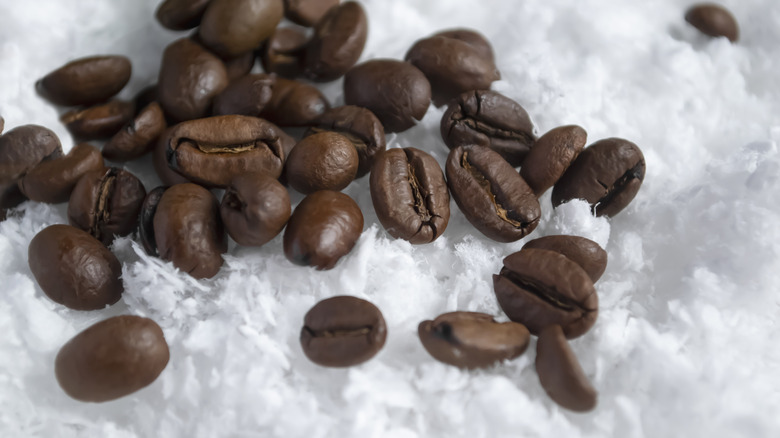
The long, slow aging beneath the snow has a profound effect on the beans. It softens the bitterness inherent to coffee, as well as improving the aroma. Aldehydes, which contribute harsh and unpleasant smells to coffee, disappear during the snow-aging process. But while these negative characteristics fade into the snow, the unique environment allows beneficial characteristics to remain, with the cold and humidity preserving the natural oils of the beans and suppressing oxidation. The result is a smooth, mellow, low-acidity brew with surprisingly rich depth and nuance.
As you might expect, given the relative unknown of this aging process, snow-aged coffee is not particularly easy to come by. It is certainly growing in popularity, but it is not something that you are likely to find on the shelves at your local grocery store anytime soon. For the truest experience, you probably need to book a ticket across the Pacific to really explore Japan's coffee shop culture. To maximize the frozen novelty effect, perhaps you could even order the snow-aged coffee served in a giant block of ice, as is sometimes offered during the height of summer in Japan. For those not inclined to shell out for a ticket to Japan — as exciting an adventure as it might be — there are a few retailers selling the coffee online. That said, they are all based in Japan, so this cup of joe doesn't come cheap by any means.