

A Historic Coastal Restaurant Is Alaska's Best Hidden Gem For Wild-Caught Seafood
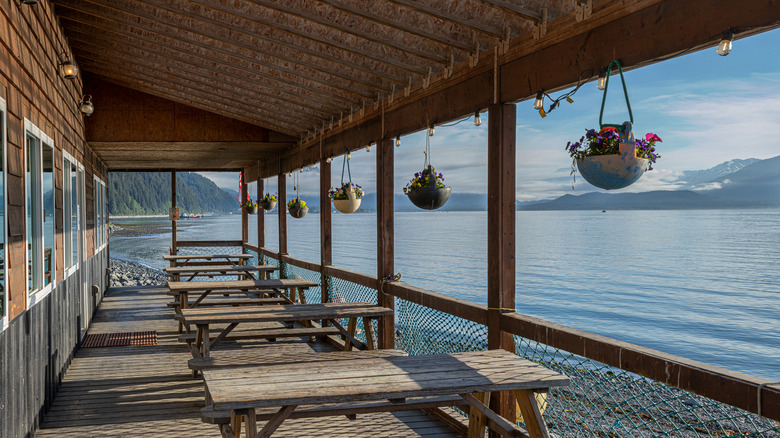
The Hangar on the Wharf is not just Juneau, Alaska's only waterfront restaurant, but a living testament to its history and the seafood industry upon which so much of the state — and, indeed, America — depends. If you want to taste wild-caught Alaskan seafood, Hangar on the Wharf is the place. Describing itself simply as "where the locals go," the restaurant is located in a former aircraft hangar for local floatplane operators, which patrons can still see flying through the Alaskan skies.
Though prospective customers should be warned that the restaurant is often crowded, this popularity speaks to the quality of the fresh and wild-caught seafood it serves. "Got halibut chowder. Have been dreaming about it since," wrote Yelp user Kassi G. in one recent review, while other patrons speak rhapsodically of not just the food, but the glorious view of Alaskan waters from which the restaurant's bounty comes.
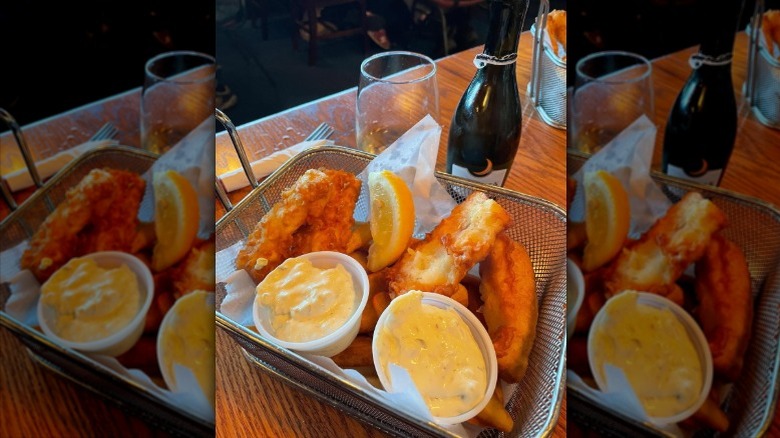
Halibut features prominently among the Hangar's favorites, with its menu boasting halibut fish tacos, tempura halibut and chips, baked halibut, halibut piccata, and even a halibut burger. Also on offer are oysters on the half shell, a smoked salmon spread made in-house, linguine with clams, grapefruit and orange-glazed salmon, a chowder of the day served in either a cup or bread bowl, and a Cajun-style jambalaya topped with sautéed prawns.
Should you not be in the mood for seafood, however, the Hangar also offers extensive alternatives, including classics like Cobb salad, chicken fried steak, and Cuban sandwiches, plus lunch specials like the always popular eggs Benedict, or the sweet, savory Monte Cristo.
The Hangar on the Wharf is a piece of Alaskan history
The Hangar on the Wharf reflects both Alaska's history and present. The more than 23,000 captains and crew of Alaska's seafood industry are responsible for harvesting almost 5 billion pounds of wild seafood per year, an output worth over $15 billion annually (via The National Provisioner). This may yet rise, as figures published by Alaska Seafood in 2025 indicated 31% of millennials and 28% of Gen Z had increased the amount of seafood in their diets over the preceding two years, compared to 25% of those surveyed overall. Alaska supplies over 60% of the wild seafood in the United States, as well as 99% of wild salmon (via the Alaska Seafood Marketing Institute).
The converted hangar that houses the restaurant, rebuilt in 1940 following a fire, was originally used for washing, refueling, and repairing floatplanes. These important aircraft are equipped with pontoons that allow them to take off or land on water, which have, since the 1900s, become vital for traversing the vast and rugged Alaskan wilderness, as well as transporting goods to remote and otherwise inaccessible parts of the state. The floatplanes, which made their berth in Juneau's hangar, would later be amalgamated into Alaska Airlines, which has its own unique history with seafood.
In 1987, an Alaska Airlines plane was delayed at Juneau after it suffered a midair collision with a salmon that a bald eagle had dropped. One Alaska Airlines customer service manager commented at the time: "Over the years, we've had planes hit various critters — moose, deer, every kind of bird. But that's a first for a fish."