

The Cost Of A Carton Of Eggs In 1990 Has Our Wallets Weeping
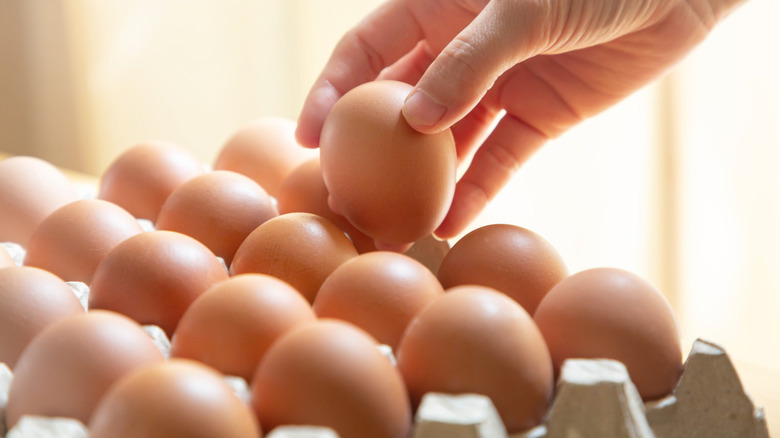
It's strange to think that something as simple as eggs has become a source of controversy, but looking back on the egg prices in the 1990s helps you understand where people are coming from. While the furor has died off a bit as prices have come back down to Earth, for years, the price of eggs has been a major economic talking point.
As post-pandemic food inflation strained people's wallets, egg prices hit almost $5 per dozen in 2023, and even went above that in 2025. While there is a lot to talk about around why eggs have gotten so much more expensive, it's hard to focus when you realize that same carton of eggs was less than $1.25 in 1990.
Now, obviously, part of that is just normal inflation. One dollar in 1990 would be the equivalent of roughly $2.46 today, compared to a normal person's wages. In February 2025, they were $5.90 on average, the equivalent of $2.40 in 1990, or roughly $1.40 more than what they actually cost. The most recent data from December 2025 has current prices for a carton of one dozen large grade A eggs (not AA) at an average of $2.72. That's not terrible, all things considered, but eggs have also historically been much more stable in price than they've been recently.
How were eggs so inexpensive in 1990?
What's perhaps ironic about the increasingly erratic price of eggs is that it's mostly a direct result of the reason eggs were so cheap to begin with. Egg prices were quite stable month-to-month up until the 2000s, but since the 2010s, price spikes have become more common.
That's because of bird flu. While food inflation has pushed the price of everything up, eggs have jumped in price more because recent outbreaks of bird flu have devastated the population of egg-laying chickens in the U.S. When the flu, also called H5N1, hits a flock, farms must kill all the chickens in response to keep it from spreading. In the most recent outbreak, that meant the country lost 158 million chickens, which led to a 25% decline in population overall. That's a big negative supply shock at the same time egg demand was at record highs.
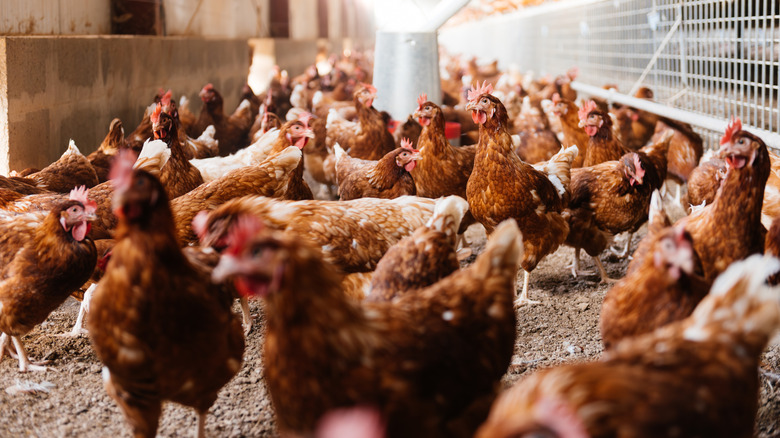
What does that have to do with the cheap eggs of the 90s? Factory farming. Egg production used to be spread out over thousands of family farms, but by the 1960s, most were being produced on factory farms. Over time, those farms got bigger, and many now house hundreds of thousands of birds at once. That industrialization of the process made eggs into a cheap commodity, but cramming more and more chickens into larger farms has also made bird flu outbreaks worse, adding to rising costs.