

How Much Coffee Does A Single Coffee Tree Produce? It's Much Less Than You'd Think
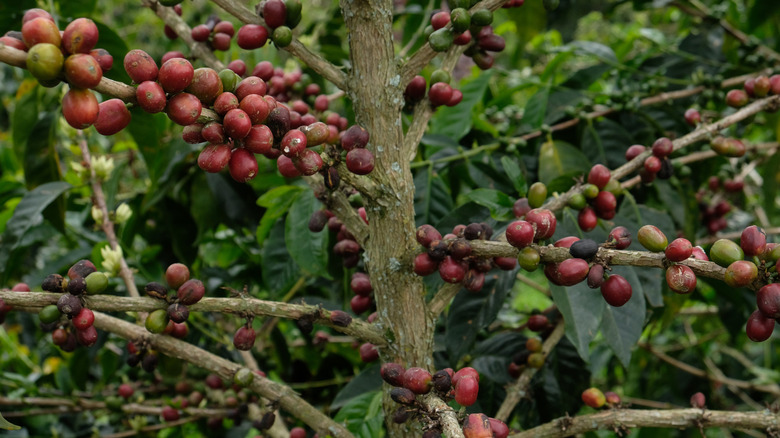
The deeper you dive into coffee cultivation, the more surprises you find. For one, did you know that coffee plants produce caffeine as a natural insecticide? In addition to warding off unwanted buzzes, that caffeine gives welcome morning and afternoon buzzes to approximately 1 billion coffee drinkers worldwide making coffee one of the Top 10 traded commodities on earth. So it may come as another surprise that in a year, a single coffee tree only produces enough fruit to make about a pound of roasted beans. Perk up and let's get to the roots of what goes into that pound.
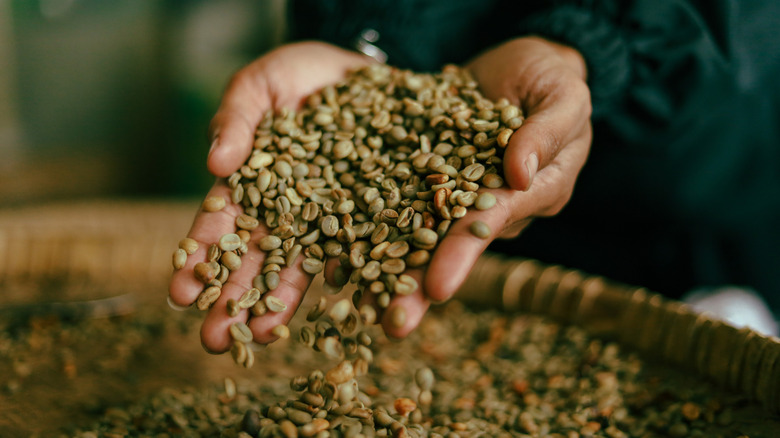
Coffee beans are actually seeds that form in fruits that are often about the size and color of cherries. After taking several years to mature, coffee trees produce around 2,000 cherries a year. With two seeds per cherry, that's about 4,000 raw coffee beans per harvest season. Once roasted, that yields around 1 pound of ready-to-grind beans.
Each year, farmers produce around 170 million 60 kilogram bags of green Arabica and Robusta coffee beans, according to the United Stated Department of Agriculture. Those 60 kilo bags are an industry trading standard and not what you'd typically see at the store. That works out to about 10.2 billion pounds of raw beans. Because coffee can lose about 15% of its weight when roasted, a back-of-the-napkin accounting means we're looking at around 8.7 billion pounds of roasted coffee beans from hardworking trees and farmers each year.
Farm to cup
Coffee plants grow well in the tropical Coffee Belt, also known as the Bean Belt, where a lack of frost, abundant rainfall and high elevations converge to create ideal growing conditions. Coffee plants can grow up to 50 feet tall, but farmers usually prune them to 5 to 7 feet so they're easier to manage. Pruning also helps generate new branches, improve air circulation, and expose more of the tree to sunlight.
There are more than 100 species of coffee, and many coffee brands, but farmers mainly focus on just two kinds of beans — Arabica and Robusta. About 70% of the coffee consumed in the world is arabica because it is generally considered better-tasting, but it is also harder to grow and more expensive. Robusta contains more caffeine than Arabica and is easier to grow because it's more resistant to disease and can better handle poor soil. It is also more bitter and fetches a lower price, although weather patterns can cause Robusta coffee prices to spike.
While there are large mechanical coffee harvesters, they can't always be used because of the lay of the land on some farms. Also they strip cherries off the trees in bulk, while people picking cherries by hand can select the ripe ones and leave others to mature. Most harvesting work is still done by hand on small farms rather than large plantations. Once harvested, cherries are sent to mills to remove the beans that are ultimately roasted and sold to consumers — often by the pound.