

Perfect Your Meatloaf's Texture For Good With Help From One Common Appliance
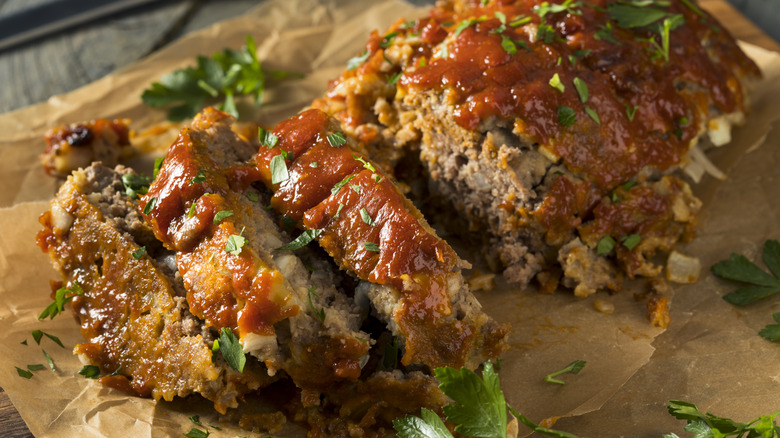
All these rich, savory flavors and your classic meatloaf still won't be complete until you have nailed the texture. Instead of crumbly or soggy forkfuls, what it should have is a cohesive density to hold the dish up through the whole meal while still tender and moist enough that every bite feels like it is melting on the tip of your tongue. This sounds like it would take a lot of work, but in actuality, there is an easy shortcut you can take, starting with a stand mixer. One of the absolute worst mistakes you can make with meatloaf is overmixing the ingredients, which results in a clumpy, paste-like chunk of meat that becomes rubbery once baked. Then there is also the issue of applying just the right amount of pressure each time you knead. Of course, it can be easy to lose track when you are in the midst of a multi-step process, and that is why the stand mixer is so helpful.
This kitchen appliance is designed specifically to combine ingredients with precise and consistent force. With lightning speed and very little effort on your end, it churns everything together in a well-controlled manner, ensuring the mixture is not overdone by accident. Furthermore, compared with hand-mixing, the stand mixer also reigns supreme thanks to its ability to distribute the pressure evenly so no part of your meatloaf turns out to be less cohesive than the rest. These elements are crucial to the release of the myosin proteins, which are broken down when the meat is ground and worked. Bound together and with other components, they develop a sticky mesh that holds your meatloaf together.
The intricacy of making meatloaf with a stand mixer
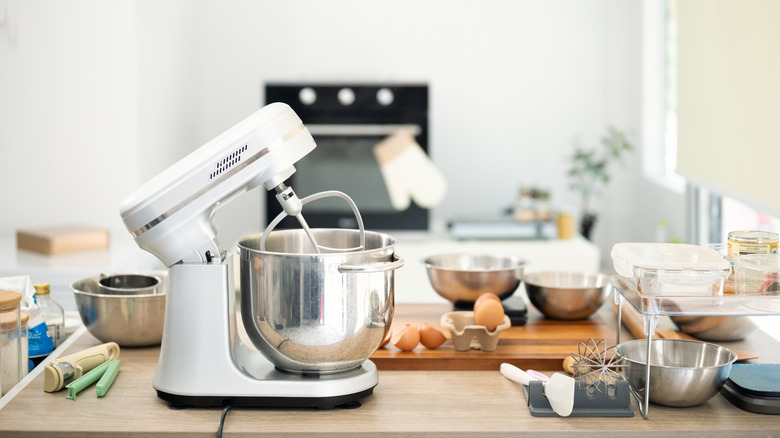
Even though a majority of the work is done by the stand mixer, it is still crucial that you use it the right way. The flat beater (also called the paddle) is a top-notch attachment for sorting through all the heavy, thick lumps of meat. On low speed (which are often speeds 1 and 2), go in with the dry ingredients first, then gradually work in liquids like sauces and milk for a smooth, easy blend. This should only take about 30 to 45 seconds. Once the mixture starts to get chunky and tacky, turn the machine off and move on to the next step.
For an even more seamless process, make sure the ingredients that go into your stand mixer are also properly prepared. The meat's fat content, undoubtedly, plays a vital role, and for this, 80/20 ground beef (80% lean meat mixed with 20% fat) is highly recommended for a moist, tender meatloaf. The binders are no less important. In combination with eggs and dairy, breadcrumbs are a common choice, but you can also experiment with oatmeal, crushed crackers, or cornflakes. Perhaps even soak the binders in milk to add more moisture, should the recipe call for it. The veggies, while not as frequently mentioned, should also be considered. No matter what you're using, you will want to finely chop them so they don't disrupt the smooth, tender texture with their own chunkiness. This is when you should move to another appliance, the food processor, for a faster meatloaf. A few pulses, and you will have veggie pieces that look like they were meticulously chopped.