

The Key Difference Between White And Yellow Onions When You Cook Them

It would be an understatement to say that onions are an essential kitchen staple. They are the aromatic foundation of countless dishes across cuisines, an ingredient that brings new levels of depth to quick stir-fries and simmering pasta sauces. But while there are many different types of onions, most home cooks tend to reach for whichever one is in their pantry. However, there is one key difference between two popular varieties that can change the way your dish turns out. Surprisingly, it comes down to texture.
When choosing whether to use white or yellow onions, you should think about the dish you're making. Yellow onions better retain their shape when cooked, meaning they're less likely to disintegrate. Although they will soften and become sweeter over time, they still have a complex, savory taste that won't completely disappear into the background. This makes them suited for dishes where you want the onions to have a presence, whether you're making fried onions, caramelized onions, braises, or certain stews and soups.
Meanwhile, white onions will break down and dissolve more easily, especially when cooked for a longer time. This makes them ideal for when you want the onions to help build flavor, like in sauces, stocks, stews, or soups. White onions are also sweeter than yellow onions, with a milder flavor that provides a good base for pickling and flash-cooked dishes like stir-fries. However, they still have a bright zing to them when raw, making them great in dips, salads, and as fresh toppings.
Texture is not the only difference
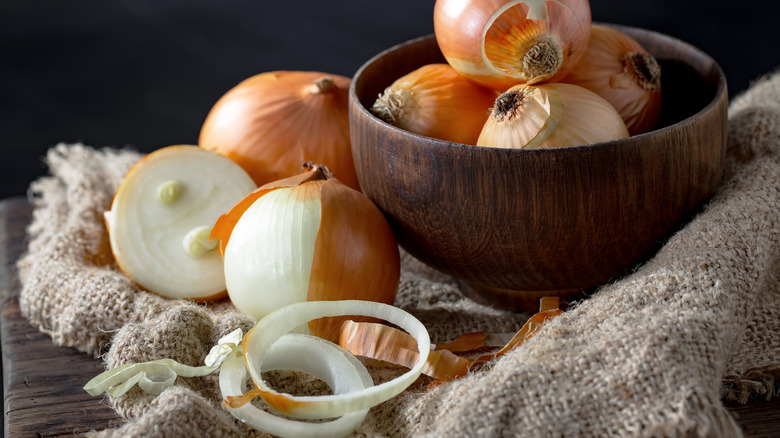
Beyond how they cook and taste, there are other differences between yellow and white onions. While raw white onions taste the same year-round, raw yellow onions taste slightly different depending on the season. If they haven't been stored for too long, they will taste sweeter in the summer and early fall as opposed to the winter, when their flavor becomes sharper. So even though yellow onions can be consumed raw, this combined with their more pungent aftertaste and the high sulfur content behind their strong flavor is another reason why most people find them better suited for cooking.
Another distinction is that yellow onions last longer in storage. According to the National Onion Association, white onions won't store for as long as other varieties given their compact cell structure. The organization also notes that yellow onions are the most popular, making up 87% of the U.S. onion crop, while white onions only make up about 5%. So odds are, you are more likely to have yellow onions on hand.
With that said, you can still swap yellow onions for white onions — or white for yellow — in most cooked dishes. However, if you need them raw onions and only have yellow, all you need to do is just rinse them in cold water to mellow out their flavor. So now that you know the main differences between yellow and white onions, learn about what you can do with other varieties by checking out our guide to cooking with every onion.