

What To Look For On Your Shiitake Mushrooms To Know They're The Best Option
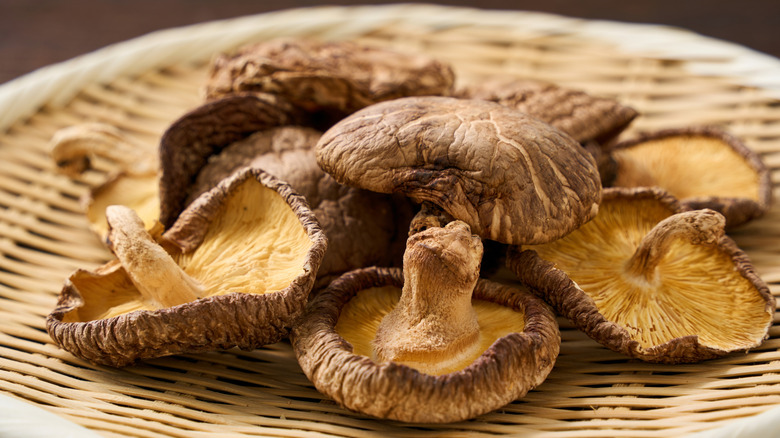
There are numerous types of mushrooms, each with unique flavor and texture characteristics. Shiitake mushrooms are from Asia, featuring a classic bulbous brown cap and a thinner, edible stem. Their meaty chew and deep umami flavor is a boon to many recipes you're sure to love, whether it's a conventional Asian stir fry or a creamy risotto. Of course, a successful shiitake recipe starts with the freshest mushrooms. So we've consulted Reyna Graves, the director of merchandising for Sprouts Farmers Market, to guide you through how to pick the freshest shiitake mushrooms at the supermarket.
Since shiitake mushrooms are often packaged in plastic-wrapped containers, a visual cue is your best bet for sussing out mushrooms at ideal freshness. "Mushrooms are at their peak when they are brown with consistent coloring of the cap and have cream-colored gills," says Graves. The cap should have a uniformly smooth-looking surface. You can also look at the shape of the mushroom cap; a fresh, young mushroom cap should be rounded and curved under at the edges instead of flat and unfurled. If you have the opportunity to feel shiitakes, tactile cues of freshness are a springy and firm texture for both the cap and the stem. Furthermore, shiitakes should be dry to the touch.
Just as there are signs of freshness, there are also signs of spoilage. According to Graves, a shiitake past its prime shows "signs of dark spots or gills, slimy patches, wrinkled or shriveled caps, too much moisture, and a sour scent."
Storing and preparing shiitake mushrooms
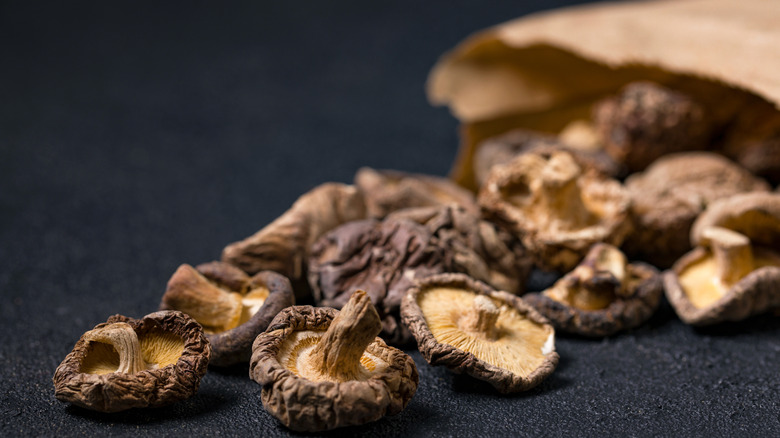
Mushrooms are a fairly delicate and perishable food. So, proper storage and preparation are key to ensuring the longest shelf life. Luckily, Graves has plenty of storage and prep tips to keep shiitakes fresh for as long as possible. Moisture is the catalyst for spoilage when it comes to mushrooms. "It's important to avoid moisture when storing shiitake mushrooms," she says. "We'd suggest storing those in a paper bag in the refrigerator for up to seven days. Make sure not to wash the mushrooms before storing them."
If you want to extend the shelf life of shiitakes even further, you'll need to cook and freeze them. Frozen, pre-cooked mushrooms will last between 6 to 12 months. "Another option," Graves points out, "is to dehydrate the mushrooms by storing them in an airtight jar in a cool, dark space." Dehydrated mushrooms have a concentrated flavor that'll bring a punch of umami to broths. They'll also rehydrate as they steep, making them a plump and meaty addition to a mushroom broth-based soup.
Of course, using mushrooms fresh from the market is ideal. Moisture is still a mushroom's enemy for cooking, as well. Consequently, Graves explains, "It's best practice to wash only right before cooking with mushrooms, and then pat dry immediately to avoid too much moisture." You might even want to use a damp paper towel to lightly wipe the dirt off shiitakes instead of running them under water as a more conservative way to clean the mushrooms.