

What Trader Joe's Does Better Than Whole Foods

We may receive a commission on purchases made from links.
While both Whole Foods and Trader Joe's have a reputation for high-quality, healthier food options, Trader Joe's offers a unique experience that attracts more of a cult following. A trip to Trader Joe's is actually something many of us look forward to, bringing its own special brand of joy. If you follow Trader Joe's social media pages and read the advertising flyer, you likely walk in the door at TJ's already excited about what's on the shelves this week. On the other hand, a trip to Whole Foods doesn't tend to incur the same type of excitement (except maybe to get a berry chantilly cake).
There are certainly some similarities. For example, you don't have to do a whole lot of label-reading at either store since both have a lot of healthy options. However, it's the differences between the two stores that create a different level of customer loyalty for Trader Joe's than Whole Foods. Overall, it's more welcoming, customer-focused, and has a less overwhelming shopping experience. Those concepts are expressed in various attributes. If you're curious about what Trader Joe's does better than Whole Foods, we have a whole list ready for you.
Trader Joe's employees provide a personal touch that Whole Foods doesn't have
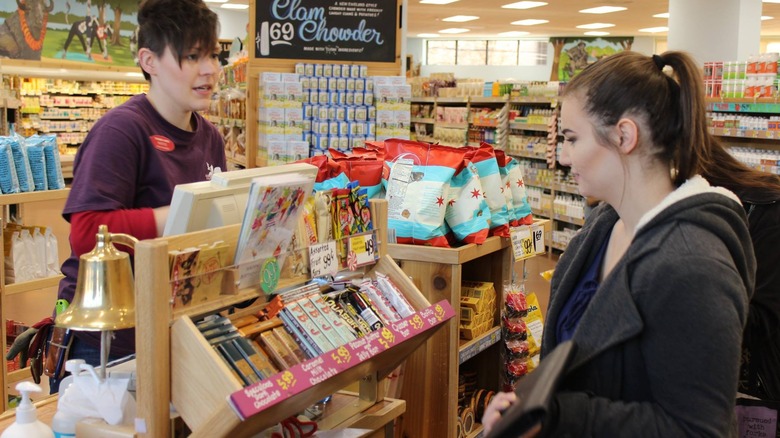
When you think about your experience at Trader Joe's, part of what makes it special is the personal touch that the employees provide. Meanwhile, you can easily go to Whole Foods dozens of times without clocking a single employee interaction or remembering them. While they may be friendly at both places, the TJ's experience tends to be next level.
Interactions with TJ's employees feel a bit like stepping into a locally-owned grocery store, where everyone is friendly and eager to help. When new hires go through Trader Joe's University, how to interact with customers is part of the training. The friendly banter at the checkout counter might catch you off guard if you're used to civil disinterest. The nice thing is that it's not from a script, like all those places that put you on the spot by disingenuously asking you what your plans are for the weekend. Instead, employees at TJ's are told to be themselves and be friendly.
Perhaps that ends up meaning they give you free flowers and chocolate when you've had a craptacular day. Or maybe they walk you across the store to find that one thing that eludes you, and it's without the disgruntled sigh you might get elsewhere. It helps that TJ's hires people with the right personality and positive attitudes, and it fosters loyalty by treating and paying its employees well, so that they like their jobs.
The whimsical art and quirky advertising at Trader Joe's is more inviting
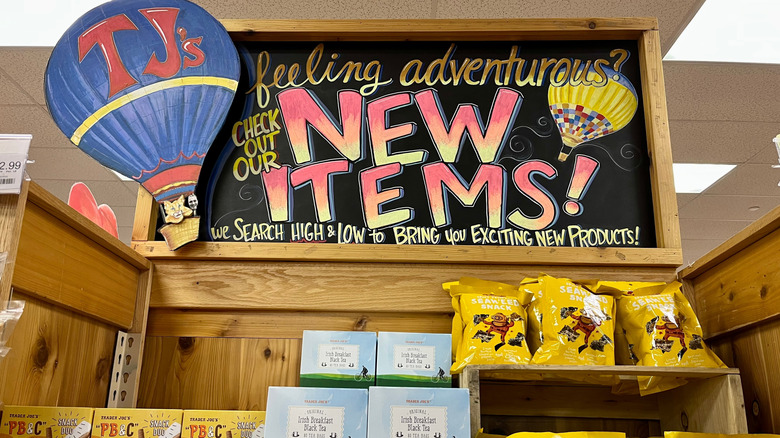
Part of a pleasurable in-person shopping experience is the aesthetics of the store and its advertising. Whole Foods is often more warm and inviting than utilitarian grocery stores with nothing but open boxes of food on display (we're looking at you, Aldi). However, Trader Joe's takes its decor to the next level and feels less industrial, while also having advertising that's fun to read.
When you look back at the history of Trader Joe's, the first store in Pasadena, California, pioneered the nautical theme that would continue as the chain expanded to play up the idea of a real Trader Joe. You still see the theme in the local stores with Hawaiian shirts and a ship's bell being used for in-store communication. However, even better are all the eye-catching hand-drawn art on the walls and whimsical signs you'll find throughout the store, created to match various themes and seasons. There's even a book called The Art of Trader Joe's, which explores everything from the art on product packaging and signage to the art in the Fearless Flyer.
Speaking of The Fearless Flyer, Trader Joe's is the only one to use an advertising newsletter, which first came out in 1969. To stay under budget, the original newsletter used non-copyrighted Victorian art from magazines and newspapers, and continues using this type of artwork today. The snarky writing style is engaging as well. Meanwhile, Whole Foods is over there with an ordinary online sales flyer website.
Trader Joe's has free samples on the floor, and you rarely see any at Whole Foods
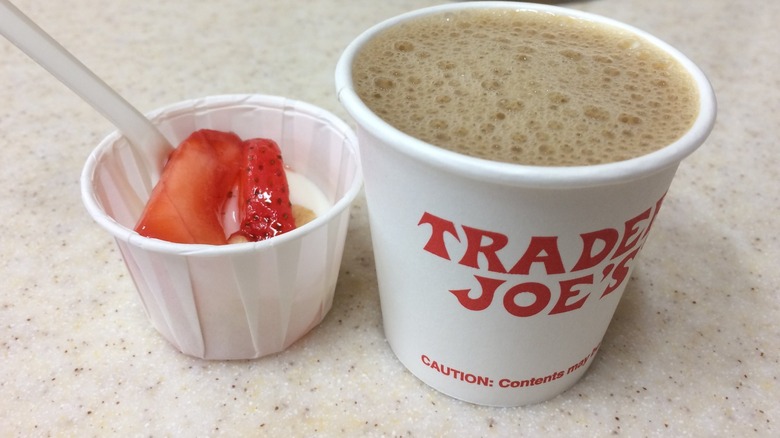
Both Trader Joe's and Whole Foods have a policy of allowing you to request a sample of almost any product they have, and both have floor samples. However, only the former still has floor samples regularly.
The sample station at Trader Joe's is often the first place people visit when they walk in the door. After the COVID-19 pandemic, sample stations were slow to return to stores, with some locations resurrecting the practice back in 2022 and others returning later. Unfortunately, you may not find the free coffee station that it once offered. You may, however, have to be strategic about when to visit to be most likely to find samples. They seem to be available more often during the store's busiest hours, when there are more employees available, and on the weekends.
Meanwhile, finding a free sample station at Whole Foods feels more like a novelty moment. One employee on social media guessed the reason the chain doesn't offer a lot of free samples anymore is that there just aren't enough employees to have someone dedicated to ensuring one person doesn't grab it all for a personal feast. Plus, it's time-consuming to create individual portions to ensure people are taking their fair share.
The only one with customer choice awards is Trader Joe's
Back in 2010, Trader Joe's started a January tradition of announcing its Customer Choice Awards winners. These come from asking customers to vote on their favorite products from the year. Whole Foods has nothing remotely close to letting customers express their product love.
At the time of writing, TJ's Customer Choice Awards have 11 categories, with a winner and four runners-up in each category. So, that's a total of 55 products that customers have indicated they love. There's an overall winner, and there are also categories for new items, beverages, cheese, produce, appetizers, breakfast and brunch items, lunch and dinner items, bath, body, and home items, snacks, and sweet treats. So, if you've been stuck in a rut buying the same thing every grocery trip, seeing the award winners can give you a good starting point for branching out to something new.
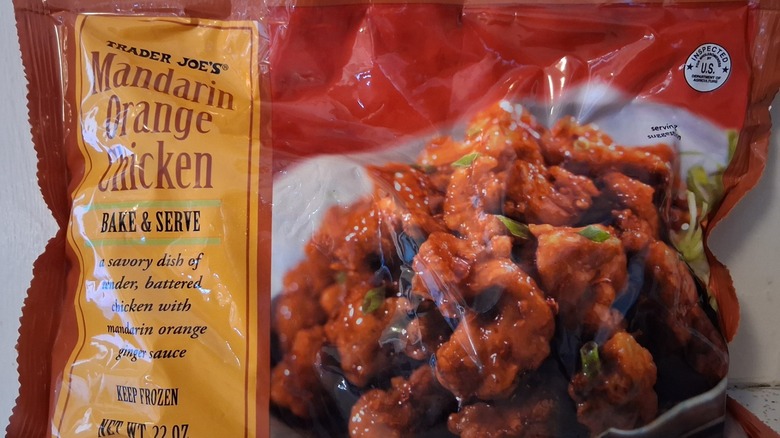
In 2023, TJ's decided to create a Product Hall of Fame to recognize products that have kept their status as a favorite over time. As a Hall of Fame member, they are no longer in the running for the yearly awards — out of fairness, of course. Those products include long-time favorites like chili and lime-flavored rolled corn tortilla chips, Mandarin orange chicken, dark chocolate peanut butter cups, peanut butter-filled pretzel nuggets, Unexpected cheddar cheese, and soy chorizo.
The prices are far better at Trader Joe's than Whole Foods

Trader Joe's is known for its reasonable prices, while Whole Foods is often known as "Whole Paycheck." Sure, you can find deals, but if you shopped with the same shopping list at both grocery stores for items you regularly get, you'd certainly spend more at Whole Foods.
Part of the strategy Joe Coulombe used when setting up Trader Joe's in the first place was about getting good deals for customers. Those deals translate into the lower prices you see throughout the store. Plus, Trader Joe's having its own label means that it doesn't have to pay for brand names or to advertise certain brands.
It's not difficult to spot the price differences between the prices at Whole Foods and Trader Joe's. Nearly everything we did a price comparison on between the two stores was more expensive at Whole Foods. For example, at the time we checked, organic sweet potatoes wer $0.55 more per pound at Whole Foods, and organic pasture-raised large brown eggs were $3 more at Whole Foods. While organic 85/15 ground beef was the same price, that seems to be the exception rather than the rule. And if you start looking at name-brand packaged items, the differences are even more pronounced.
Without multiple brands at Trader Joe's, there's less decision fatigue
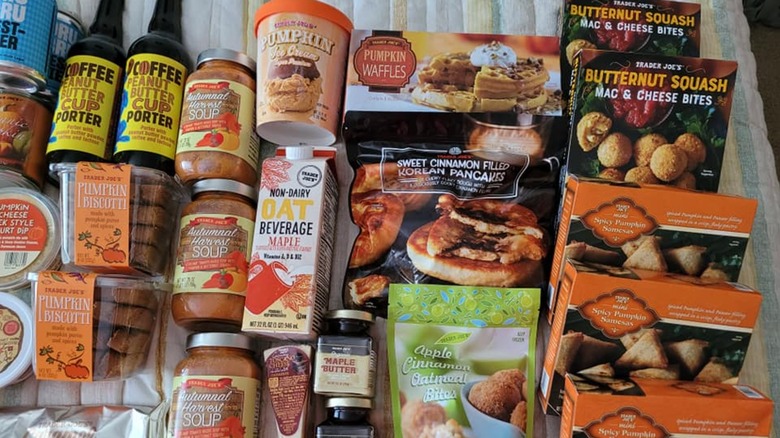
There's a lot to be said for going to a grocery store that causes less decision fatigue, especially at the end of a long day. These days, the majority of Trader Joe's products are private label, eliminating the need to choose between lots of brands. Meanwhile, Whole Foods still carries multiple brands of each item in addition to its 365 store brand. The simplicity of a TJ's shopping trip is part of the appeal.
TJ's can offer fewer brands because it has created products that customers have come to love enough to prefer over name brands, such as its dark chocolate version of peanut butter cups, which has become a Hall of Fame item. Having only one brand of most items means that, when you are looking for something like a can of beans, you don't have to decide between 12 different brands and price points; you just grab the can from the shelf. Sure, there are some decisions at TJ's, like which flavor you might prefer. However, it's nowhere near the level of decisions you have to make at other stores like Whole Foods.
When you're faced with an overload of choices, it's mentally exhausting. Thus, it becomes more difficult to make a good choice, maintain self-control, or sometimes to even make any choice at all. Beware, though; having a lack of decision fatigue might end up making you buy more at Trader Joe's, especially when you know everything is going to be good.
Trader Joe's smaller size allows lower-stress, quicker shopping trips
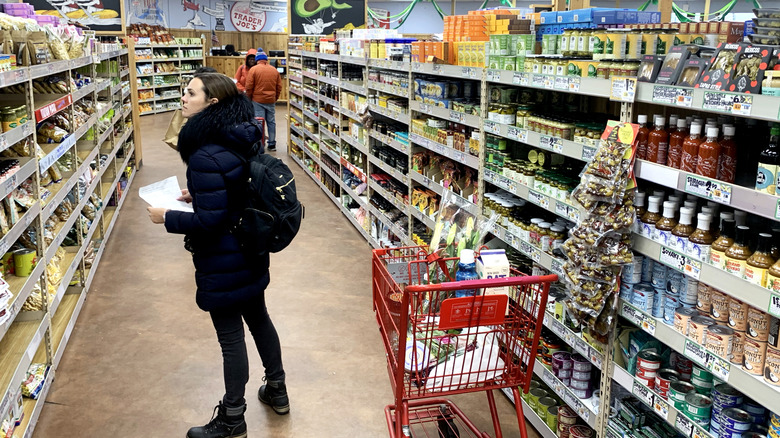
The size of the two stores tends to be quite a bit different, with Trader Joe's at its largest still being smaller than Whole Foods at its smallest. Usually at 25,000 to 50,000 square feet, Whole Foods comes closer to the average grocery store size (51,000 square feet). Meanwhile, with its stores only coming in at 10,000 to 15,000 square feet, Trader Joe's stores are much smaller.
There are a lot of advantages to a smaller store. One reason we've already mentioned is that a better-curated store without an overwhelming number of options eliminates decision fatigue. It's also great for getting in and finding what you need quickly, so that you can get out of the store faster with what you went in to buy. Smaller stores with targeted products are especially nice when you want to stop in for just a few ingredients for a specific meal after work, rather than stock up for the future. Plus, with a smaller format and a simple layout, finding that one elusive item is easier when you have fewer aisles to explore.
Both stores have delved into even smaller models in certain locations, like New York City, where shopping habits are different. The Whole Foods Market Daily Shop falls in the 7,000 to 14,000 square feet range, while Trader Joe's Pronto markets are only 2,800 square feet and more like a convenience store.
Primarily using its own label means everything on the shelf is a good bet at TJ's
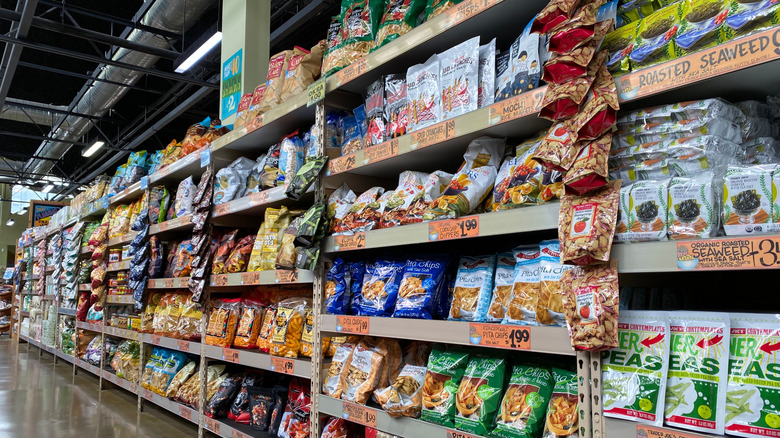
Trader Joe's first debuted its first private label item in 1972 and has never looked back. According to the Inside Trader Joe's podcast, the percentage of private label items is currently between 85% to 95%. It started out offering private labels for items that people weren't expecting to have a certain name brand, like granola. As TJ's started offering more private-label items, it tried out fun labels and a bit of humor to draw in customers. Meanwhile, at Whole Foods, the products are from a variety of brands.
At most grocery stores, when you see the private generic label, you know it's cheaper, but you also expect a lesser quality than the leading brand. However, customers have come to expect high-quality products under the Trader Joe's label, making it a major label in itself. Having mainly private-label items means that TJ's offers only the best-tasting products to keep its reputation intact.
At Trader Joe's, you know that you're getting a product that's high-quality, naturally-derived, and doesn't have artificial flavors or synthetic colors (among other things). While you know that you're getting natural products at Whole Foods, too, there's no guarantee that the random brand you pull off the shelf is going to be great because there are so many brands. So, with the prices often being higher at Whole Foods, it's a bigger gamble trying something new than trying something new at TJ's.
Trader Joe's culture encourages more of a cult fan base
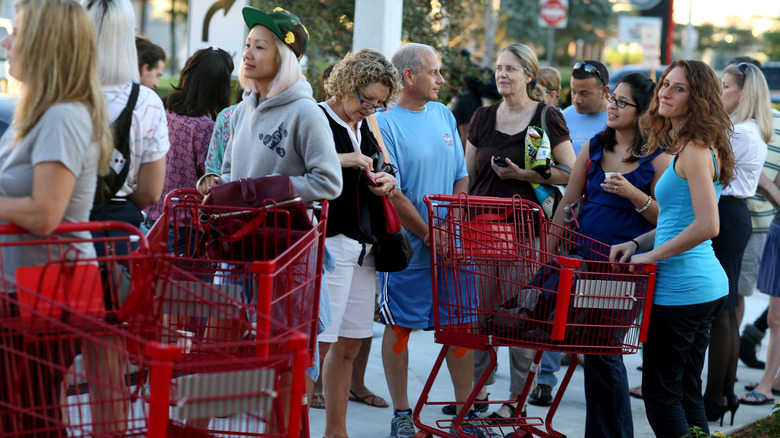
There are certainly diehard fans for both Trader Joe's and Whole Foods. However, TJ's encourages more of a cult following rather than simply loyal customers. When a new location opens, people are lined up and excited to go in, often having anticipated it for years.
Trader Joe's Reddit has close to 400,000 members, with customers gushing over their latest addictive finds. Meanwhile, the Whole Foods Reddit has a paltry 36,000 or so members, and the board seems to mainly be filled with complaints, especially from employees. Heading over to Facebook, you'll find dozens of Trader Joe's fan groups from obsessed shoppers, most with tens or hundreds of thousands of members. One group, Favorite Trader Joe's Product, has over 1.2 million members. Meanwhile, there are only a handful of Whole Foods fan groups on Facebook, with the most popular, Everything Vegan Whole Foods Market, only having 7,700 members. The same pattern follows on other social media outlets.
Fair warning: If you follow any of the social media groups for Trader Joe's, you'll be tempted constantly with everything from canvas tote bags to gingerbread ice cream sandwiches. Plus, there's always someone showcasing all the new must-have products. And you'll want to get in before they're gone because many new items are available for a limited time. As you can imagine, Trader Joe's fandom becomes sort of a mania once you get started.
There's no app or membership to wrangle at Trader Joe's
Last, but not least, there's no app or membership to wrangle at Trader Joe's like there is at Whole Foods. So, you get the same deals no matter what without having to whip out your phone or get frustrated with technology.
At Whole Foods, there's an app to skip the checkout lane for contactless payment. But do you really want to do all the work yourself and still pay higher prices? The app also includes Prime discounts and all the sales you have to keep track of. Plus, you can pay with your in-store code on the app. However, our writer has found that the code (and sometimes even a phone number) tends not to work more often than it does, leaving more frustration than convenience and often leading to leaving the store paying full price.
Meanwhile, at Trader Joe's, everything is simple. Yes, there's a shopping list on the TJ's website, but that's as fancy as it gets. The chain doesn't have to keep up with expensive app building and maintenance, and you don't have to keep up with when the store is having sales or wrangling codes. What you see on the price tags is exactly what you can expect to pay at the register. So, if you're tired of playing all the price and app reindeer games, you'll likely prefer Joe's. There's nothing technological to figure out with the carts either (like Whole Foods' Dash Carts), which also makes it more accessible to the less tech-savvy as well as those who just want to shop in peace.