

Overly Hot Water Might Be Ruining Your Tea. Here's Why
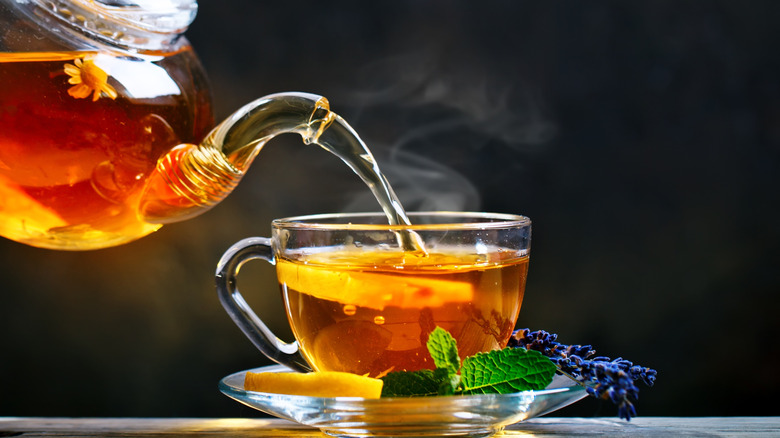
Here's a hot tip for tea: Temperature matters. If you're like many westerners, you may just bring water to a boil and pour it over bagged or loose-leaf tea, regardless of the variety. But it turns out that while boiling water may be the best temperature for brewing black tea, other types of tea require cooler water for the perfect pour.
During a discussion about tips for brewing the perfect tea, Jeannie Liu, founder and owner of Seattle tea shop Miro Tea, explained why overheating the water can be detrimental to your cup of tea. "Tea gets bitter because of over-extraction of its tannins, catechins, and caffeine," she shared.
Tea leaves contain all sorts of chemicals and nutrients that react differently to a range of temperatures. A general rule is lower temperatures for more delicate teas like green or white, and a higher temperature for more robust infusions, such as black tea. Herbal teas like chamomile or rooibos also like it hot.
The just-right tea temperature Goldilocks would be proud of
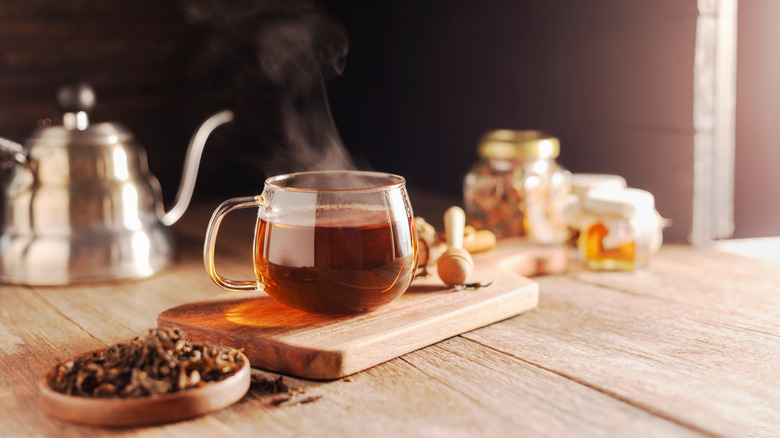
While exact tea-steeping temperatures vary slightly depending on which expert you consult, the ranges are similar. The young leaves and buds of white tea need 160 to 185 degrees Fahrenheit, while a good cup of green tea should be steeped at a similar 160 to 180 degrees Fahrenheit. Going up the heat scale, try 185 to 205 degrees Fahrenheit for oolong tea. You can go right up to 212 degrees Fahrenheit for black tea as well as herbal teas. Also, keep in mind that boiling water multiple times depletes it of oxygen, which can lead to less aroma and more astringency in any tea.
With such varying and precise temperatures for tea brewing, it can be helpful to have a temperature-controlled tea kettle. But if you don't have one, you can use a regular kitchen thermometer, or simply let boiling water cool for a bit before pouring it. You can also watch for the small bubbles that start to form around 160 degrees Fahrenheit, the "crab eyes" that are characteristic around 175 degrees Fahrenheit, and, of course, the common rolling boil that signifies a full 212 degrees Fahrenheit.