

10 Best Substitutions For Turmeric
We may receive a commission on purchases made from links.
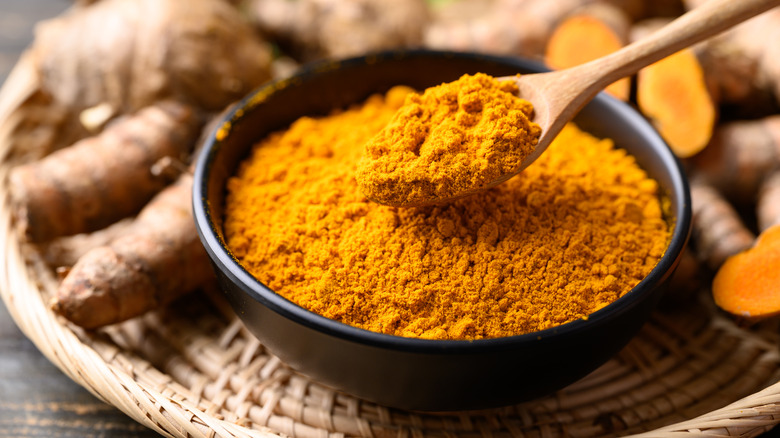
Cooking may be a lot of fun, but making last minute substitutions is definitely not. While we don't need to dig into why they're needed sometimes needed, it being prepared to deal with any unforeseen substitutions if (and when) they come up is a part of kitchen life. Now, some flavor substitutions are easier than others; for example, if you need to replace one licorice-like ingredient for another, there's licorice itself, fennel, anise, star anise, tarragon, and more. But what about something like turmeric, which plays such an indispensable role in Indian cuisine and other dishes?
Tumeric's flavor is hard to pin down, after all. It has assertively earthy and pepper notes, along with various undertones of nuttiness and citrus (and fresh and dried turmeric are somewhat different). Then there's the color, which is also part of the equation. Of course, if you remember the movie "Moneyball," you know when like-for-like replacements aren't available, you just need to assemble a team of substitutions that collectively get you close to the same result.
I fell in love with Indian food years ago, and started teaching myself how to cook it at home — often without the exact right ingredients. Learning to analyze and replicate those flavors served me well during my career as a chef, since cranking out hundreds of portions of Indian-style meals (in establishments that aren't built around that cuisine) is a challenge. Drawing on that experience, here are 10 substitutes that can help you create a reasonable approximation of turmeric's color and flavors.
Marigold petals
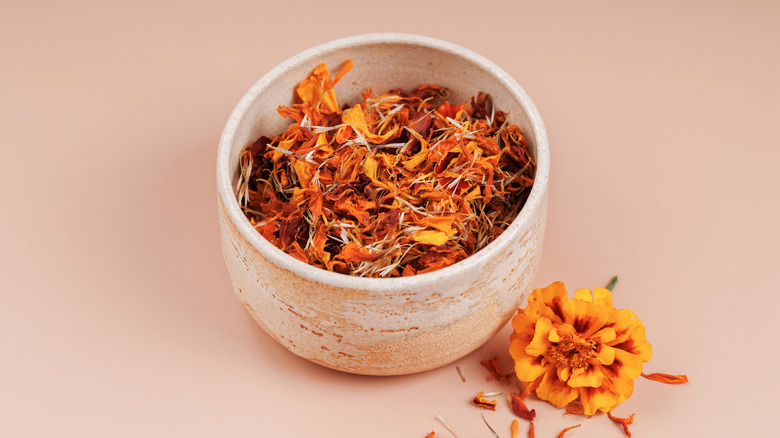
This is a substitute you can actually grow for yourself, though it's not a practical option for tonight's dinner, given the time involved. Still, dried marigold petals are a time-honored way of giving foods a bold yellow look (as turmeric or saffron will) but at a much lower cost. In fact, they're often fraudulently used to adulterate or stretch a quantity of saffron at a profit for the seller.
Now, you may have gathered that marigold is a coloring ingredient, not a flavoring ingredient, and you'd be right, as they have minimal flavor of their own. But the dried petals can be ground or crushed in a mortar and pestle, then either infused in liquid or simply added directly to your dish. Either way, they add the color you're looking for when turmeric isn't available, which means you don't need to consider that factor when selecting spices to replace the flavor notes.
Marigold petals are used widely in Latin cookery, so they're not hard to find if you live in an area with ethnic groceries. The only thing to be aware of is that you need to be careful with edible flowers in general, because they can be problematic for people with allergies. Also, if you grow marigolds and want to dry some for kitchen use, avoid spraying those blossoms (or anything nearby) with herbicides or pesticides.
Ground yellow mustard seed

For a lot of us, turmeric is mostly identified with Indian cookery, though it's used in a number of other Asian cultures, as well. It's also used in familiar products like plain ol' yellow mustard, which provides a familiar mustard-yellow (which is a bit of a misnomer). As it happens, mustard seed is also a common ingredient in Indian and Asian cooking (Nepal is the leading mustard grower, surprisingly, ahead of giants Russia and Canada), and it shares a lot of flavor notes with turmeric.
More than that, mustard seed packs a distinctive peppery note and some earthiness. Indian dishes may use black, brown, or yellow mustard seeds, depending how much of that pungent heat they're looking for (the darker, the hotter). As a turmeric substitute, you'd want to use the yellow kind and grind them finely, or just buy pre-ground yellow mustard powder.
Mustard is more assertive than turmeric, so use a light hand. A good rule is to look at the amount of turmeric the recipe calls for, and use half as much mustard. It's primarily a flavoring ingredient, but it will give your food a slightly yellow tinge, as well.
Cumin
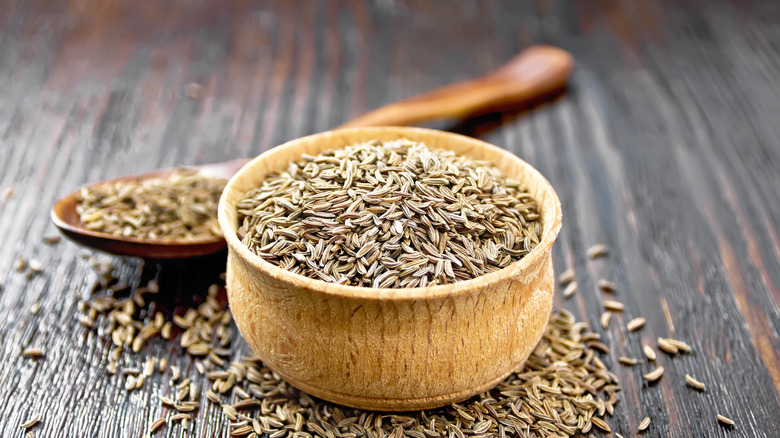
Cumin seed is one of the world's most widely-used savory spices. It's a key ingredient in many cuisines, from India through Central Asia and the Mid-East to North Africa, and spread from there to the New World via Spain. You'll find cumin used in many of the same dishes as turmeric, and the two have a lot of shared ground. Cumin lacks the pepperiness of turmeric, but like the other spice, it's distinctly earthy and pungent, and also has a hint of bitterness.
If it's toasted in a dry pan, or aromatized in hot oil, it also develops nutty and citrusy undertones, subtleties you'll find in turmeric, too. Cumin is often paired with coriander, which accentuates those undertones. Since it doesn't have turmeric's peppery edge, you'll have to use other ingredients to replace that. If your recipe doesn't already include cumin in some form, you can add it in roughly the same quantity as the turmeric that's specified. If you're using it in both roles, you can cut back by ¼ to ½ the amount (to taste) so the cumin doesn't become overly dominant.
Saffron
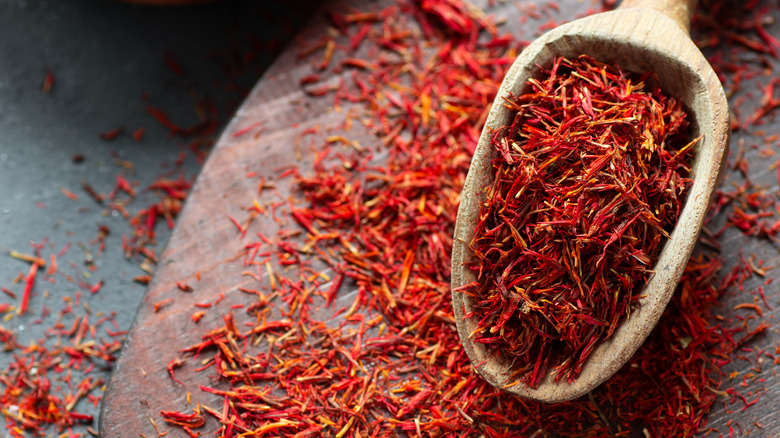
Saffron is famously the world's most expensive spice, with just a few strands fetching more than a full jar of most other flavorings. There are good reasons for that (its cultivation and harvest is ridiculously labor-intensive), which means it's the kind of thing that's used on special occasions. In fact, turmeric itself is often suggested as a lower-cost substitute for saffron!
Saffron is one of the few substitutes that handily replicates turmeric's ability to color foods (and stain the cook's clothing, as a few of my chef jackets can attest), as well as bringing a deep, rich, bold flavor of its own. It's not a like-for-like match for turmeric in flavor: it's also very pungent, but it doesn't have the bitter or peppery notes that turmeric provides. You might decide to leave it as-is, and create a version of the dish that centers saffron's flavor, or you can add the pepperiness and bitterness with other spices. Either way is fine.
Realistically, the chance you'll have saffron on hand but not turmeric is low, but it happens (it's happened to me). If you've bought some to make risotto, paella, or some other celebratory rice dish, and happen to have a few strands left over, this is your chance to take advantage of it.
Curry powder
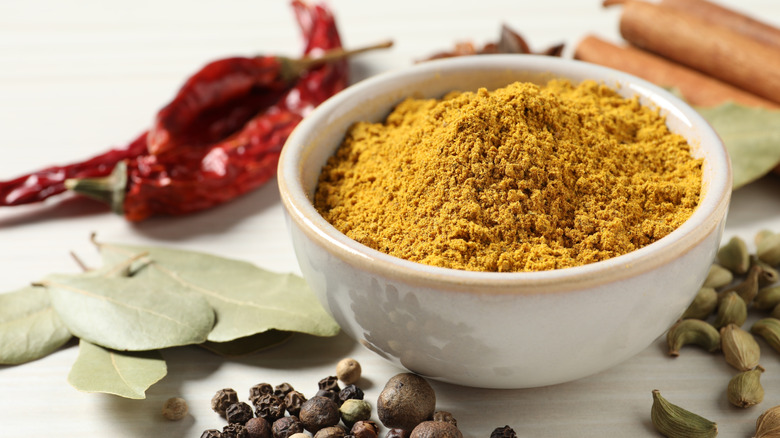
You'll find influencers and bloggers online who are happy to sneer at the standard-issue yellow curry powders sold in supermarkets. Most will argue that it does little justice to the complexity of so-called real Indian cookery. Some will urge you to make your own, or hold forth on the differences between curry powder and curry paste. Well, despite its lack of snob appeal, the important detail, in the context of replacing turmeric, is that turmeric is itself the lead ingredient in curry powder.
It's turmeric that gives the powder its signature color, and much of its basic flavor profile. The rest of the spices will vary, depending on the brand you buy, but other spices in the mixture typically include things like cumin, coriander, mustard seed, ginger, cardamom, and fenugreek seed.
So take a look at your recipe, and see which of those it calls for. You can reduce those accordingly, or even leave them out altogether, until the dish is nearly ready and its flavors have fully developed. Then, if it feels like it needs a little extra, you can add back some of those spices selectively until you've got the flavor profile you were looking for.
Annato
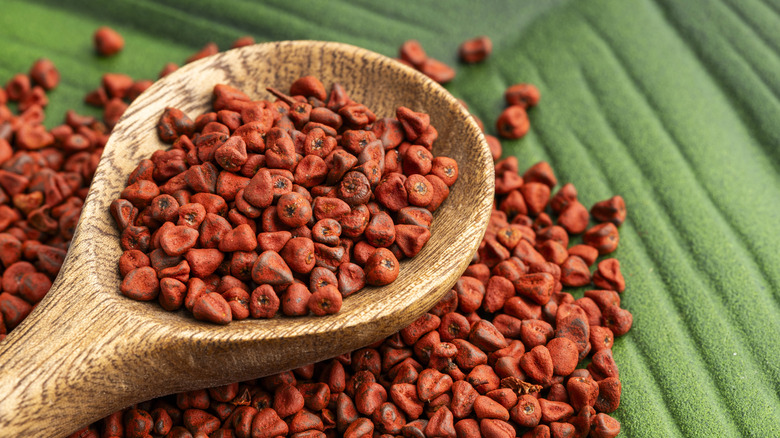
Lots of spices share some flavor characteristics with turmeric, but relatively few other ingredients are as adept at coloring your food. One that can not only match turmeric for color, but arguably raise it, is annato.
Annato seeds have a deep orange-red color, and they've been used as a coloring agent for centuries, in food and other applications. Today, for example, they're often used as a natural replacement for artificial red and yellow food colorings. For culinary purposes you'll see annatto used mostly in Caribbean, Latin American and Filipino cooking, where the seeds (whole, ground, infused in oil, or in the form of achiote paste) bring a bold yellow-to-orange color depending how much of it you use.
Annatto does have a distinctive flavor of its own, but it's less assertive than turmeric. It's a bit peppery, with a whiff of sweet spice (think nutmeg) that turmeric doesn't have. If you keep achiote paste or another form of annatto in your house for specific dishes, it'll bring the color, and a smidge of compatible flavor, to dishes that might otherwise use turmeric.
Ginger
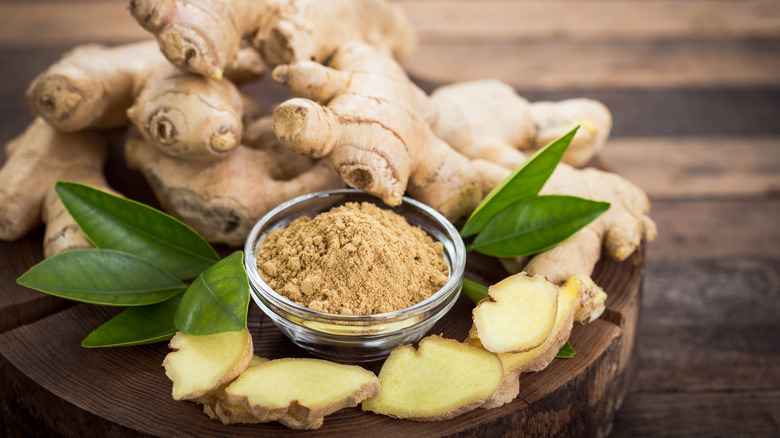
Turmeric in its whole form is a rhizome, the branching, underground root of the plant, somewhat resembling a darker version of ginger or galangal. That's perfectly natural, because all three are in the large ginger family, or Zingiberaceae. Like turmeric, ginger can easily be found in fresh or dried form, and its flavor is somewhat different depending which way you use it.
Dried ginger is more assertive and peppery, while fresh has more delicate citrusy and even floral notes. You can use either one as a partial substitute for turmeric in your dishes, where they'll supply some of the peppery bite and delicate undertones the spice would normally bring. Ideally you'd use fresh ginger to replace fresh turmeric, and dried for dried, but they'll work either way.
If you happen to have galangal on hand (it's used a lot in Thai and other Southeast Asian cuisines), that's an interesting alternative. It's earthier and has a somewhat sharper flavor profile than ginger, so if anything it's a better fit in dishes meant to use turmeric.
Paprika

I'm personally a big fan of paprika, and think it's an underutilized spice (there's more to life than deviled eggs, people!). You may very well have some in your spice rack, and if it's still nice and red, you can use it as a flavoring and coloring option for dishes that normally use turmeric. If it's faded to a rusty brown, well ... sadly it's too stale to do you much good, so toss it out and buy a new one.
Paprika comes in sweet, hot, and smoked versions – all of them made from a specific kind of thin-walled red pepper. Spain and Hungary are the two countries that use it most imaginatively in their cooking, and unsurprisingly that's where the best paprika comes from. Personally, I use Pride of Szeged, a Hungarian brand that's easy to find..
Paprika gives foods a deep, vivid color, though it skews orange-red rather than yellow. Still, it can help make your dishes appropriately colorful, even though the color may not quite be traditional. On the flavor side of the equation, sweet paprika adds a mellow bell-pepper flavor, which does little to simulate turmeric. Hot paprika brings a bit of chile spice to the mix, which can work well in turmeric-centric dishes, and a pinch of smoked paprika (if you have it) is slightly earthier and has a hint of bitterness from the smoke, so it can help round out those flavors nicely.
Fenugreek

Fenugreek is an interesting spice, because it's actually in the legume family, like peas and beans. So if its oddly squared-off little seeds remind you of crowder peas, that's why. Both the seeds (as a spice) and the leaves (as a herb) are widely used in Indian cooking. The leaves have a pleasant bitterness, like many other greens. The seeds, which are easier to find, can be used whole or ground.
They bring a complex, bitter, earthy note to your foods, and a slight astringency that turmeric shares. When toasted, the seeds develop a sweet and nutty note that's reminiscent of caramel or maple (it's used to make artificial maple flavoring, in fact). You can use both the seeds (methi, in your Indian cookbooks) and leaves (kasoori methi) together or separately, in dishes that call for turmeric. They'll provide an aromatic, earthy, pleasing bitterness.
Two quick things to be aware of. One is that ground fenugreek seeds act as a mild thickening agent, as well as a flavoring. A second is that because it's a legume, some people with peanut allergies may react to fenugreek, as well.
Garam masala
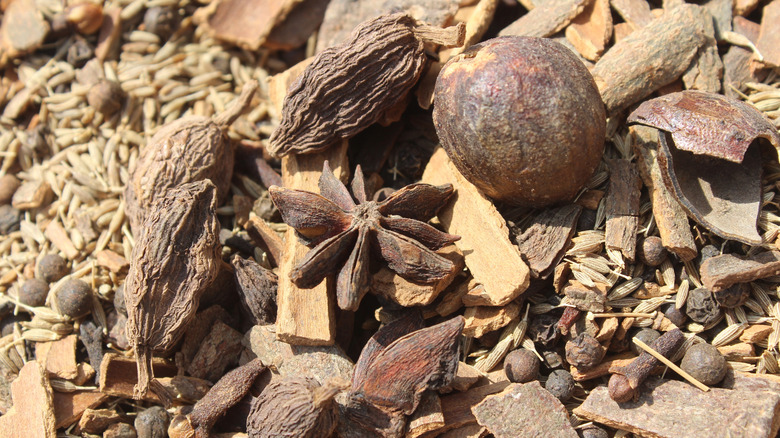
If you're looking for a turmeric substitute, it probably means you like to cook Indian-themed food; who else buys, and runs out of, turmeric? That means you're probably also the kind of person who keeps garam masala on hand.
Garam masala is a general-purpose Indian spice mixture that hits many of the same flavor notes as turmeric. You could think of it as the upscale version of curry powder, providing many of the same flavor notes but without the turmeric that gives the other spice mixture its yellow color. If you're in a hurry, a generous sprinkle of garam masala, along with the coloring agent of your choice, is often your best option. Overall, garam masala is more aromatic than turmeric, but it hits many of the same notes, and at least gets you into the right neighborhood. You can fine-tune the flavor profile from there by adding other spices until your dish tastes right.
Bear in mind that brands vary in the specific combination of spices they use — and in proportions, as well — so changing from one brand to another may also alter the flavor of your dishes. If you want some control over that, prepping your own homemade garam masala lets you fine tune it to your own taste, while giving you a consistent end result.