

Ditch The Slow Cooker: There's A Much Better Way To Make Chili
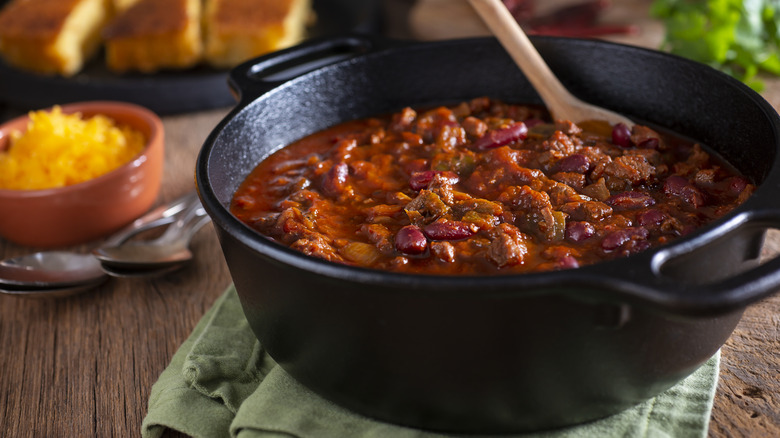
What do you use to make your homemade chili? There are plenty of options: a classic pot on the stovetop, slow cooker, or multi-cooker. But if your answer's not a Dutch oven, you're missing out. In a Dutch oven, every aspect of your chili gets elevated, from the initial browing to the final intensity of the flavor.
While a slow cooker is one of the most popular appliances for making chili, it will produce a batch that tastes flatter and less flavorful than a Dutch oven. The secret lies in the brilliant heat distribution and browning power that only a Dutch oven can provide. Don't believe us? Give our classic Cincinnati chili recipe a whirl in the Dutch oven: Boil the beef until it's done, add seasoning and spices (including cocoa powder), and simmer in a Dutch oven at 300 degrees Fahrenheit for two hours.
The result will be chili with big flavor all around. It's a world of difference from the lifeless slow-cooker chili you may have eaten before. The texture and appearance might look unpromising at first — dark and slightly thick — but that's the Maillard reaction doing its job. One spoonful and you'll understand why you can't stop.
The science behind why Dutch ovens are superior

A slow cooker simmers your meat rather than browns it, keeping everything submerged in liquid at a steady 170 to 280 degrees Fahrenheit. A Dutch oven, by contrast, can reach 300 degrees or more — hot enough to trigger the Maillard reaction and caramelize beef into something deeply savory. That's a flavor slow cookers can't deliver, no matter how long you let them run.
Another reason slow cookers can't measure up is the moisture issue. A Dutch oven's enclosed environment traps some steam while still allowing gradual, controlled evaporation. As water leaves, everything becomes more concentrated — that includes flavor and depth. Slow cookers, on the other hand, are humidity chambers. Endless condensation drips back into your food, diluting flavors with every cycle and creating a one-note broth environment that no amount of spice can overcome because you're literally swimming those spices in an ever-expanding pool of liquid. It's why slow cooker chili tastes flat. The flavors never had a chance to concentrate — they're too busy dissolving.
Finally, there's the time factor. Slow cookers do break down muscle fibers and collagen into gelatin for tenderness, but it comes at the cost of flavor dilution and zero browning. A Dutch oven achieves that same tenderness in just two hours — the concentrated heat works faster, and you've already built flavor through caramelization. You're getting tenderness and depth in one step.
More tips for using a Dutch oven to make chili

Most chilis recipes work well in a Dutch oven, but there are some swaps you can make for a better final product. Instead of canned beans, try using dried beans (kidney, black, or pinto are fine) and pre-soaking them overnight instead. This prevents the beans from becoming pebble-hard while letting them actually absorb the chili's flavor. You'll taste the difference immediately if you've ever skipped this step.
Next, Dutch oven chili can get quite dry because moisture evaporates aggressively in the heat. The fix is surprisingly simple: Wrap aluminum foil around your pot before lidding it. This seals in steam and slows evaporation. If things still look parched at the end, you can also add a splash of broth.
Just like chili made with other appliances, the best part of chili is adding some toppings like sour cream, cilantro, diced onions, and sharp cheese to level it up even more. Swap out your standard pot or slow cooker for a Dutch oven, and see just how good your chili can be.