

The Birthplace Of Hollandaise Sauce Might Take You By Surprise

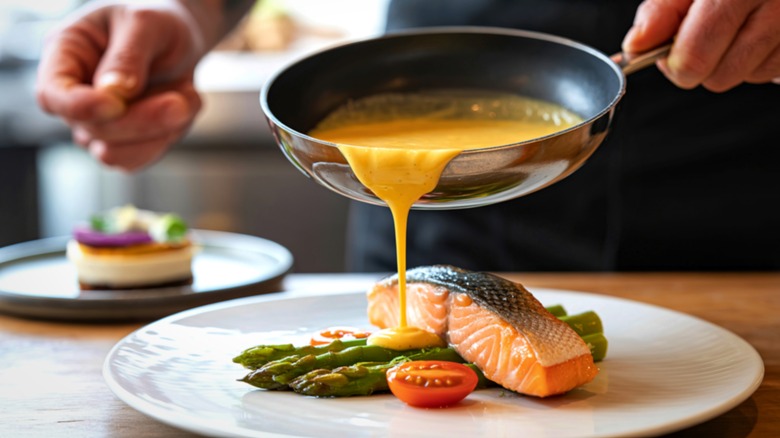
Just as it takes creativity to invent a new dish, some chefs employ the same creative liberty when naming their dishes. A surprising number of foods are named after places other than where they originated – like French fries, which were conceptualized in Belgium. Today, we're taking a closer look at another geographically-titled food, and unlike fries, it's actually French. Despite its Dutch-sounding name, hollandaise sauce was created in France, a hairpin balance of room-temperature egg yolks, warm butter, lemon juice, and pepper. Hollandaise is so French, in fact, that it holds a position of esteem as one of French cuisine's five fundamental "mother" sauces, alongside béchamel, espagnole, velouté, and sauce tomate.
Perhaps perplexingly, the word "hollandaise" is French for "from Holland," yet the condiment originated in northern France's Normandy. Initially, it was known as "sauce Isigny," a nod to the Normandy town of Isigny-sur-Mer and the Calvados region's dairy farming tradition, known especially for its butter (Normandy remains the cream capital of the country today). So, why the name change? Two dominant theories have emerged as to why the French mother sauce earned its Dutch-inspired moniker. The first theory posits that the name change happened during World War I, when France had to import its butter from Holland due to domestic production issues. The second theory places the name centuries' further back, during a period of diaspora.
Hollandaise hails from France, despite its Dutch name
Per the lore, during the 1500s and 1600s, hollandaise sauce was brought from Normandy to Holland by fleeing Huguenots. Huguenots followed the teachings of French Protestant Reformationist John Calvin, and left France en-masse to escape severe persecution from the staunchly-Catholic French government, culminating in St. Bartholomew's Day Massacre in 1572. Many Huguenots fled to the nearby Netherlands, blurring the geographical origin of the lush, creamy sauce.
It's worth noting that the hollandaise sauce foodies were enjoying in the 1600s might have looked a little different from the sauce epicures know today. The first recorded recipe for hollandaise includes vinegar, making it closer to a modern-day béarnaise sauce (a hollandaise variation that adds white wine or vinegar, diced shallots, tarragon, and peppercorns into the mix). A 1651 sauce recipe printed in Francois Pierre de La Varenne's seminal "Le cuisine franis (The True French Cook)" describes a similar proto-hollandaise makeup, calling for butter, vinegar, salt, nutmeg, and egg yolk as a binder. It's an interesting full-circle culinary moment, considering béarnaise wouldn't be officially "invented" for 200 more years in the 1800s, when chef Jules Colette of Le Pavillon Henry VI restaurant in Paris ceremoniously named the sauce after Henry VI's birthplace of Bearn, France. Whatever the name, to serve, glossy, silky, brightly acidic, hollandaise is customarily draped over eggs, fish, or vegetables – and it tastes just as good.