

You Shouldn't Treat Jasmine Rice Like Any Old White Rice. Here's Why

There are some numbers that just stay with you over time. Take for instance, your childhood landline — or the ratio of water to rice. But when making jasmine rice, you'll need to think twice since it doesn't follow the same 2:1 water-to-rice ratio as other white rice. Bagged jasmine rice usually calls for 1 ½ cups of water for every cup of rice, but it might be easy to overlook if you're used to more liquid. However, different types of rice have different cooking requirements. Long-grain jasmine rice has a lower starch content compared to other rice and is intrinsically softer, chewier, and thicker. For this reason, it typically requires less cooking liquid for a perfectly tender texture.
Jasmine rice, which originates in Thailand where it's referred to as "hom mali," is one of the main kinds of rice key to many Thai dishes. It's also produced and used in other Southeast Asian cuisines. To experience the buttery, slightly nutty flavor and tender texture that the rice variety has to offer, it's key to cook it correctly — with the right amount of water. Since it's less starchy than other kinds of rice, including long-grain basmati, jasmine rice does not even need to be soaked to remove starch before cooking. Cook it in too much water, and it will absorb excess liquid and come out gummy. With jasmine rice, less water is typically more.
How you like to cook jasmine rice may vary on the cooking method
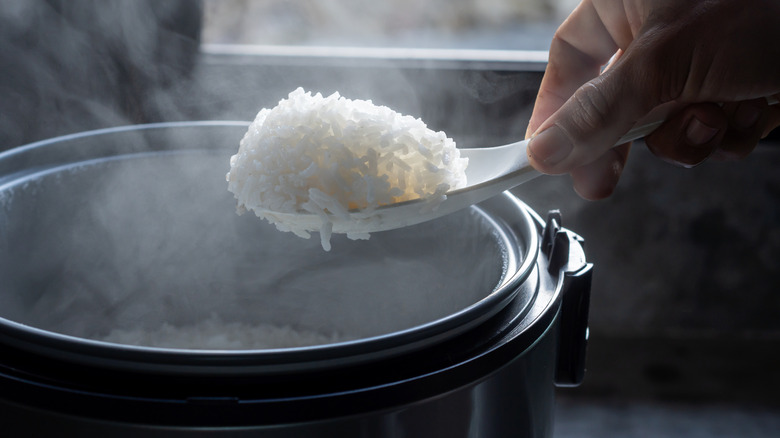
When cooking one cup of jasmine rice on the stovetop over low heat, use about 1 ½ cups of water. While this is a general rule of thumb, the long-grain rice can be prepared to different preferences and different cooking methods. If you're using a rice cooker or other pressure cooker to make your rice, for example, you'll want to use even less cooking liquid since less steam is released using the sealed cooking appliance. A 1:1 water-to-rice ratio is typically used for making white rice in a rice cooker, but you may need to experiment with using a tiny bit less water.
With either cooking method, the amount of water will depend on the desired texture for your rice. Some people like their jasmine rice a little more tender or sticky, which may be useful for certain dishes where the rice acts as a foundation to hold and absorb saucy mains like Thai chicken curry. In that case, you could add a bit more than 1 ½ cups of water when making 1 cup of rice on the stovetop. However, if you like your rice a little more firm in separate granules, which can be desirable when making a dish like fried rice, use 1 ½ cups or 1 ¼ cup of water. When in doubt, start out with less water and add a little in to steam while the rice finishes cooking.