

Do Bourbon Beginners Need To Drink Out Of A Proper Glass? Here's What To Know Before Taking Your First Sip

We may receive a commission on purchases made from links.
It's easy to imagine that any old glass is fine for enjoying bourbon, and in some ways that's true. But a new bourbon on the block, one you've never tried, requires a proper bourbon tasting glass. It's the highly recommended way of discovering notes and traits of individual bourbons, potentially finding ones that match your whiskey proclivities. To better understand which type of glass to use, we have some expert insight from Tasting Table whiskey connoisseur, Kenny Jarvis. In his guide on 13 tips for drinking bourbon as a beginner, he addresses the crucial tasting vessel, identifying it as a small, tulip-shaped glass, ideally one known as the Glencairn glass. Besides, a bourbon tasting glass is also crucial for bourbon beginners in general, since a certain type of glassware highly influences the way one interprets flavors, allowing newbies to cultivate a personal bourbon persona.
According to Jarvis, bourbon tasting centers on the all-important aroma. A tulip-shaped glass, tapering at the top, traps the aromas, concentrating them on your nose when tipping the glass. Calling whiskey his favorite smell, he says that "a proper tasting glass gives you the best possible chance to enjoy that aroma in all its glory." It helps form your opinion of the specific bourbon and identify personal tasting notes. There's some science behind the aroma and taste concept, so here's a look at how the two coincide in a bourbon tasting glass.
The art of nosing bourbon
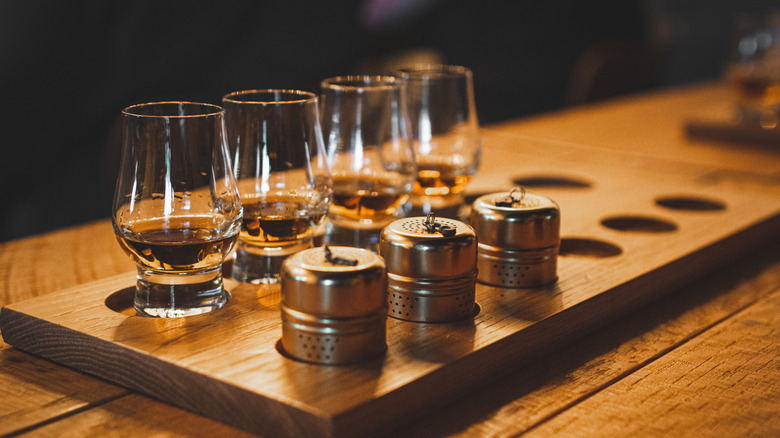
As Jarvis explains, the Glencairn, or a similar tulip-shaped tasting glass, directs the aromas to your nose, impacting the flavor and perception of the bourbon you're tasting. That's not just an olfactory illusion, but a scientific fact. A spirit like bourbon contains numerous fragrant compounds that our sense of smell detects sooner and more intensely than what we actually taste. In other words, there's more complexity in the smell than in the taste, and the nose is more sensitive than the taste buds.
Again, the aroma is crucial, so avoid sticking your nose into the glass and taking a deep sniff. All that does is overwhelm your senses with the stringent vapors of alcohol. Instead, hold the tapered glass beneath your nose and breathe gently with short sniffs before bringing it closer to your mouth and slightly parting your lips. There's actually a term for that process: nosing. Though some recommend swirling the bourbon in the glass, others say that's a rookie mistake, as excessive aeration can overpower the more subtle aromas.
When it's time to taste instead of smell, the tapered tasting glass helps control the amount of bourbon sliding into your mouth. "Taking small sips allows the bourbon to roll across your tongue," explains Jarvis, "so that you can appreciate the different layers of flavor." Those flavors can be mesmerizing and plentiful, evidenced by the existence of an official bourbon tasting wheel. For a condensed version, check out these nine most common tasting notes for bourbon.