

What The Discovery Of 4,000-Year-Old Noodles In China Taught Us About The World-Famous Food
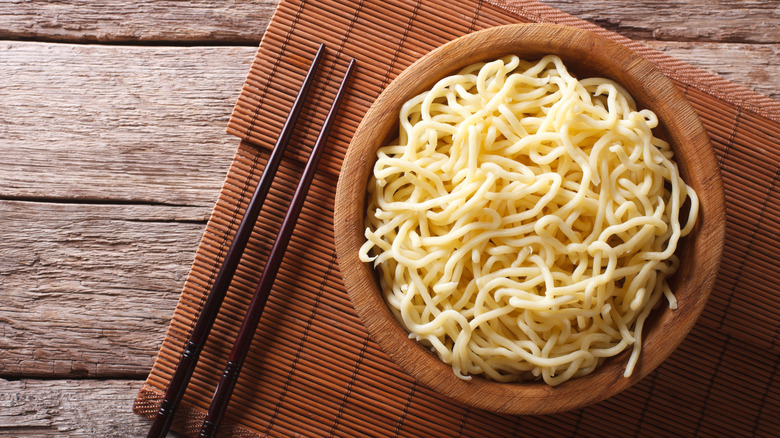
Food history is a fascinating topic that often leads to heated debate. There is such a visceral connection to the foods we grow up eating, the foods of our cultures, that to question their origins quickly challenges our sense of identity. But, by nature, food is, and always has been, a collaborative art. The origin of spaghetti is both ancient and debated, for example. Spaghetti is obviously Italian, but did pasta originate in Italy? Or was it transported to Europe by early explorers and travelers? A bowl of noodles discovered by archaeologists in Western China might not settle the debate, but it certainly adds another layer to the conversation.
At the Lajia archaeological site in Qinghai Province, China, buried beneath 10 feet of sediment deposited by an ancient earthquake, archaeologists discovered a startlingly well-preserved bowl of noodles. An overturned bowl sealed the thin, yellow noodles into a chamber capable of safeguarding them for 4,000 years. In so doing, the groundwork was set for this bowl to challenge the narrative of where noodles were first developed and how they were made.
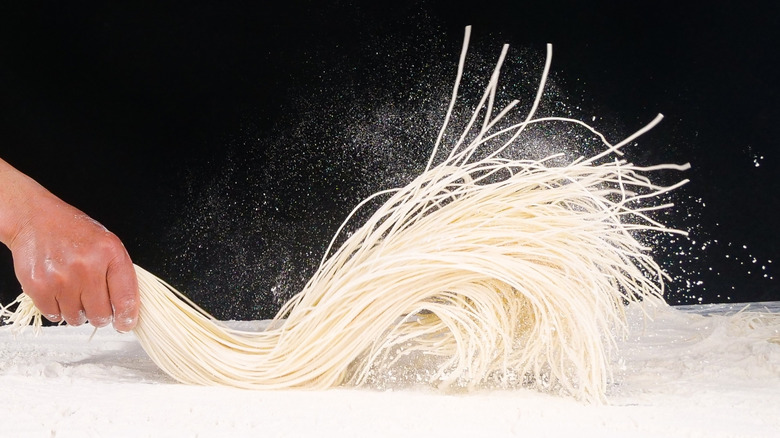
The ancient noodles discovered bear a great resemblance to modern dishes. The thin and delicate noodles measured around 20 inches in length, seemingly made with the same hand-pulled technique still used for some Chinese noodles. They were also noted to be quite uniform, suggesting evidence of a well-honed technique. Perhaps the most significant difference between these noodles and their modern counterparts is that they were made with millet, a grain indigenous to the region that has been cultivated in the area for at least 7,000 years — long before wheat. While millet noodles might not be something found on too many menus anymore, they are still found in rural parts of China.
The first noodles were likely made with different grains
This discovery challenges evidence that testaroli could be the first pasta dish, though calling it pasta could also be considered a stretch. It was developed by the Etruscans, a Mediterranean civilization that was centered in what is now Italy from the 8th through 3rd centuries B.C., but the relationship of testaroli to noodles is tenuous. Testaroli was made with a batter (potentially, wheat-based) cooked on a griddle like a crepe, before it was sliced and boiled. It may be an early form of pasta, but it bears little resemblance to today's spaghetti or the Chinese noodles in question.
As much as we would love to have a definitive answer to how pasta first originated, the story likely doesn't have a simple explanation. As agriculture developed, and grains became a primary food source around the world, some things seem to have developed naturally in many places. There is a joke on the internet that every culture developed some form of swords, doughnuts, and fermentation, and there is a kernel of truth in this. With the same supplies on hand, humans find similar ways to utilize them to the greatest effect. So, while it is entirely possible that someone was personally responsible for bringing the knowledge of pasta from one culture to another, it is every bit as likely that multiple cultures realized that mixing flour with water and boiling it produced a versatile food that was a pleasure to eat. However it happened, we can thank our ancestors for the many different types of noodles – millet or otherwise — that they came up with.