

Having Nightmares? What Foods You Eat Before Sleeping Might Be The Culprit

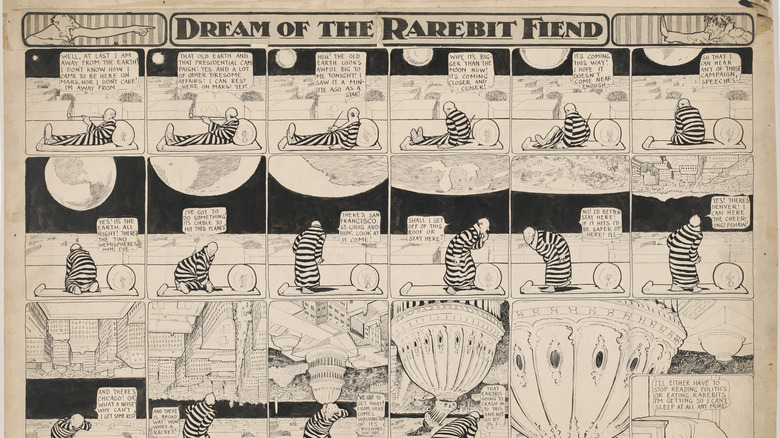
If you have ever woken up, heart racing from a truly unhinged dream after that midnight snack of a grilled cheese, then you have company. Medieval physicians claimed the gluttony of heavy suppers caused humoral excess, phlegm and "grosse vapors" which led to nightmares, Charles Dickens had Scrooge blaming the festive, ghostly apparitions on "an undigested bit of beef", and early 1900s cartoonist Winsor McCay literally drew a series called "Dream of the Rarebit Fiend," where characters eat Welsh rarebit, a beloved cheese toast, with adventurous, bizarre night terrors ensuing. A century later, real scientific researchers are asking, is fondue before bed a mystical portal to an evening of surrealist torment?
A 2025 study, published in Frontiers in Psychology, surveyed more than a thousand college students to find out how they thought food affects their sleep and dreams. About 40% said certain foods make their sleep better or worse. Only 5.5% said food changes their dreams, which suggests there is not one surefire, nightmare-inducing snack, so much as sensitive people whose guts and sleep are tightly linked. When those people did point a finger, though, they were remarkably consistent. Desserts and sweets were the top-blamed culprits, followed by dairy, then meat, and spicy food. Conversely, fruit, vegetables, and herbal tea tended to be associated with better sleep.
The study also found that people who notice food-dream links also tend to have more frequent nightmares in general and more food sensitivities. In this day and age, we understand more of the complexity of the gut-brain axis, the information superhighway between the central nervous and digestive systems. The study seems to show that because our digestion has a direct line to our brains, when irritated, it makes noise — and funny pictures, too.
What's on the nightmare menu at the dream buffet
There are a few common foods most likely to haunt dreams. Dairy, especially for anyone with even low-level lactose intolerance, is first up. When lactose isn't broken down efficiently, it ferments, producing gas and intestinal pressure that the vagus nerve dutifully reports back to the brain. That bio-mechanical distress pushes sleepers into shallower stages, and dreams can get vivid and strange.
A sugary midnight snack, like a brownie or bowl of ice cream, on the other hand, will trigger a sharp glucose rise, and there's evidence that when blood-sugar crashes, or the body perceives a metabolic stress, stress hormones such as cortisol and adrenaline can rise, and we know disrupted or light sleep often leads to more emotionally intense REM cycles as compensation.
Then there are spicy foods, which increase core temperature. Our bodies need to cool down to sleep, and a raised temperature delays the descent into deep sleep, pushing REM later into the night, where it becomes compressed and intense. High-fat foods slow gastric emptying, which makes reflux more likely while lying down. Even minor reflux can cause micro-arousals, which are tiny awakenings you won't remember except for the fact that your dreams might feel like they were directed by David Cronenberg. Caffeine and chocolate eaten too close to bed, certain cured meats with nitrates, and high-histamine foods for some sensitive individuals can also trigger digestive or hormonal irregularities.
None of these foods is universal nightmare fuel, but they can be contributors to strange, disturbed sleep, because more than any single food villain, nightmare triggers are intensely personal. Two people can eat the same late-night cold pizza slice (yum); one sleeps peacefully, and the other spends the night escaping a labyrinth made of their middle school cafeteria.
Brains take food to heart

Nightmares are signals. The sleeping brain is porous, responsive, theatrical. Sometimes it's processing emotion, sometimes memory, and sometimes simply the consequences of eating a plate of chain-restaurant nachos at the wrong hour. The food can tilt the night in one direction or another, adding texture or plot twists your subconscious is all too happy to use. Part of this is genetics and microbiome, and partly what else is already gnawing at someone internally. Dreaming is an emotional metabolizer; digestion is a physical one. When both are working in overdrive, they blend into each other, to surreal results. Food-induced nightmares are simply the byproduct of sleep and digestion being a delicate, interdependent ecosystem.
And sometimes, the culprit isn't physiological but psychological. Stress, unprocessed grief, and anxiety can all make dreams more vivid. If the brain is already running hot, a heavy or irritating meal simply gives it more material to work with. The strange dream isn't "caused" by cheese so much as compounded by it. If a certain food reliably turns your sleep into a haunted escape room, adjust the timing, support your gut, and give your REM cycles the calm they need to keep the winged monsters in the wings.
If you're routinely waking up from Technicolor stress-dreams, the easiest diagnostic tool is boring but effective: a food-and-sleep log. Record what you ate, when you ate it, how you slept, and what you dreamed. Patterns emerge quickly. If you're prone to nightmares but don't have an aptitude for note-taking, just try eating "rich" foods earlier, and eat easier-to-digest snacks before bed: a banana and yogurt, toast with nut butter, and herbal tea. And if you love spicy noodles at 11 p.m., accept that you are signing a cosmic waiver for weird dreams.