

The Wooden Spoon Myth You Shouldn't Believe When It Comes To Honey
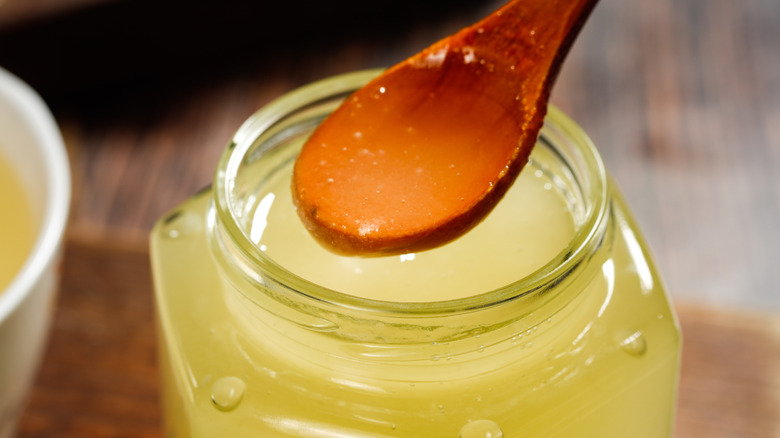
For honey aficionados, the spiraled wooden honey dipper is essential for drizzling the viscous liquid gold over their favorite foods. Honey dippers can be made with different materials, such as stainless steel or silicone, but most traditional honey dippers are made of wood. Alternatively, you may have heard that it's best to use a wooden spoon for dipping into any of the many types of honey.
To see if there was any merit to the common myth that honey should be served with a wooden spoon, we spoke with Eloy De La O, the Director of Quality for Sioux Honey. "While there is no scientific data stating wooden spoons are 'better,'" he reveals, "wooden spoons are often preferred due to the leaching properties of honey."
Honey's complex chemical composition of several enzymes has antibacterial properties and aids digestion. It's believed that when a reactive element — such as a metal spoon — comes in contact with honey, it leaches metal into the honey and damages the beneficial enzymes. In reality, honey's enzymes are stable unless heated. As De La O notes, "Any leaching of unwanted properties would take a significantly long time before occurring." While it's true that a metal spoon could leach metal into honey over a prolonged period, you would need to store the spoon in the honey before it would have a deleterious effect.
A honey dipper is helpful but it isn't essential
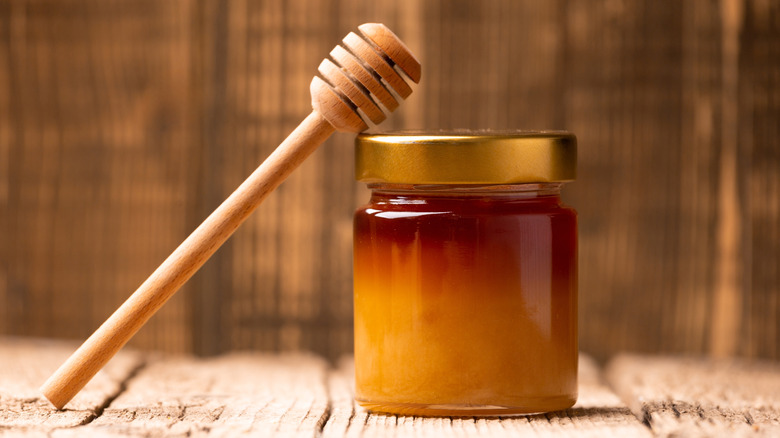
We wondered why wooden spoons are used so prevalently to serve honey. As De La O explains, "The use of wooden utensils largely comes down to personal preference and may also stem from the traditional popularity of the classic wooden honey dipper." The honey dipper's origins are a mystery, although there is some speculation that it was invented in China. A honey dipper can actually be useful because its unique design allows the honey to cling until the precise moment you want to drizzle it.
By holding the honey dipper vertically, the honey stays trapped due to its high viscosity, and when you hold the dipper horizontally, gravity takes over, and the honey drips off. "The grooved shape of the honey dipper helps capture honey," De La O notes, "and makes it easier to twirl, drizzle, and transfer without excess dripping." However, he also believes that a honey dipper really isn't more efficient than a wooden spoon. "There's no scientific evidence to support any specific benefit," De La O reminds us. "It simply comes down to personal preference."
There are both pros and cons to using any time-saving wooden utensil, and cleaning them by hand rather than putting them in the dishwasher is necessary to maintain them. According to De La O, any utensil, no matter its shape, can be used to serve honey. But for some, the beehive-shaped honey dipper is a homey and nostalgic aesthetic that is part of the experience of enjoying honey.