

The Addition That's Common In American Beverages But Almost Nonexistent In Europe

If you find yourself in Europe looking for one of your favorite beverages, from a soda to a cocktail, you may be surprised to find one very basic, ubiquitous-in-America ingredient missing: ice. Ice-less drinks are all but unthinkable in the United States, where we like our beverages as cold as can be. Why doesn't that staple status for ice travel across the Atlantic?
The answer lies in cultural preferences and customs as well as history itself. America's love affair with ice began when the concept of using it was born here. Entrepreneur Frederick Tudor started sending ice from American bodies of water all around the world in the 1800s. It was seen as a luxury to be able to afford and cool or preserve your food and beverages with ice. When Tudor still had leftover ice from his export business, he'd give it to American taverns, who popped chunks of it into drinks. People loved how refreshing those chilly drinks were, and then wanted to buy ice from Tudor — a genius marketing plan.
Ice became a de rigueur beverage ingredient for Americans, and it also became more available and affordable over the years as people started keeping kitchen essentials in iceboxes. But because it was being exported, ice's expensive inaccessibility stuck around longer in Europe, and so it never caught on. Even when it did become more readily available, Europeans didn't get the appeal, believing it just watered their drinks down.
To dilute or not dilute
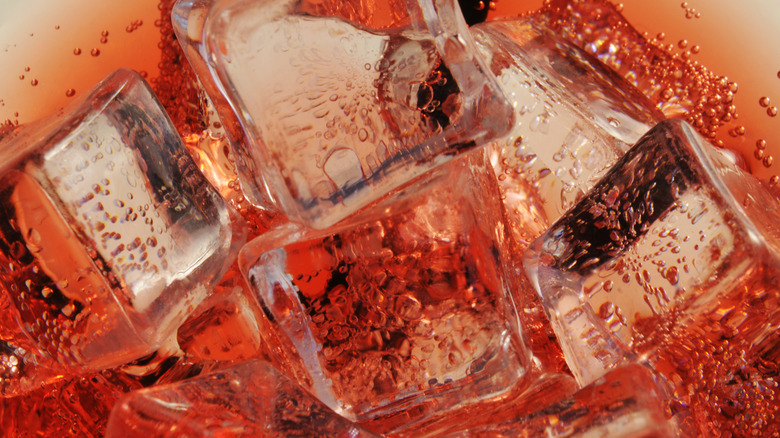
The fact that ice will dilute any liquid it's in doesn't deter Americans. We prefer how thirst-quenching ice makes any drink, and when it comes to something like a soda, we're happy to simply refill our cups. Europeans don't see the point, perhaps because the tradition isn't as long-running there as it is in the U.S. Plus, there are plenty of different beliefs that ice isn't just arbitrary but downright undesirable, all cementing the fact that Americans will stick out like sore thumbs for taking drinks with ice overseas. They may feel cheated out of space in their glass — Europeans don't have the giant portions or refills that are the norm in America. They may worry the ice is dirty. They may even believe ice is bad for you, with drinks that cold, bad for digestion, or for your throat.
Europe even has cocktail bars that entirely write off ice. When legendary bartender Ryan Chetiyawardana opened his first (now closed) bar in London, White Lyan, it used no ice or perishables. New Paris hot spot De Vie does not serve cocktails on ice, primarily due to sustainability concerns. Ice's dilution is actually necessary for marrying different ingredients and toning down strength in some cocktails, which bars like De Vie navigate around or avoid. It's not the worst idea for Americans to use less ice, either. We'd waste less water and never suffer from a stale-tasting cocktail made with old freezer ice.