

Follow This Temperature Rule When Substituting Sugar With Honey
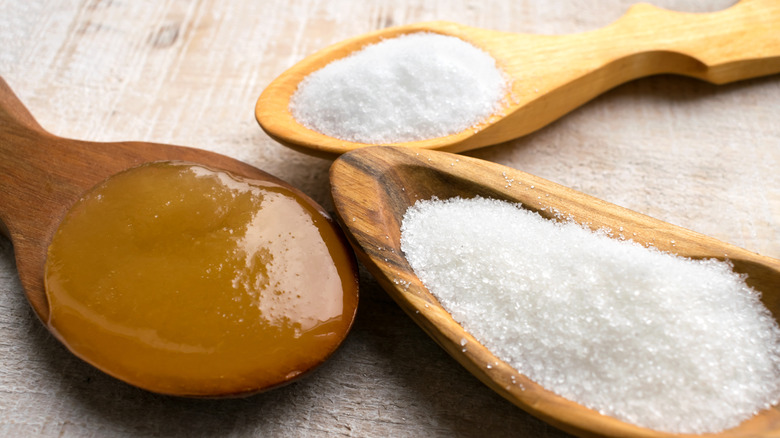
Baking is often referred to as a science when compared to cooking where you can adjust and adapt on the fly. When cooking, swapping out ingredients is usually a non-issue, like changing maple syrup for honey in a salad dressing recipe. But for baking, it's not quite so straightforward. We spoke with Joy Wilson, the pro baker and cookbook author behind Joy The Baker, for advice on how to substitute honey for sugar when baking.
"Honey browns fast," Wilson explains, "so lower the oven temp[erature] by about 25 degrees Fahrenheit to prevent overbaking or burning." Unlike granulated sugar, honey doesn't require heat and time to become a liquid, so Wilson advises to "check your bake 10 minutes early as honey speeds up caramelization."
When measuring honey, it can be helpful to coat your measuring spoon or cup with a light coating of oil so that the honey slides right out, rather than clinging to the sides of the measuring vessel. You can make this process even easier by measuring everything for baking with a scale. Honey has a low pH level of about 4, on average, making it an acidic ingredient, while granulated sugar's pH level is 7, making it neutral. Because of this extra acidity, it can be helpful to add a small amount of baking soda (which requires an acid to activate and rise) to your recipe in order to ensure a proper rise.
Flavor and texture are impacted
Sugar has a variety of purposes beyond adding sweetness in baking, like acting as a leavener, similar to baking soda or yeast, as it creates tiny bubbles when mixed with fat. Sugar also contributes to the texture of baked goods by adding moisture and keeping them tender. Although it is technically a dry ingredient, sugar is often used as a wet ingredient when baking by adding it to other wet ingredients, as it breaks down when heated in the oven. At any temperature, honey is a wet ingredient, so you can also incorporate it along with other wet ingredients in your baking recipe. One thing to be aware of, however, is that honey will contribute more liquid, so you'll need to reduce other liquids in the recipe to compensate.
While sugar obviously lends sweetness to baked goods, it has a fairly neutral taste, unless the sugar has been caramelized or altered in another way. Honey will offer a more distinct flavor alongside the sweetness, depending on how much you use, so be aware that swapping will impart some of that classic honey flavor to whatever you're baking. It can be beneficial to use a lighter or more neutral honey if you're not looking to showcase that flavor, and opt for a darker, more floral honey to really boost those flavor notes of honey. Check out some the best honey varieties for baking so you can choose the right honey for your next baking project.