

What Really Makes Thai Food Spicy? This Core Ingredient Turns Up The Heat
We may receive a commission on purchases made from links.
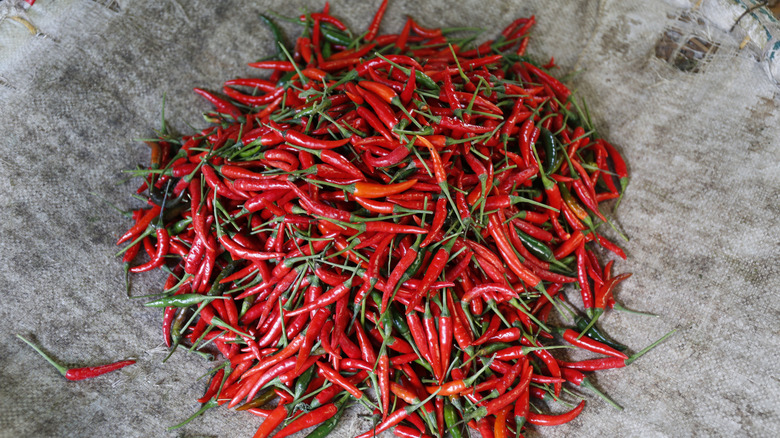
If there's one thing most traditional Thai dishes have in common, it's heat. We've consulted Ann Thanthicha Piwatsuwan, the head chef at BKK New York, for her insight on the core ingredient that makes Thai food so spicy. The answer is, unsurprisingly, chili peppers, namely, "bird's eye chili and prik bon (dried ground chili)." However, according to Piwatsuwan, "They bring more than heat — they add fragrance, brightness, and character."
Dried ground chili is made from crushing dry-roasted bird's eye chili peppers, which are also known as Thai chilies. You can buy dried options like Unclejum's Thai Prik Bon online. Generally, it provides more spice, while fresh chili has a more discernable flavor. As chef Piwatsuwan explains, "[Bird's eye chilies] have a unique fruity, floral quality that's hard to find in other peppers."
With a Scoville score of 50,000 to 100,000 SHU, Thai chilies are much hotter than Mexican chilies like jalapenos and serranos. Still, claims Piwatsuwan, "The chili doesn't just burn, it sings. Thai heat is sharp and clean, never heavy or smoky. It wakes up the palate and amplifies every other flavor on the plate." Although the spice from a combination of dried and fresh chili peppers is surely powerful, Thai cuisine uses them in conjunction with other ingredients that balances the heat and enhances their aromatic flavors. For example, a green papaya salad neutralizes the zestiness of fresh chilies with lime juice and umami-rich fish sauce, whereas a stir-fried pad see ew complements spicy prik bon with a sticky sweet soy sauce.
More Thai flavors to complement spicy chili peppers
Chili peppers are just one aspect of Thai cuisine. Their spice and heat are complemented by other aromatic, savory, salty, and sweet ingredients. At the very foundation of Thai cooking, chef Piwatsuwan cites three indispensable ingredients: fish sauce, bird's eye chili, and lemongrass. She explains, "Fish sauce brings umami depth. Chili adds brightness and energy. Lemongrass gives that fresh citrus lift. Together, they create the tension and balance that define Thai flavor."
Still, Thai food is much more complex, pairing these key ingredients with countless spices, herbs, and seasonings. "Our essential aromatics include bird's eye chili, garlic, galangal, lemongrass, makrut lime leaves, coriander root, and Thai basil," she shares. In fact, you'll often see Thai recipes with a long list of exotic ingredients that might not be sitting in your pantry. Not to worry, says Piwatsuwan, "Thai cooking is flexible by nature. If you can't find coriander root, use cilantro stems. If galangal isn't available, ginger brings a similar warmth."
Of course, you can always leave the complexity to the pros. Chef Piwatsuwan is quick to promote chili peppers and her own Thai restaurant in NYC. On the menu at BKK New York, she describes how the Pad Kra Pao Moo Krob (crispy pork with basil) is "made with freshly pounded chili and garlic flash-fried over high heat" and how "the aroma is unmistakable." She goes on, "When paired with jasmine rice, the heat becomes beautifully balanced — exactly how Thai food is meant to be eaten."