

The Number-One Red Flag On Store-Bought Food Labels Goes Far Beyond The Ingredients Themselves
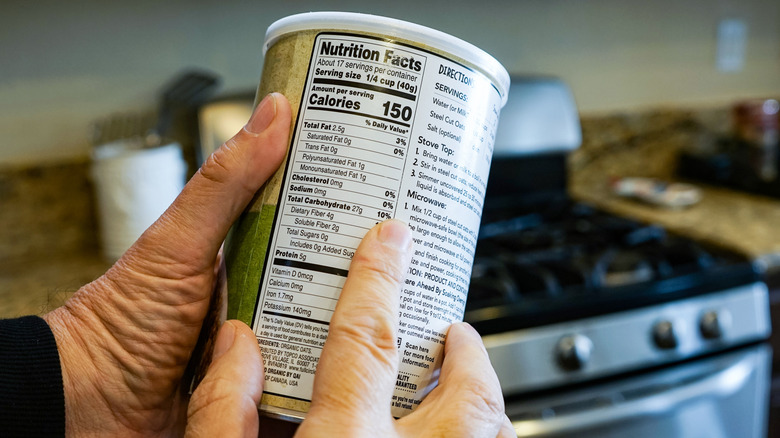
Since the 1990s, foods sold in the U.S. have come with a familiar black-and-white table listing out their nutritional facts in precise detail down to the milligrams of protein and carbohydrates. Some may choose to gloss over this table, but for many — diabetics, dieters, folks who simply want to have more control over what they eat — it can be extremely helpful. But the fact that it looks "official" and is scribbled with numbers doesn't mean all of them are trustworthy. In an interview with Real Simple, Amy Davis, RDN noted that there's one red flag to always look out for when reading this nifty box: whether it complies with FDA labeling regulations or not.
If the accuracy of the label is very important to you (say, if you're allergic to something like gluten or egg), the label being FDA-compliant can be a pretty good measuring stick for its trustworthiness. The good news? You don't need to read and memorize the entirety of the 132-page Food Labeling Guide from the FDA to spot problems.
Some basic facts can be helpful in spotting non-compliant labels. "When I see nutrition labels that are non-compliant with FDA labeling rules, for example, calories not listed in intervals of 10, it makes me question the accuracy of the nutrition label as a whole," said Davis. So if a product lists 123 calories, that's a huge red flag. The right way to write it would be 120 calories. When a label can't even get the basics right, it raises questions about whether you can trust their other claims, like being dairy-free, gluten-free, or egg-free.
Content and format problems to watch out for
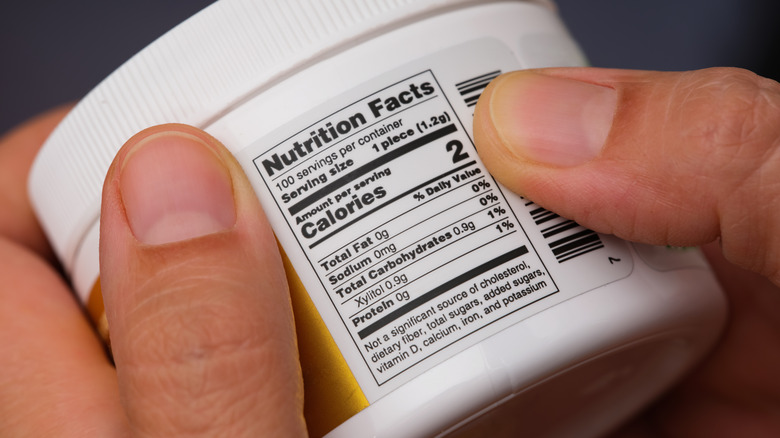
Beyond calories, every nutrient listed needs to be rounded correctly. The catch? Each nutrient follows different rounding rules. If there's a particular nutrient you're monitoring closely, take time to learn how it should be rounded. If you're cutting down on salt, for instance, according to the Code of Federal Regulations on food nutritional labelling, sodium is counted by 5 milligrams increments if the total is under 140 milligrams, 10 milligrams if exceeding 140 milligrams — so question any label that claims it has 106 milligrams of sodium. Sugar and fiber are counted in 1 gram increments, and so on.
Outside of rounding errors, you may want to check out the serving size, too. The FDA has a comprehensive database on what constitutes a proper serving for a certain kind of food, in the form of the Reference Amounts Customarily Consumed (RACC). So, one serving of brownie is standardized as 40 grams. There's no such thing as half a brownie (20 grams) according to FDA standards, but some food manufacturers might try this anyway to make their nutrition facts look better on the packaging – cutting the serving size in half makes calories and sugar look more appealing.
And of course, look out for the format of the nutritional facts table itself. The FDA requires all labels to include the same core elements – calories, fats, carbs, protein, cholesterol, sodium, total and added sugars, fiber, and four specific micronutrients (vitamin D, calcium, iron, and potassium). Even if the product contains zero of something, it still needs to be listed. Any omissions mean the label isn't following FDA rules.
Watch out for allergen and the nutritional info, too
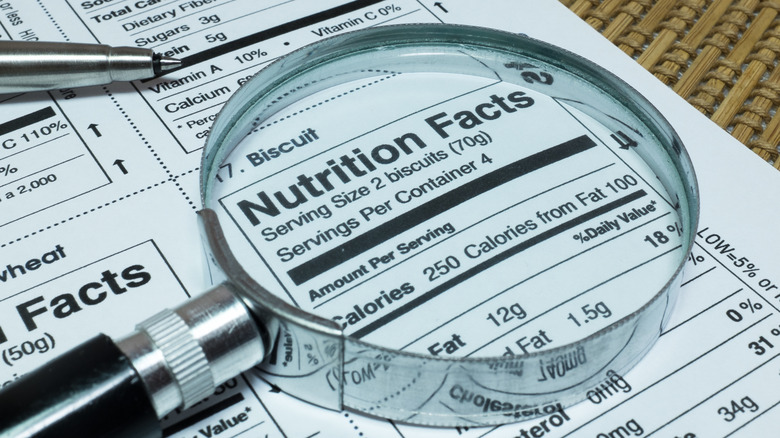
Here's where non-compliant labels become genuinely dangerous. If you have food allergies, you need to know exactly what's in your food — no guessing games. Say you're lactose intolerant and need to avoid milk. An FDA-compliant label will clearly state "Contains: Milk" right on the package. Listing just "casein" or "whey" (both milk-derived proteins), however, would be in violation of FDA regulations — as both can trigger a reaction. The FDA makes it very clear that nine major allergens must be addressed on the label using their common names (milk, eggs, fish, crustacean shellfish, tree nuts, peanuts, wheat, soybeans, and sesame).
There's a second category of allergen that can appear on a label: those that might be found in trace amounts within. This could be because of cross-contamination, like if a non-milk-containing food is produced in the same facility as another product that has milk in it. The FDA leaves it to the company's discretion on whether to put a warning on the label or not – a cautious company might write "May contain: Milk" on the label in this instance. You'll want to pay close attention to these precautionary warnings. Overly broad statements like "may contain everything" on every product suggest a company isn't properly managing their production lines. That kind of vagueness should make you question how seriously they're taking allergen control and whether their labels are truly accurate.